Table of Contents
Pairing Roses with Calla Lilies: Sleek Architectural Lines and Purity
The pairing of roses and calla lilies brings together two remarkably different floral personalities. Roses contribute layered petals, fragrance, romance, and centuries of poetic association; calla lilies add sculptural curves, calm restraint, and an almost architectural elegance. Together, they create arrangements that feel both emotionally expressive and visually disciplined.
Understanding the roses and calla lilies meaning requires looking beyond a simple equation of “love and purity.” Roses have carried symbolic meanings since antiquity, appearing in Greek and Roman mythology, Persian poetry, Christian iconography, and the elaborate floral dictionaries of the Victorian era. Calla lilies entered European horticulture from southern Africa and later became important symbols in Western wedding, religious, funerary, and modernist design traditions. Their union can communicate devoted love, refined beauty, renewal, dignity, or remembrance, depending on color and context.
Botanical Contrast and Visual Harmony
Botanically, roses belong to the genus Rosa in the Rosaceae family. Their familiar blooms consist of layered petals surrounding reproductive structures, although centuries of cultivation have transformed many garden varieties into densely petaled forms. Calla lilies are not true lilies. They belong to the genus Zantedeschia in the Araceae family and are native primarily to southern Africa.
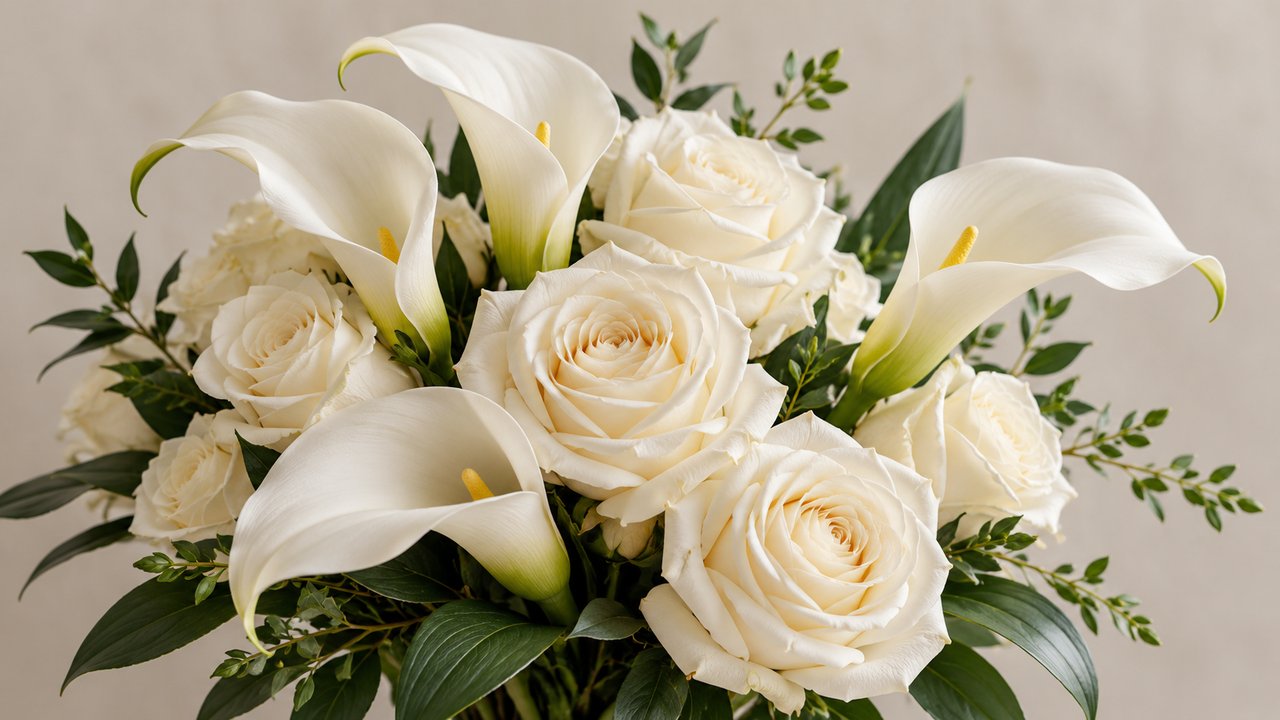
What appears to be the calla lily’s single rolled petal is actually a modified leaf called a spathe. It surrounds the upright spadix, on which many tiny flowers are borne. This clean silhouette contrasts beautifully with the rose’s intricate form. In floral design, round roses act as visual anchors, while elongated calla stems and tapered spathes introduce height, direction, and negative space.
Core Symbolism of Roses and Calla Lilies
Roses most commonly represent love, but their symbolism extends to secrecy, loyalty, admiration, gratitude, friendship, grief, and spiritual devotion. The Latin expression sub rosa, meaning “under the rose,” associates the flower with confidentiality. In medieval Christian imagery, roses could signify divine love, martyrdom, or the Virgin Mary. By the nineteenth century, color and presentation had become essential elements of the rose’s message.
The name “calla” derives from the Greek kallos, meaning beauty. Calla lilies are consequently associated with magnificent or exceptional beauty. Their pale, chalice-like form also encouraged meanings of purity, holiness, faith, and rebirth in Christian-influenced traditions. Because the same flower appears at weddings and funerals, it possesses a valuable symbolic duality: it can honor both a promising beginning and a dignified transition.
When combined, roses and calla lilies commonly signify love made noble by sincerity. Roses voice affection; callas refine that message with grace, integrity, and permanence. A bridal bouquet may suggest pure, committed love, while a memorial arrangement can express enduring affection, spiritual peace, and respect.
| Color Pairing | Principal Meaning | Best Occasion |
|---|---|---|
| Red roses and white callas | Passionate love joined with fidelity and purity | Weddings, anniversaries, romantic declarations |
| White roses and white callas | Innocence, reverence, unity, and remembrance | Weddings, baptisms, memorials |
| Pink roses and blush callas | Tender admiration, affection, and graceful joy | Birthdays, engagements, thank-you gifts |
| Yellow roses and yellow callas | Optimism, friendship, confidence, and renewal | Congratulations, recovery, friendship |
| Burgundy roses and dark callas | Profound devotion, mystery, and sophisticated beauty | Milestone anniversaries, formal events |
| Champagne roses and cream callas | Elegant celebration, gratitude, and mature affection | Weddings, promotions, refined hostess gifts |
Color Nuance and Cultural Interpretation
Red roses retain their powerful association with romantic passion, while a white calla tempers that passion with solemn commitment. White-on-white arrangements are more nuanced: the layered history of white rose symbolism encompasses innocence, bridal love, reverence, and remembrance. This makes an all-white bouquet appropriate for both ceremonies of union and expressions of sympathy.
Yellow combinations feel brighter and less formal. In contemporary Western gifting, the yellow rose meaning centers on friendship, happiness, warmth, and encouragement. Earlier European flower dictionaries occasionally connected yellow roses with jealousy or fading affection, but that interpretation is now uncommon. Paired with golden callas, they convey confidence and forward-looking joy.
Pink suggests admiration and sweetness rather than consuming passion. Peach emphasizes gratitude and sincerity, while coral adds energy and desire. Cream and champagne tones communicate cultivated elegance; the champagne rose meaning is especially suitable for luxurious celebrations that require warmth without the intensity of red.
Deep plum, burgundy, or nearly black callas create a dramatic modern mood. They do not literally mean death, despite their appearance in gothic design. More often, they suggest mystery, transformation, power, and unconventional beauty. Cultural meanings are never entirely universal, however. White flowers are bridal symbols in many Western settings but are strongly associated with mourning in parts of East Asia. When gifting across cultures, the recipient’s customs should outweigh generalized flower-language rules.
Occasions, Recipients, and Modern Etiquette
- Weddings: White callas with white, blush, or champagne roses symbolize fidelity, new beginnings, and elegant commitment. Compact callas suit streamlined gowns; cascading stems complement formal or architectural venues.
- Anniversaries: Red roses and white callas express passion sustained by trust. Burgundy and cream create a quieter message of mature devotion for major milestones.
- Congratulations: Yellow, peach, or orange flowers celebrate promotions, graduations, and new homes without implying romance.
- Sympathy: White roses and callas offer serenity and dignity. Before sending, consult the family’s faith and preferences, as customs surrounding roses for sympathy differ between services, homes, and cultures.
- Apology or reconciliation: Pale pink or peach roses with cream callas communicate sincerity gently, but flowers should accompany direct words rather than replace accountability.
Give romantic red combinations only where that message is welcome. Include a brief card explaining your intention when colors could be ambiguous. For hospitals, first confirm fragrance, allergy, and container restrictions. Funeral flowers generally go to the service through the florist, while a smaller sympathy bouquet or plant may be sent to the home. Avoid sending lilies or callas to households with pets without warning: Zantedeschia contains irritating calcium oxalate crystals and should be kept away from children and animals.
Companion Flowers and Styling
Good companions should support rather than obscure the calla’s silhouette. Ranunculus echoes the rose’s layered softness; lisianthus adds airy romance; orchids reinforce the arrangement’s polished, sculptural character. Delphinium provides vertical movement, while hydrangea creates volume for large installations. For texture, consider waxflower, astrantia, viburnum, or restrained sprigs of eucalyptus.
For a modern bouquet, use long-stemmed callas asymmetrically with clustered garden roses and minimal foliage. A monochromatic palette emphasizes form. For a romantic garden style, mix blush roses, miniature callas, sweet peas, and trailing greenery. In sympathy work, white callas can establish height while white roses, stock, and soft foliage create a peaceful base. Do not overcrowd the design: visible space around each calla preserves its architectural impact.
Care and Vase Longevity
Choose roses with firm heads and petals that are only beginning to unfurl. Calla spathes should be smooth and resilient, with no translucent bruising or split edges. Use a clean vase and fresh floral solution. Remove all foliage that would sit below the waterline, then recut stems with a clean, sharp knife or shears.
Calla stems are fleshy and prone to splitting, so handle them gently and use relatively shallow water—about 5 to 8 centimeters is often sufficient—while ensuring the rose stems can still drink adequately. A tall, narrow vase can satisfy both needs by supporting the arrangement without requiring excessive water. Refresh the water every one or two days, recut stems as needed, and keep the bouquet away from direct sun, heaters, drafts, and ripening fruit. Roses commonly last five to ten days; callas may last seven to fourteen days under good conditions.
In cultivation, roses generally prefer abundant sun, fertile well-drained soil, and good air circulation. Callas appreciate rich soil and steady moisture during active growth but resent prolonged waterlogging, particularly during dormancy. In cold climates, tender calla rhizomes may need lifting and frost-free storage.
A Union of Emotion and Form
The enduring appeal of roses and calla lilies lies in balance. One flower is intricate, historic, and emotionally abundant; the other is spare, poised, and sculptural. Their shared meaning can range from passionate fidelity to peaceful remembrance, shaped by color, culture, proportion, and occasion. Chosen thoughtfully, the pairing does more than look elegant: it communicates love disciplined by sincerity, beauty strengthened by dignity, and purity enriched by human feeling.


