Table of Contents
Alabaster Rose Meaning: Spiritual Reverence, Wholeness, and Sacred Beginnings
The alabaster rose meaning centers on spiritual reverence, inner wholeness, gentle remembrance, and the promise of a sacred beginning. Neither starkly white nor overtly cream, an alabaster rose has the softly luminous appearance of polished alabaster stone: pale, warm, and subtly translucent. Its color may carry undertones of ivory, pearl, linen, or the faintest blush. This visual softness gives the flower a more contemplative character than a brilliant white rose and a more ceremonial quality than an ordinary cream rose.
Historically, “alabaster rose” has not usually denoted one universally recognized botanical cultivar. It is primarily a poetic and floristic color description applied to roses with warm white or ivory petals. Modern florists may use the phrase for garden roses, hybrid teas, spray roses, or preserved roses whose coloring resembles carved alabaster. Because flower names vary among growers and markets, anyone ordering alabaster roses should describe the desired tone as well as using the name.
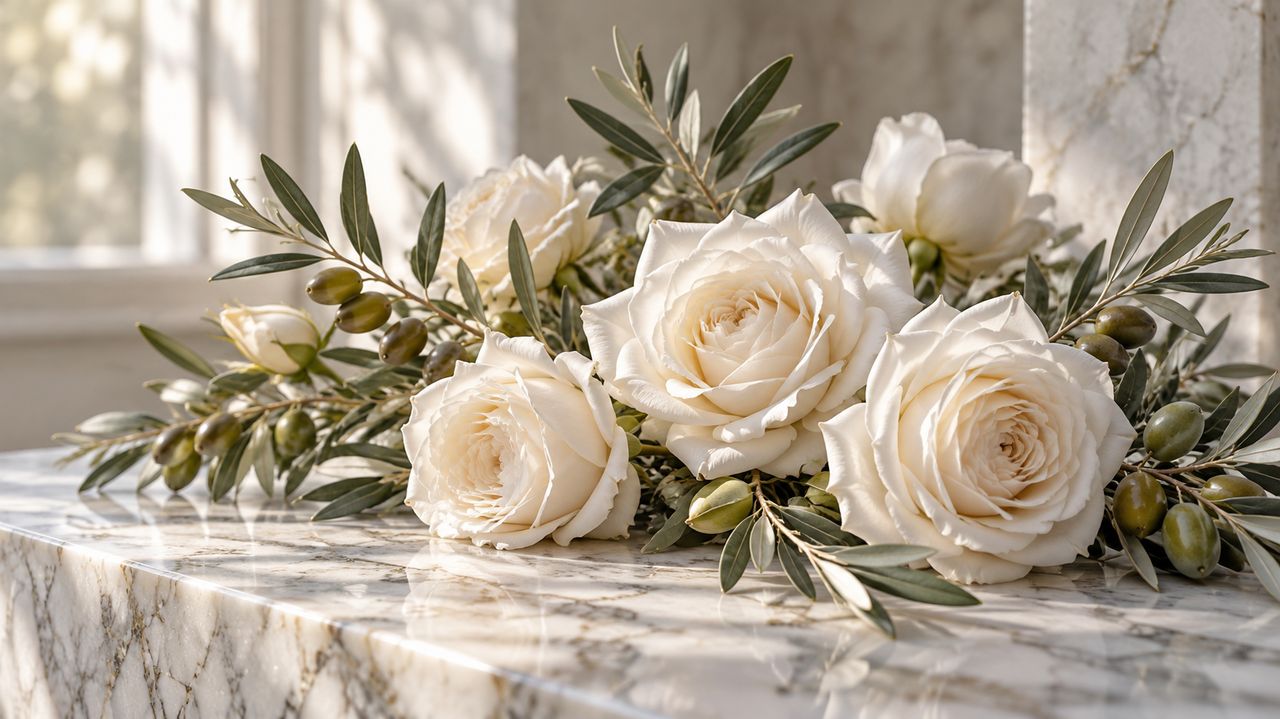
The symbolism of these roses grows from several intertwined traditions. White roses have long represented purity, innocence, secrecy, and spiritual devotion. Alabaster, meanwhile, has been used for sacred vessels, devotional sculptures, funerary objects, and architectural ornament since antiquity. When the imagery of the white rose and alabaster stone is combined, the result is a flower associated not merely with innocence, but with something precious, consecrated, enduring, and made whole.
What Does an Alabaster Rose Symbolize?
At its heart, an alabaster rose communicates quiet honor. It is suited to emotions that are profound but do not need to be loudly declared. Its restrained color suggests sincerity without performance, love without possession, and hope without naïveté.
- Spiritual reverence: The pale, sculptural bloom evokes prayer, contemplation, humility, and respect for what is sacred.
- Wholeness: Its balanced, harmonious coloring represents emotional integration, reconciliation, and the restoration of inner peace.
- Sacred beginnings: Alabaster roses are meaningful for weddings, baptisms, naming ceremonies, new homes, and other threshold moments.
- Pure and mature love: Unlike the youthful innocence often attributed to bright white roses, alabaster suggests purity refined by experience.
- Remembrance: The flower can honor a life, a cherished relationship, or a memory that continues to exert a gentle presence.
- Grace and dignity: Warm ivory petals convey elegance without extravagance, making them appropriate for solemn and formal settings.
- Peaceful renewal: Their unfolding petals can symbolize healing, forgiveness, and the willingness to begin again.
Historical and Cultural Roots
Alabaster was prized in ancient Egypt and throughout the Mediterranean world for vessels, carvings, lamps, and funerary furnishings. Although many objects called alabaster were technically calcite or gypsum, their pale luminosity made them symbols of refinement and sacred value. Containers carved from this material held perfumes, ointments, and ceremonial substances. Consequently, “alabaster” came to suggest both an exquisite vessel and the precious essence contained within it.
In biblical and later Christian imagery, an alabaster vessel of costly perfume became associated with devotion, sacrifice, hospitality, and wholehearted love. A rose described as alabaster can therefore carry a related message: “What I offer you is sincere, precious, and given with reverence.” In Christian art, white roses have also been connected with the Virgin Mary, heavenly love, purity of intention, and paradise. An alabaster-toned rose adds warmth and human tenderness to this spiritual vocabulary.
In medieval Europe, the white rose acquired both devotional and dynastic meanings. It appeared in religious gardens, heraldry, poetry, and courtly symbolism. During the Victorian era, floriography transformed flowers into an elaborate social language. White roses commonly signified innocence, silence, worthiness, and a heart untouched by duplicity. Victorian flower dictionaries were not perfectly consistent, however; meanings changed according to the source, arrangement, stage of bloom, and accompanying flowers. A warm alabaster rose would have been understood through this broader white-and-cream palette rather than as a fixed entry with one rigid definition.
In contemporary Western floristry, alabaster roses appear frequently in weddings, memorials, luxury interiors, and understated romantic bouquets. In several East Asian contexts, white flowers may have particularly strong funerary associations, while in many Western settings they are equally familiar at weddings. Customs vary by country, faith, and family, so the recipient’s tradition should always take precedence over a generalized flower dictionary.
Alabaster Rose Meanings by Context
| Context | Primary Meaning | Suggested Message | Best Pairing |
|---|---|---|---|
| Wedding | Sacred union and enduring devotion | “May your shared life begin in grace.” | Myrtle, sweet pea, or white ranunculus |
| Memorial | Peace, honor, and loving remembrance | “Their memory remains a blessing.” | White lilies, lisianthus, or rosemary |
| Baptism or naming ceremony | Blessing and spiritual beginning | “Welcome to a life surrounded by love.” | Baby’s breath or pale delphinium |
| Reconciliation | Truth, healing, and restored harmony | “I honor our bond and hope we can begin again.” | Olive foliage or blue iris |
| Anniversary | Mature, steadfast love | “Our love has deepened with time.” | Blush roses or fragrant stock |
| New home or vocation | Purposeful transition and hope | “May this new chapter bring peace and fulfillment.” | Eucalyptus, bay, or seasonal greenery |
Shades, Forms, and Subtle Variations
Color temperature changes the message. A nearly pure white alabaster rose emphasizes spiritual purity, solemnity, and clarity. Warm ivory suggests hospitality, fidelity, and cultivated elegance. A flower with champagne or biscuit undertones feels celebratory and luxurious, while one with the faintest pink center adds tenderness, affection, and emotional vulnerability. Green-tinged outer guard petals can introduce ideas of renewal, vitality, and growth.
Form matters as well. A tightly closed bud represents potential, secrecy, youth, or a beginning not yet fully revealed. A half-open bloom suggests becoming, trust, and hope in progress. A fully opened garden rose conveys wholeness, generosity, and love brought into its fullness. Highly petaled rosette forms feel romantic and historic, while long-stemmed hybrid teas appear formal and ceremonial. Fragrant David Austin English roses are especially effective when the desired mood is abundant, heirloom-inspired, and emotionally rich.
The number of stems can refine the message. A single alabaster rose expresses concentrated reverence or singular devotion. Two can symbolize partnership and mutual regard. Three are often read as a complete declaration of love, although the symbolism varies across traditions; a fuller explanation of the three roses meaning can help when choosing a deliberately numbered gift. A dozen communicates formal admiration, while a large mass of alabaster blooms creates an atmosphere of sanctuary, unity, and timeless abundance.
When to Give Alabaster Roses
Alabaster roses are especially appropriate when an occasion feels both emotional and ceremonial. They make elegant wedding flowers for couples who want something warmer than optical white and less yellow than cream. They are also fitting for engagements, vow renewals, milestone anniversaries, ordinations, confirmations, graduations, housewarmings, retirements, and the beginning of a meaningful vocation.
For a romantic partner, they say, “I honor the deepest and most enduring part of our love.” For a close friend, they communicate trust, gratitude, and peaceful affection without necessarily implying romance. For a parent, mentor, spiritual leader, or caregiver, they express esteem and recognition of quiet service. Their visual neutrality also makes them a considerate choice when the recipient’s favorite color is unknown.
In bereavement, alabaster roses offer dignity and consolation. They can represent the peaceful continuity of love rather than only loss. Before sending roses for sympathy, consider the family’s religion, cultural customs, and funeral instructions. Some traditions welcome white flowers at the home and service; others reserve them for particular rites. A brief card should be sincere and specific, avoiding elaborate interpretations that place an emotional burden on the grieving recipient.
Modern Etiquette and Card Messages
Because “alabaster” is not a standardized commercial color, confirm the actual flowers before ordering. Ask the florist whether the roses lean white, cream, champagne, or blush, and request a photograph when exact color matters. At weddings, compare a sample bloom with the clothing and linens under natural light: a warm ivory rose can make a cool white dress appear blue, while a pure white flower may look harsh beside antique lace.
Allow context to clarify the gift. Alabaster roses can seem bridal, spiritual, sympathetic, or romantic depending on presentation. A handwritten card prevents ambiguity. Suitable messages include “With peaceful gratitude,” “May this new chapter be blessed,” “In honor of a beautiful life,” or “For the love that has made us whole.” Avoid presenting an elaborate all-white arrangement as an unannounced romantic gesture in a culture where white flowers are strongly associated with mourning.
For gratitude that should feel warmer and more exuberant, add pink flowers or choose a deeper rose color. The traditional dark pink rose meaning emphasizes explicit appreciation and thankfulness, while alabaster keeps the mood quiet, reverent, and reflective.
Companion Flowers and Bouquet Styling
Alabaster roses reward thoughtful texture. For a sacred or minimalist arrangement, combine them with olive branches, white lisianthus, and a restrained amount of eucalyptus. Olive signifies peace, while the silvery foliage strengthens the roses’ stone-like luminosity. For weddings, pair them with white sweet peas, ranunculus, gardenias, or lily of the valley. Myrtle is a historically resonant bridal foliage associated with love and marriage.
For an old-world, painterly bouquet, add blush garden roses, apricot stock, café-toned carnations, and trailing jasmine. This palette reveals the warmth within alabaster petals. For a modern architectural design, use only a few fully open roses with sculptural anthuriums, lunaria, or bare branches in an asymmetrical vessel. Avoid crowding them with too many bright colors; their distinction lies in tonal subtlety.
Memorial arrangements can include white lilies for restored innocence, rosemary for remembrance, or blue iris for faith and hope. Check whether strong fragrance is appropriate in hospitals, care facilities, or small chapels. Lilies may also shed pollen and are highly toxic to cats, so lisianthus, snapdragons, or stocks can be safer stylistic alternatives in some homes. Rose stems themselves should still be kept away from pets and children because of thorns and possible floral preservatives.
Botanical Character and Cultivation
All cultivated roses belong to the genus Rosa in the family Rosaceae. What florists call alabaster coloring can occur in hybrid tea, floribunda, shrub, spray, and garden rose types. The apparent shade depends on genetics, growing temperature, maturity, soil nutrition, harvest stage, storage, and light. Cooler conditions often intensify pink or green nuances, while warmth can make creamy pigments more evident.
Gardeners seeking an alabaster effect should select cultivars in person when possible rather than relying solely on catalog photographs. Observe the bloom from bud to petal drop, because many pale roses open from cream or blush buds and fade toward white. Consider disease resistance, climate suitability, repeat flowering, fragrance, mature size, and vase performance alongside color. Most roses prefer at least six hours of direct sun, fertile but well-drained soil, good air circulation, and deep watering at the root zone.
Keep foliage dry when practical, remove diseased leaves, and mulch without piling material against the canes. Pruning requirements vary by rose class and climate. Repeat-flowering modern roses are commonly pruned in late winter or early spring as growth resumes, whereas once-blooming old garden roses are generally shaped after flowering so that premature pruning does not remove the season’s buds.
How to Extend Vase Life
- Choose roses with firm petals, upright heads, fresh green sepals, and buds that have begun to loosen rather than remaining rock-hard.
- Clean the vase thoroughly, then fill it with fresh water and properly measured commercial flower food.
- Remove all foliage that would sit below the waterline, since submerged leaves encourage bacterial growth.
- Recut 2 to 3 centimeters from each stem at an angle with a clean, sharp knife or floral shears.
- Keep the arrangement away from direct sunlight, radiators, drafts, and ripening fruit, which releases bloom-aging ethylene gas.
- Refresh the water frequently, wash the vase if it becomes cloudy, and remove fading petals or stems promptly.
If a rose head droops prematurely, recut the stem and place it in fresh conditioned water in a cool location. Do not crush or hammer rose stems; damaged tissue can impede efficient water uptake. With clean tools, sound hydration, and a moderate room temperature, quality cut roses commonly remain attractive for about five to ten days, though cultivar, transport history, and harvest maturity all affect longevity.
A Symbol of Quiet Completion
The enduring alabaster rose meaning is one of luminous restraint. This is a rose for experiences too significant for spectacle: a vow made sincerely, a life remembered tenderly, a fractured relationship beginning to heal, or a new path entered with humility. Its warm whiteness unites the innocence of the white rose with the devotional history and sculptural permanence of alabaster.
Whether carried down an aisle, placed beside a memorial portrait, offered to a mentor, or arranged in a peaceful home, the alabaster rose speaks of love refined into reverence. It does not deny complexity. Instead, it gathers experience into wholeness and offers the possibility that every sincere ending may also contain a sacred beginning.