Table of Contents
Iceberg Rose: The World’s Most Beloved Pure White Floribunda Classic
Few roses unite horticultural excellence and emotional symbolism as gracefully as the Iceberg rose. Introduced in Germany in 1958 by the celebrated rose-breeding house W. Kordes’ Söhne, this floribunda was originally named ‘Schneewittchen’—German for “Snow White.” It arose from a cross between the red-flowered hybrid musk ‘Robin Hood’ and the elegant white hybrid tea ‘Virgo.’ The result was transformative: a vigorous, repeat-flowering rose that produced luminous white blossoms in generous clusters rather than as occasional solitary blooms.
Named World’s Favourite Rose in 1983 by the World Federation of Rose Societies, Iceberg has become a familiar presence in cottage gardens, formal borders, civic landscapes, wedding arrangements, and memorial plantings. Its color suggests purity, but its clustered habit gives that purity warmth and sociability. Unlike a single, ceremonial white rose, a flowering Iceberg shrub conveys openness, abundance, and enduring goodwill. This balance between innocence and resilience explains why it remains both a botanical classic and a remarkably expressive flower.
Botanical Character and History
Iceberg is classified as a floribunda, a group valued for bearing flowers in clusters over a long season. Its pointed buds open into semi-double blooms, typically measuring about 5–8 centimeters across. Each flower has a relaxed, lightly ruffled form surrounding visible golden stamens. The fragrance is usually mild, although its strength varies with climate, soil, and time of day.
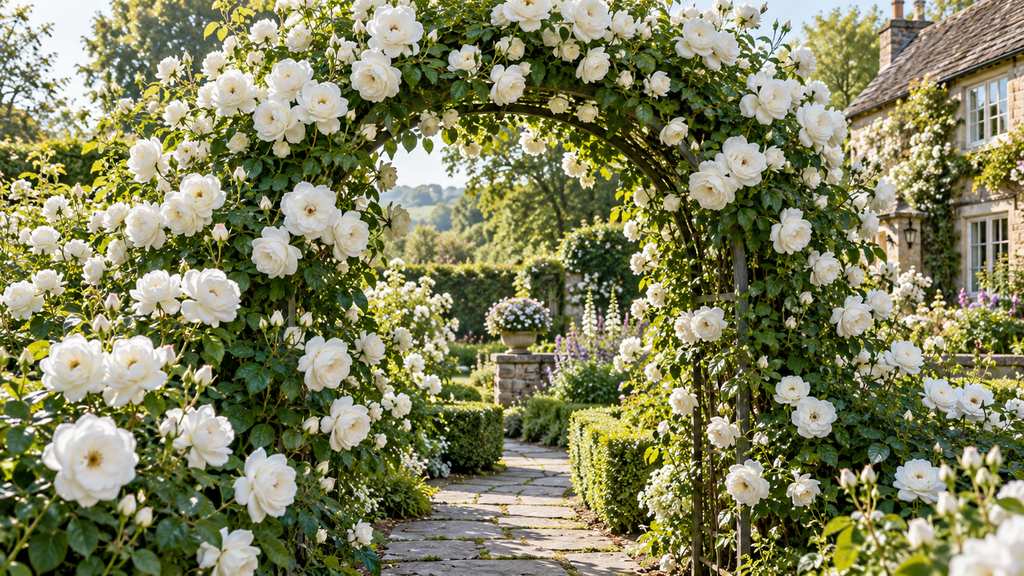
A mature shrub commonly reaches 90–150 centimeters in height, depending on pruning and growing conditions. In mild climates it may become larger and flower for much of the year. The original bush form has also produced climbing sports, often sold as ‘Climbing Iceberg,’ which can cover arches, fences, and walls. There are pink-tinged and burgundy sports as well, but the classic white cultivar remains the standard against which they are understood.
Primary Meanings of the Iceberg Rose
The central meanings of the Iceberg rose are purity, sincerity, peace, remembrance, and faithful affection. White roses historically carried associations with innocence and spiritual truth, yet Iceberg adds another layer: its willingness to flower repeatedly makes it an emblem of renewal and constancy. It does not symbolize a fragile perfection that appears only once; it suggests goodness continually restored after hardship.
- Purity and honesty: Its clear white petals communicate transparent motives, truthful affection, and freedom from pretense.
- Peace and reconciliation: White softens emotional tension, making Iceberg appropriate for apologies, renewed friendships, and gestures of goodwill.
- Reverence and remembrance: Its restrained beauty suits memorials, condolences, anniversaries of loss, and contemplative spaces.
- New beginnings: The color white evokes an unwritten page, giving the rose relevance at weddings, births, graduations, and housewarmings.
- Enduring devotion: Repeated flushes of bloom represent affection sustained through changing seasons.
- Grace under pressure: Its reputation as a dependable landscape rose has made resilience an especially fitting modern interpretation.
Floriography Through Different Eras
In ancient Mediterranean cultures, white flowers could be connected with sacred rites, beauty, and transitions between earthly and spiritual life. Roses were associated with deities of love, but white roses often implied a more restrained or transcendent form of affection than red ones. Medieval Christian imagery later linked the white rose with innocence, divine love, and the Virgin Mary, strengthening its religious and ceremonial significance.
During the nineteenth century, flowers became coded social messages. In the Victorian language of flowers, a white rose commonly signified innocence, silence, reverence, or a heart unacquainted with romantic passion. Meanings were never completely standardized: flower dictionaries differed, and presentation could alter the message. A white rosebud might imply youthful innocence, while a fully open bloom could express mature sincerity or remembrance.
Iceberg itself arrived in the twentieth century, long after Victorian floriography’s height. Nevertheless, it inherited this symbolic vocabulary. Postwar gardeners also found meaning in its practicality: vigorous plants covered damaged or newly developed landscapes with repeated white bloom. Today, its symbolism is less rigid. It can signify minimalist elegance at a wedding, calm support during bereavement, or simply admiration for someone whose strength is quiet rather than theatrical.
Color, Variation, and Bouquet Context
Iceberg blossoms are not always stark white. Cool weather may bring a faint blush to the buds, while aging petals can develop cream, pearl, or pale pink tones. Strong sun may bleach flowers to brilliant white; rain and heat can shorten their pristine phase. These natural variations do not diminish the rose’s identity. Instead, ivory suggests warmth and maturity, cool white conveys clarity, and a pink blush introduces tenderness.
Color companions substantially change the message. Pairing Iceberg with red roses creates a dramatic union of purity and passion. Pink flowers communicate gentle affection, while blue delphiniums or lavender evoke serenity. For a warmer, more welcoming arrangement, peach and apricot blooms introduce gratitude and sociability; the symbolism becomes especially coherent when considered alongside traditional apricot rose meaning. A broader guide to rose color meanings can help refine mixed bouquets where every shade contributes to the message.
| Context | Suggested Companions | Combined Message |
|---|---|---|
| Wedding | Sweet peas, ranunculus, myrtle | Sincere love and a hopeful beginning |
| Condolence | Lilies, stock, eucalyptus | Peace, dignity, and remembrance |
| Friendship | Apricot roses, chamomile, mint | Warmth, trust, and hospitality |
| Apology | White tulips, olive foliage | Honesty, peace, and reconciliation |
| Celebration | Lisianthus, feverfew, greenery | Fresh opportunity and joyful optimism |
When to Give Iceberg Roses
Iceberg roses are particularly appropriate for weddings, engagements, christenings, naming ceremonies, graduations, retirements, sympathy gestures, and anniversaries. Give them to a partner when the intended message is loyal, peaceful love rather than intense passion. For a friend, mentor, host, or colleague, a garden plant can express lasting appreciation without appearing overly romantic.
Modern etiquette depends more on context than on an inflexible floral code. At funerals, check the family’s religious or cultural preferences and respect requests for charitable donations instead of flowers. For hospital visits, choose a modest, low-fragrance arrangement only where flowers are permitted. A potted Iceberg rose is a thoughtful housewarming gift, but include care instructions and make certain the recipient has suitable outdoor space.
Because white flowers may represent mourning in several East Asian traditions, an all-white bouquet can carry a more solemn meaning than the giver intends. Conversely, white roses are standard bridal flowers in many Western settings. A brief card resolves ambiguity: “For a peaceful new beginning” or “With sincere gratitude” makes the symbolism personal and clear. Avoid presenting white roses as a romantic declaration if the relationship is uncertain; combine them with warm-toned flowers or explain the friendly intent.
Companion Flowers and Styling
Iceberg’s open flowers suit loose, garden-inspired arrangements. Combine them with sweet peas and trailing jasmine for romance; with rosemary, olive, and eucalyptus for a sculptural Mediterranean mood; or with cosmos and feverfew for meadow-like informality. Cream ranunculus adds texture without disturbing a monochrome palette. Dark foliage, burgundy dahlias, or deep red roses creates a more dramatic, formal composition.
Use odd-numbered clusters and vary stem heights so the flowers retain their natural movement. Since garden-grown Iceberg stems can be shorter and more branched than florist hybrid teas, small compotes, hand-tied posies, and low centerpieces display them especially well. After an important occasion, selected blooms can become keepsakes; a careful drying roses technique helps limit browning, although white petals naturally mature toward ivory.
Cultivation and Vase Care
Plant Iceberg in fertile, well-drained soil with at least six hours of sun, allowing good airflow around the foliage. In very hot regions, light afternoon shade can preserve flower quality. Water deeply at soil level rather than repeatedly wetting the leaves, and mulch to moderate temperature and moisture. Feed in spring and after the first major flowering flush according to local climate.
Remove spent clusters by cutting back to a strong outward-facing leaf. Perform structural pruning during the appropriate dormant or cool season, removing dead, weak, and crossing wood. Iceberg is vigorous, but it can be susceptible to black spot in humid conditions, so sanitation, spacing, and resistant companion planting practices matter. Climbing Iceberg should be trained horizontally where possible, encouraging flowering shoots along the length of each cane.
For the vase, harvest when the outer petals begin to loosen. Cut early in the morning with clean tools, remove foliage below the waterline, and recut stems at an angle. Place them promptly in a clean vase with floral preservative. Refresh the water every one or two days and keep the arrangement away from direct sun, heaters, drafts, and ripening fruit. Individual garden blooms may last roughly five to seven days, with cooler conditions generally extending their beauty.
A White Rose of Lasting Character
The Iceberg rose deserves its classic status not because it is merely white, but because it makes whiteness feel abundant, approachable, and alive. Its history links disciplined German breeding with the enduring symbolism of purity, peace, remembrance, and renewal. Whether planted beside a doorway, trained over an arch, offered in reconciliation, or carried at a wedding, it speaks with quiet authority. Iceberg’s deepest message is ultimately one of resilient grace: sincerity need not be severe, beauty can be generous, and hope can bloom more than once.