Table of Contents
Julia Child Rose: Warm Butter Gold Floribunda with Sweet Licorice Scent
The Julia Child rose brings together culinary history, cheerful color, and exceptional garden performance. Its rounded, butter-gold flowers possess the comforting richness of a well-made sauce, while their sweet licorice fragrance adds an unexpectedly sophisticated note. Named for Julia Child—the American chef, author, and television personality who made French cooking approachable—this floribunda naturally evokes generosity, pleasure, confidence, and the joy of sharing something beautiful.
American rose breeder Tom Carruth developed the cultivar, and Weeks Roses introduced it in the United States in 2006. Julia Child personally selected the rose that would bear her name, giving the association unusual authenticity. The cultivar was introduced in Britain as ‘Absolutely Fabulous,’ a name that captures its exuberant flowering habit. It received the prestigious All-America Rose Selections award in 2006 and remains admired for abundant bloom, disease resistance, and enduring golden color.
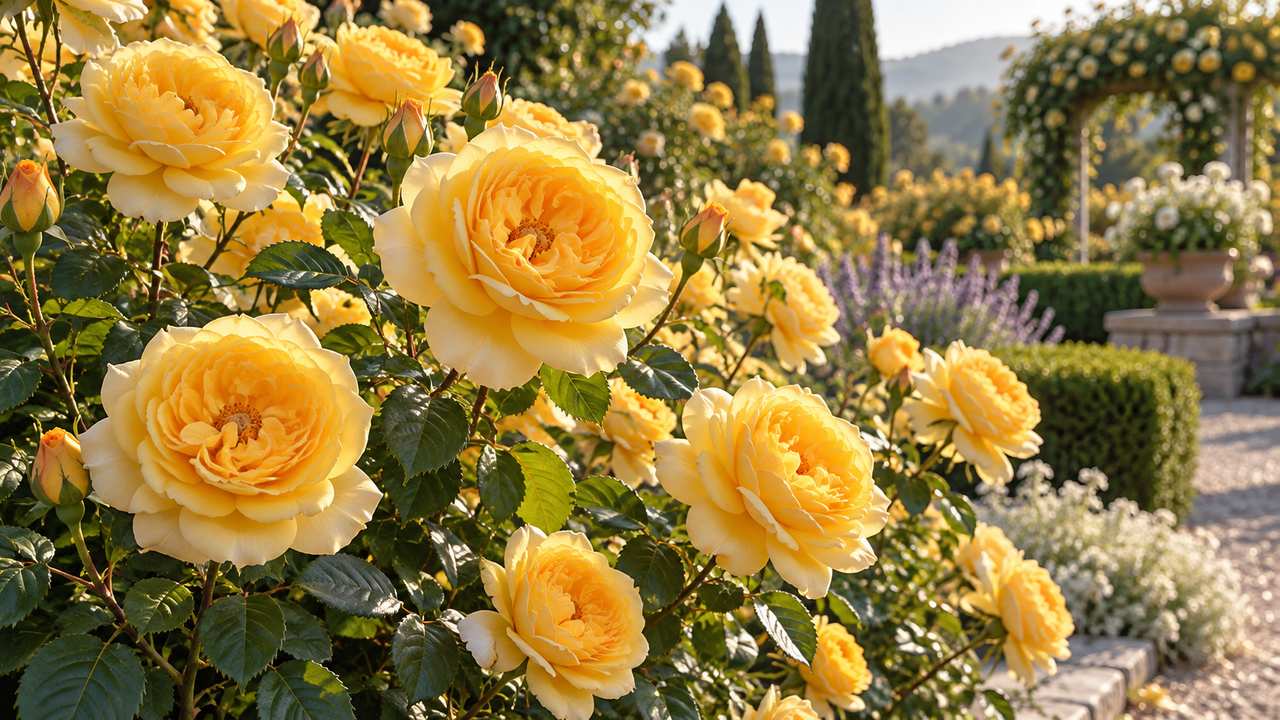
Botanically, the Julia Child rose is a compact, bushy floribunda, generally reaching about 26 to 38 inches in height and width, although mature dimensions vary with climate and pruning. Its glossy, deep-green foliage provides a handsome background for clusters of full, cupped flowers. Each blossom commonly carries around 35 petals, opening from pointed buds into old-fashioned, softly ruffled rosettes.
Meaning and Symbolic Character
Because Julia Child is a modern cultivar, it has no separate entry in the coded Victorian flower dictionaries that established many familiar floral messages. Its symbolism instead emerges from traditional yellow-rose lore, its culinary namesake, and the plant’s distinctive character. The result is a richer message than the generic idea of friendship often assigned to yellow roses.
- Joy and optimism: Its luminous flowers resemble warm sunlight and convey encouragement without appearing sentimental or solemn.
- Hospitality and generosity: The connection with Julia Child makes the rose especially expressive of shared meals, welcoming homes, and wholehearted abundance.
- Friendship and admiration: Golden roses celebrate affectionate bonds, professional respect, and gratitude without automatically suggesting romantic love.
- Confidence and authenticity: Julia Child’s wit, curiosity, and willingness to learn publicly give the flower associations with courage, individuality, and joyful imperfection.
- Good taste and cultivated pleasure: The layered flowers and unusual fragrance suggest refinement, but their sunny warmth keeps the message approachable.
Historical and Cultural Interpretations
Yellow flowers have not carried one unchanging message. In parts of the ancient Mediterranean world, golden blossoms were associated with sunlight, divine radiance, and prosperity. During the nineteenth century, however, some European floriography manuals interpreted yellow roses as jealousy, infidelity, or fading affection. That darker reading reflected the era’s elaborate system of coded courtship rather than a universal custom.
By the twentieth century, especially in North America, yellow roses had acquired brighter associations: friendship, welcome, remembrance, and delight. The Julia Child rose belongs firmly to this modern tradition. Its creamy warmth is gentler than a sharp lemon yellow, so it communicates affection and hospitality more readily than rivalry or emotional distance.
Cultural context nevertheless matters. Yellow can signify happiness, status, sacredness, harvest, or mourning depending on the recipient’s background. In contemporary Western gifting, the Julia Child rose is normally understood as celebratory and friendly. In a cross-cultural or highly formal setting, a short card explaining that the flowers honor warmth, generosity, or a shared love of cooking prevents ambiguity.
Color, Form, and Nuance
The flower is often described as butter gold rather than simply yellow. Freshly opening blooms may appear saturated and almost honeyed, while mature petals soften toward warm gold or creamy yellow. Strong sun, cool nights, soil conditions, and the age of each flower influence the display. This subtle variation creates depth within a single shrub and gives cut arrangements a naturally layered appearance.
Color changes the emotional tone of a bouquet. Pairing Julia Child roses with peach or apricot flowers emphasizes welcome and domestic warmth, themes also central to apricot rose meaning. Salmon accents make the arrangement more animated and affectionate; the traditional salmon rose meaning balances companionship with restrained desire.
Mauve flowers introduce antique elegance and a more contemplative mood. Their associations with rarity and refinement, explored through mauve rose symbolism, make them suitable for milestone birthdays or artistic recipients. Pale green foliage and flowers freshen the gold without competing with it. The ideas of renewal and equilibrium found in mint green rose significance are particularly appropriate for housewarmings and new ventures.
| Context | Suggested Meaning | Best Companions | Presentation |
|---|---|---|---|
| Friendship gift | Joy, loyalty, appreciation | Chamomile, feverfew, eucalyptus | Loose garden-style bouquet |
| Host or housewarming | Hospitality, prosperity, welcome | Mint, rosemary, pale-green hydrangea | Low ceramic bowl or potted shrub |
| Milestone birthday | Achievement, confidence, vitality | Mauve lisianthus, apricot roses | Abundant, rounded arrangement |
| Encouragement | Hope, resilience, brighter days | White stock, waxflower, soft grasses | Simple hand-tied stems |
| Memorial tribute | Gratitude and warm remembrance | Cream roses, rosemary, olive foliage | Restrained arrangement with a note |
When and How to Give Julia Child Roses
These roses are especially suitable for birthdays, thank-you gifts, retirement celebrations, promotions, dinner invitations, culinary graduations, and housewarmings. A living plant is a thoughtful gift for a gardener, cook, teacher, mentor, or anyone whose warmth gathers people together. Cut flowers are appropriate for friends, colleagues, relatives, and hosts.
For romance, clarify the intention. A bouquet containing only golden roses may read as affectionate friendship, while adding blush, coral, or red flowers introduces romantic warmth. For sympathy, use fewer colors and choose cream companions so the tribute feels peaceful rather than festive. Avoid sending a strongly scented arrangement to hospitals without checking fragrance and flower policies.
Modern etiquette favors meaning over rigid stem counts. An odd-numbered hand-tied bouquet often looks natural, while a dozen feels formal and celebratory. Include a personal message such as, “For the joy and generosity you bring to every gathering.” When gifting a shrub, provide its cultivar name, expected size, and basic planting instructions rather than presenting it as an anonymous yellow rose.
Companion Flowers and Styling
Julia Child roses excel in relaxed, food-inspired arrangements. Pair them with rosemary, flowering mint, sage, or basil for an aromatic kitchen-garden composition, ensuring herbs have not been treated with unsuitable chemicals if they may later be used for cooking. White cosmos, chamomile, sweet peas, and feverfew create an airy cottage effect. Burgundy foliage or chocolate cosmos gives the gold dramatic depth, while apricot dahlias and salmon ranunculus produce a glowing harvest palette.
Choose matte ceramics, amber glass, aged brass, or simple clear vessels. Cool silver containers sharpen the yellow; warm earthenware enhances its buttery quality. Because the flowers are full and visually generous, leave space between clusters and use branching foliage to prevent the bouquet from becoming a dense yellow mass.
Cultivation and Cut-Flower Care
Plant Julia Child in a site receiving at least six hours of direct sun, with good air circulation and fertile, well-drained soil. Water deeply at soil level rather than lightly wetting the foliage. A two- to three-inch organic mulch helps regulate moisture, but keep it away from the crown. Feed according to local climate and soil conditions, stopping sufficiently early in cold regions to avoid tender late growth.
Deadhead spent clusters to encourage repeat bloom, cutting back to a strong outward-facing leaf. In early spring, remove dead, weak, or crossing wood and shape the shrub while preserving its naturally rounded form. Although noted for disease resistance, it still benefits from sanitation, adequate spacing, and observation for aphids, spider mites, black spot, or mildew. Winter protection may be necessary in colder parts of its commonly listed USDA Zones 5 through 9 range.
For the vase, cut stems in the cool morning when buds have begun to open. Use clean shears, remove foliage below the waterline, and recut stems at an angle before placing them in fresh water with floral preservative. Replace the water every one or two days and keep the arrangement away from direct sun, heaters, and ripening fruit. Home-grown floribunda stems may be shorter than commercial florist roses, but careful harvesting can provide roughly five to seven days of attractive display.
A Rose of Warmth and Appetite for Life
The Julia Child rose is more than a golden garden performer. Its butter-rich color, clustered abundance, and licorice fragrance express a distinctive philosophy: pleasure should be shared, confidence can coexist with humor, and elegance need not feel intimidating. Whether planted beside a terrace, carried to a gracious host, or arranged with herbs and softly colored flowers, it offers an eloquent modern message of friendship, hospitality, admiration, and wholehearted joy.