Table of Contents
Pairing Roses with Spring Tulips: Renewal, Passion, and Seasonal Freshness
Few floral pairings express the meeting of enduring emotion and fresh possibility as gracefully as roses and spring tulips. Roses carry centuries of associations with love, beauty, secrecy, devotion, and loss. Tulips, emerging from bulbs after winter dormancy, suggest renewal, confidence, and the welcome return of color. Together, they create a message that feels both established and newly alive: affection deepened by experience, passion entering a hopeful season, or friendship refreshed after distance.
The historical roots of this pairing cross several cultures. Roses appeared in ancient Greek, Roman, Persian, and later Christian symbolism, while tulips were cultivated and celebrated in Persia and the Ottoman Empire long before becoming objects of fascination in seventeenth-century Europe. Victorian floriography eventually turned both flowers into elements of an elaborate social vocabulary. Yet the roses and tulips meaning is not fixed. Color, number, condition, presentation, and cultural context can transform a bouquet from romantic declaration to cheerful congratulations or compassionate encouragement.
The Central Meaning of Roses and Tulips Together
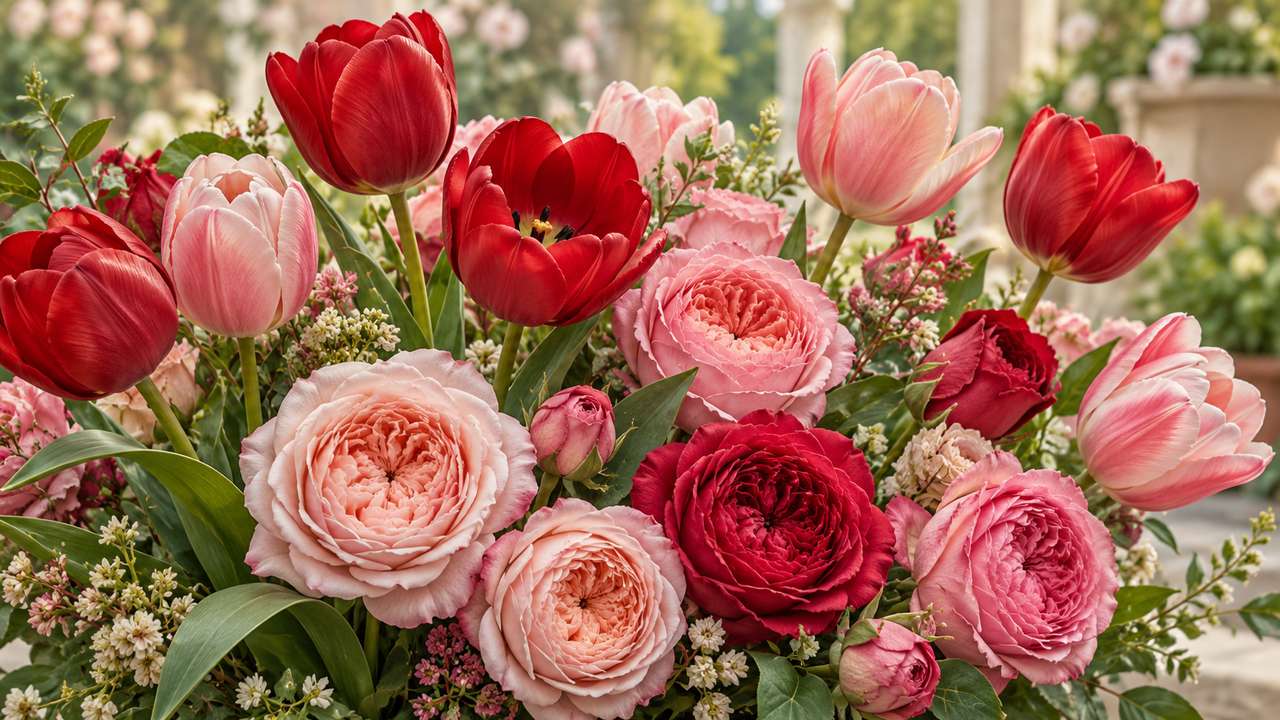
At its simplest, a rose-and-tulip bouquet unites emotional depth with seasonal optimism. The rose generally supplies the emotional foundation: love, admiration, loyalty, gratitude, or remembrance. The tulip adds movement and freshness, suggesting spring, awakening, elegance, and a willingness to begin again. This makes the combination especially appropriate when the giver wants to honor an existing bond while looking toward its future.
Botanically, the contrast strengthens the symbolism. Roses are woody perennials that can flower repeatedly and persist for years with careful pruning. Tulips are bulbous geophytes whose spring display arises from energy stored underground during dormancy. In symbolic terms, the rose represents a cultivated relationship that endures, while the tulip represents hidden potential becoming visible.
- Romantic interpretation: Lasting affection renewed by desire, honesty, or reconciliation.
- Platonic interpretation: Warm friendship, admiration, and shared optimism.
- Seasonal interpretation: The return of beauty, energy, and abundance after winter.
- Milestone interpretation: Pride in what has already been achieved and confidence in what comes next.
- Memorial interpretation: Love that remains present alongside hope, healing, or spiritual renewal.
Historical and Cultural Interpretations
In classical Mediterranean traditions, roses were connected with Aphrodite or Venus and therefore with beauty and desire. The Latin expression sub rosa, “under the rose,” also linked the flower with discretion and confidential speech. In Christian art, roses acquired additional meanings, including sacred love, martyrdom, purity, and heavenly grace, depending on their color and context.
Tulips developed a particularly rich symbolic life in Persian and Ottoman culture. In Persian poetry, the red tulip could evoke ardent love, sacrifice, or the lover’s burning heart. Ottoman gardens celebrated tulips as emblems of refinement, paradise, and cultivated beauty. During the eighteenth-century Ottoman “Tulip Era,” the flower became closely associated with sophisticated courtly culture. In the Dutch Republic, meanwhile, rare tulips became luxury objects during the famous speculative episode now called Tulip Mania. European tulips consequently gained associations with rarity, taste, prosperity, and status.
Victorian flower dictionaries often interpreted red roses as passionate love and tulips as declarations of love, fame, or beautiful eyes, although meanings varied among publications. Modern floristry is more flexible: recipients usually read the palette and overall mood before decoding each stem. A pastel arrangement feels tender and restorative; a saturated red composition reads as romantic; a lively yellow-and-coral bouquet communicates sociability and celebration.
Color Pairings and Their Messages
| Rose and Tulip Pairing | Primary Meaning | Best Occasion | Emotional Tone |
|---|---|---|---|
| Red roses and red tulips | Passionate, openly declared love | Anniversary or romantic proposal | Intense and confident |
| Pink roses and pink tulips | Affection, grace, and happiness | Birthday, new romance, or thanks | Gentle and joyful |
| White roses and white tulips | Sincerity, peace, and new beginnings | Wedding, sympathy, or reconciliation | Serene and respectful |
| Yellow roses and yellow tulips | Friendship, optimism, and shared delight | Congratulations or a friendly gift | Bright and sociable |
| Coral roses and orange tulips | Enthusiasm, attraction, and momentum | Promotion, launch, or exciting romance | Energetic and expressive |
| Burgundy roses and purple tulips | Profound admiration, dignity, and luxury | Formal anniversary or evening event | Dramatic and sophisticated |
Red is the clearest romantic choice, but deeper shades alter its character. Burgundy roses suggest mature sensuality and gravitas; the tradition of burgundy rose passion becomes especially striking beside plum or near-black tulips. Florists should note that true black roses and tulips do not naturally exist: cultivars described as black are extremely dark crimson, maroon, or purple. Their theatrical appearance can evoke mystery, transformation, farewell, or rebirth, themes explored in the history of black rose meaning.
Yellow now commonly conveys warmth and friendship in many Western settings, although older European sources sometimes associated it with jealousy or fading affection. Understanding the modern yellow rose meaning helps prevent outdated interpretations from overshadowing a cheerful gift. Coral is equally nuanced: it bridges pink tenderness and orange energy. Pairing peach tulips with roses informed by coral rose symbolism creates an expressive but less conventional romantic arrangement.
Occasions, Recipients, and Modern Etiquette
For a spouse or established partner, combine garden roses with double tulips in related reds, blushes, or wine tones. For a new romantic interest, choose pink, peach, or coral rather than an imposing mass of red. Yellow, apricot, and white combinations suit friends, hosts, colleagues, teachers, and relatives because they communicate appreciation without forcing romantic implications.
Roses and tulips are particularly apt for spring birthdays, engagements, Easter gatherings, housewarmings, graduations, Mother’s Day, and professional celebrations. White and pale pink stems can also express sympathy, especially when arranged simply. For someone grieving, avoid language about “moving on”; describe the flowers as a sign of continuing care, peace, and the gradual return of light.
Modern etiquette favors thoughtful scale over extravagance. Send compact arrangements to hospitals or workplaces, where space and fragrance may be concerns. Check whether the recipient has pets: tulips are toxic if ingested by cats and dogs, and rose thorns can cause injury. Remove or blunt thorns before hand-tying a bouquet, include a brief personal note, and never assume that red flowers are neutral in a professional relationship.
Companion Flowers and Bouquet Styling
Because roses are rounded and tulips are clean-lined, successful designs preserve some contrast instead of packing every bloom into a rigid dome. Allow tulips to arc slightly above or beyond the roses; they continue to elongate after cutting and naturally lean toward light. A loose, asymmetrical silhouette emphasizes seasonal freshness.
- For romance: Add ranunculus, sweet peas, or spray roses in tonal shades.
- For woodland spring: Use hellebores, muscari, narcissus, and delicate flowering branches.
- For modern minimalism: Combine one rose variety, one tulip variety, and sculptural foliage.
- For fragrance: Add stock or hyacinth sparingly so the scent does not become overpowering.
- For texture: Use viburnum, waxflower, lady’s mantle, or airy spirea.
Avoid overcrowding tulips with heavy woody stems. For wedding work, reflexed rose petals and parrot tulips create abundant texture, while lily-flowered tulips give a cleaner, more architectural effect. Variegated foliage, olive, or eucalyptus can be attractive, but spring branches often produce a more seasonally authentic composition.
Care, Longevity, and Cultivation
Choose roses with firm petals and tulips whose buds are colored but not fully open. Use a thoroughly clean vase, remove all foliage below the waterline, and recut stems with a sharp knife or floral snips. Place them promptly in cool water mixed with commercial flower food. Refresh the water every one or two days and keep the arrangement away from radiators, direct afternoon sun, ripening fruit, and cold drafts.
Tulips may grow several centimeters in the vase, so select a vessel that supports roughly the lower third to half of their stems. Roses often benefit from a deeper initial drink, while tulips prefer reliably fresh, cool water. If one variety declines first, remove it rather than allowing decomposing tissue to contaminate the vase. With attentive care, tulips commonly remain attractive for five to seven days and quality cut roses for approximately seven to twelve days, depending on cultivar and storage history.
In the garden, plant tulip bulbs in autumn in free-draining soil, generally at a depth around two to three times the bulb’s height. Grow roses in a sunny, well-ventilated site with fertile soil, consistent deep watering, and enough room to reduce fungal pressure. Their flowering periods may overlap in spring, particularly with early roses and late tulips, producing the same symbolic dialogue outdoors: permanence meeting renewal.
A Living Message of Love and Renewal
The enduring appeal of roses and tulips lies in their balance. Roses bring memory, commitment, and emotional richness; tulips bring candor, movement, and the promise of another season. By considering color, culture, recipient, and setting, a florist or thoughtful giver can shape that broad symbolism into a precise message. Whether offered for romance, friendship, consolation, or celebration, the finest pairing does more than look beautiful: it acknowledges what has endured while welcoming what is ready to bloom.