Table of Contents
Pairing Roses with Exotic Orchids: Tropical Opulence and Refined Luxury
Few floral pairings communicate abundance as eloquently as roses and exotic orchids. Roses contribute fragrance, emotional warmth, and centuries of romantic symbolism; orchids add sculptural form, tropical glamour, and an aura of rarity. Together, they create a visual conversation between familiar beauty and cultivated mystery. The central roses and orchids meaning is therefore layered: passionate affection refined by admiration, intimacy elevated by elegance, and enduring devotion expressed with a sense of ceremony.
The pairing also joins two remarkably different botanical lineages. Roses belong to the genus Rosa and typically produce many-petaled, radially symmetrical flowers on woody shrubs. Orchids belong to the vast Orchidaceae family, whose blooms have bilateral symmetry and a specialized petal called the lip, or labellum. In an arrangement, the rose reads as rounded, generous, and emotionally direct, while the orchid appears architectural, poised, and intriguingly unfamiliar.
Historical Roots of Rose and Orchid Symbolism
Roses have carried meaning since antiquity. In Greek and Roman traditions, they were associated with Aphrodite or Venus, beauty, desire, secrecy, and the fleeting nature of life. Early Christians later reinterpreted the rose as a symbol of martyrdom, divine love, purity, and the Virgin Mary. By the nineteenth century, European and American floriography assigned increasingly precise messages to rose colors, stages of bloom, and presentation styles.
Orchids followed a different symbolic path. The name derives from the Greek orchis, reflecting ancient associations with fertility and virility. In China, orchids were celebrated for fragrance, moral refinement, scholarly integrity, friendship, and nobility; Confucian writings helped establish the orchid as an emblem of cultivated character. In Victorian Britain, imported tropical orchids became prestigious greenhouse treasures. Their rarity, expense, and demanding cultivation connected them with luxury, exotic beauty, and sophisticated desire.
When combined, these histories deepen the roses and orchids meaning. The rose declares feeling; the orchid distinguishes the recipient as exceptional. The bouquet can suggest, “My affection is sincere, and my admiration for you is extraordinary.” It is more nuanced than a bouquet of red roses alone and warmer than an arrangement composed solely of orchids.
Core Meanings of the Pairing
- Refined romance: Roses supply recognizable romantic language, while orchids make the gesture feel selective, mature, and luxurious.
- Admiration and respect: Orchids temper overt passion with dignity, making the combination appropriate for mentors, parents, honored guests, and professional milestones.
- Beauty in contrast: Soft rose petals beside graphic orchid forms symbolize harmony between different personalities, cultures, or ways of living.
- Prosperity and abundance: Full roses and cascading orchids create visual richness suitable for weddings, anniversaries, openings, and major celebrations.
- Rare devotion: Historically precious orchids suggest that the recipient, and the relationship, is singular rather than ordinary.
Color, Variety, and Emotional Nuance
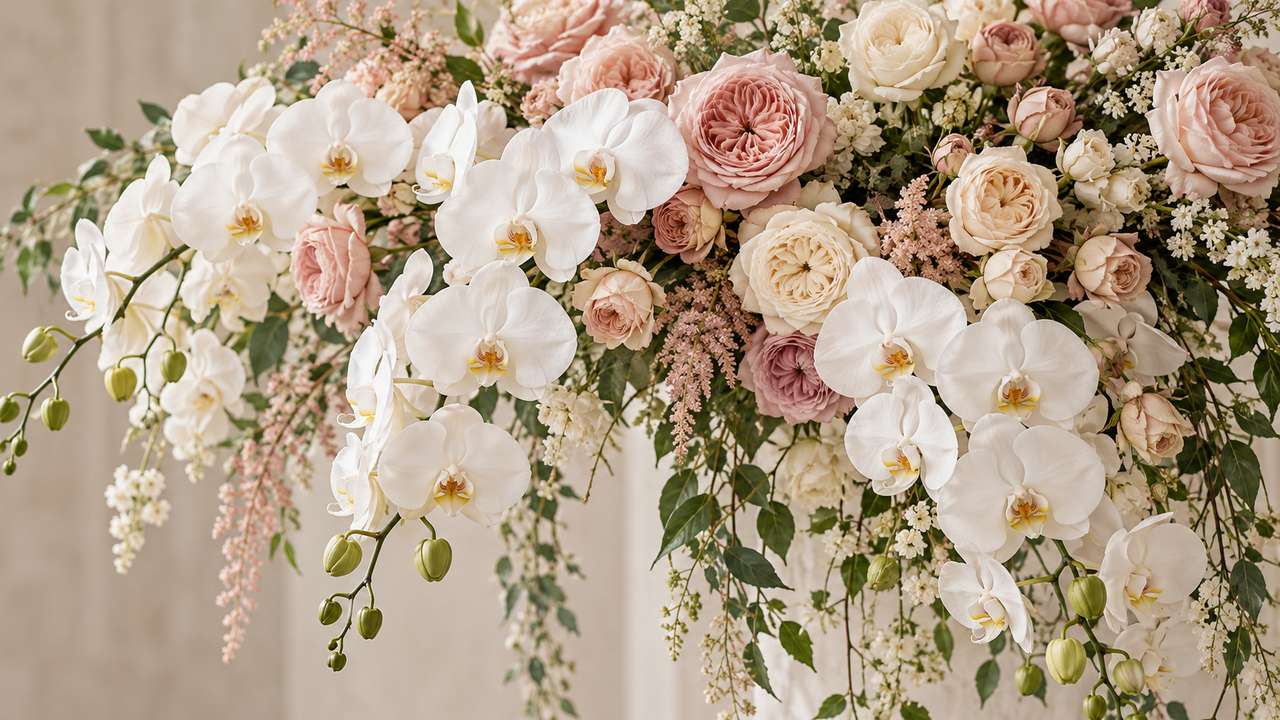
Color determines whether the arrangement feels romantic, familial, celebratory, or ceremonial. Red roses with white Phalaenopsis orchids express passionate commitment balanced by grace. Blush roses and pale pink Cymbidiums communicate tenderness, gentle admiration, and polished femininity. White roses paired with white orchids can signify purity, remembrance, spiritual love, or minimalist luxury; context and the accompanying message should clarify the intention.
Cream roses soften the composition and are especially useful when gratitude matters more than passion. Their associations with charm and consideration are explored in this guide to cream rose symbolism. Pair them with green Cymbidiums for quiet sophistication or burgundy orchids for an opulent autumnal effect.
Yellow roses and golden Oncidium orchids create a bright message of friendship, optimism, and shared success. Orange roses with sunset-toned Mokara orchids suggest enthusiasm, confidence, and attraction. Lavender roses alongside violet Vandas evoke enchantment, creativity, and fascination, making the combination ideal for artistic recipients or dramatic evening events.
Unnaturally colored roses require particular care. Dyed multicolored flowers emphasize novelty and exuberance; understanding the rainbow rose meaning can help determine whether they suit a birthday, Pride celebration, or playful achievement bouquet. Blue-dyed roses paired with indigo Vandas amplify wonder and the pursuit of the impossible, themes closely associated with the blue rose mystery.
So-called black roses are generally very dark crimson or purple cultivars rather than naturally black blooms. Combined with burgundy Cymbidiums, they can represent transformation, dramatic elegance, farewell, or renewal. Because interpretations vary, consult the fuller black rose meaning and include a card to prevent a theatrical bouquet from being mistaken for a message of grief.
| Rose and Orchid Pairing | Principal Meaning | Best Occasion | Style Character |
|---|---|---|---|
| Red roses and white Phalaenopsis | Passionate, honorable devotion | Anniversary or proposal | Formal and timeless |
| Blush roses and pink Cymbidiums | Tenderness and admiration | Wedding or new baby | Soft and romantic |
| Cream roses and green Cymbidiums | Grace, gratitude, and success | Thank-you or promotion | Modern and understated |
| Yellow roses and Oncidiums | Joy, friendship, and optimism | Birthday or congratulations | Lively and radiant |
| Lavender roses and purple Vandas | Enchantment and rare beauty | Creative milestone or courtship | Dramatic and artistic |
Occasions, Recipients, and Modern Etiquette
For a romantic partner, select red, coral, blush, or lavender roses with Phalaenopsis, Vanda, or Cattleya orchids. A proposal bouquet should reflect the recipient’s taste rather than rely automatically on red. For spouses celebrating a milestone anniversary, luxurious long-stemmed roses with cascading orchids convey both established love and continued fascination.
For friends, colleagues, teachers, or hosts, avoid a heavily romantic red palette unless the relationship clearly supports it. Yellow, cream, peach, green, and white combinations express appreciation without ambiguity. A compact arrangement of cream roses and green Cymbidiums makes an elegant executive gift, while bright spray roses and Dendrobiums suit graduations, launches, and housewarmings.
White rose-and-orchid designs are appropriate for sympathy, but customs differ. In many Western contexts, white suggests peace and reverence. Across parts of East Asia, white flowers are strongly associated with mourning, making them fitting for condolences but potentially unsuitable for celebratory gifts. Red may symbolize romance in Europe and North America, yet also good fortune and festivity in Chinese cultural settings. Always consider the recipient’s traditions.
Modern etiquette favors clarity. Include a short handwritten message, especially when using colors with multiple meanings. Send hospital arrangements only after checking fragrance and container restrictions. For home delivery, choose a vase arrangement rather than a hand-tied bouquet if the recipient may be unable to process stems immediately. Avoid sending elaborate romantic flowers to a workplace if public attention could cause discomfort.
Companion Flowers and Styling
Because both focal flowers are visually commanding, supporting materials should create rhythm rather than competition. Lisianthus echoes the rose’s softness; anthuriums reinforce the orchid’s tropical character; ranunculus adds intricate texture; and calla lilies introduce clean, ceremonial lines. For airy movement, use sweet peas, delphiniums, jasmine vine, or restrained stems of waxflower.
Choose foliage according to mood. Glossy monstera and palm leaves make the bouquet boldly tropical. Olive, eucalyptus, or Italian ruscus produces a quieter, contemporary silhouette. For formal arrangements, group roses into rounded masses and allow orchids to arc beyond them. For editorial styling, use fewer stems, visible negative space, and asymmetrical placement. A low, wide vessel suits dining tables, while a tall arrangement belongs in an entrance hall where its scale can be appreciated.
Care, Vase Life, and Botanical Practicalities
Roses and orchids have compatible but not identical needs. Begin with a meticulously clean vase and fresh, lukewarm water mixed with commercial flower food. Remove every leaf that would sit below the waterline. Recut rose stems diagonally with a sharp knife or clean shears, taking care not to crush the vascular tissue. Orchid stems should also receive a fresh cut but must be handled gently because individual blooms bruise easily.
Keep the arrangement in bright, indirect light, away from heating vents, direct sun, ripening fruit, and cold drafts. Fruit releases ethylene gas, which accelerates floral aging. Check the water daily, replace it every two days, and clean the vase before refilling. Remove fading rose petals and spent orchid blossoms promptly. Depending on variety and freshness, cut roses commonly last about five to twelve days, while Cymbidium and Dendrobium stems may remain attractive for two weeks or longer.
For living displays, a potted Phalaenopsis accompanied by a small vase of roses is often more sustainable than inserting cut roses into orchid potting media. Most epiphytic orchids require airy bark, excellent drainage, filtered light, and careful watering; ordinary garden soil can suffocate their roots. Roses, by contrast, generally need generous sun, fertile soil, airflow, and deeper, more regular irrigation outdoors.
A Lasting Language of Luxury
Ultimately, the roses and orchids meaning arises from balance. Roses speak of love, warmth, gratitude, and human attachment; orchids contribute rarity, refinement, strength, and cultivated beauty. Color, form, cultural setting, and recipient determine which message comes forward. When chosen thoughtfully, cared for properly, and accompanied by sincere words, this pairing becomes more than an extravagant display: it is a richly articulated tribute to affection made elegant and admiration made unforgettable.