Table of Contents
2 Roses Meaning: Deep Mutual Affection and the Union of Two Souls
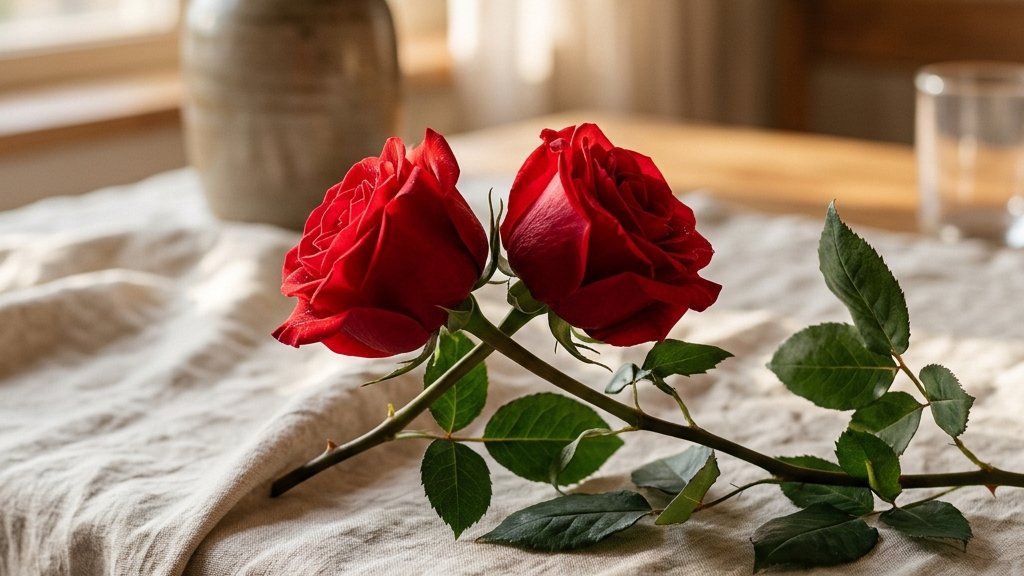
The meaning of two roses is both intimate and beautifully precise: deep mutual affection, partnership, and the union of two souls. Unlike a single rose, which often communicates a direct personal declaration, a pair creates a visual conversation. One bloom represents the giver, the other the recipient, and their placement together suggests that two individual lives, hearts, or intentions have become connected.
This symbolism makes two roses especially appropriate for romantic milestones, private proposals, anniversaries, reconciliations, and moments when “I love you” feels incomplete without “and we belong together.” The gesture is compact rather than extravagant, but that restraint is part of its power. Two carefully selected roses can convey reciprocity more clearly than a large bouquet chosen without similar thought.
What Do Two Roses Symbolize?
At its core, a gift of two roses says, “Our feelings are shared.” It represents mutual love rather than one-sided admiration. The number two naturally evokes partnership: two people, two perspectives, and two separate identities moving in harmony. In romantic flower language, this is commonly interpreted as the joining of two hearts or souls.
The arrangement can also signify commitment without implying possession. Each flower remains distinct, yet the pair forms one composition. This balance between individuality and unity helps explain why two roses suit established couples as well as people taking an important early step in a relationship.
- Mutual affection: Love, care, or admiration flowing in both directions.
- Union: Two individuals choosing emotional or spiritual togetherness.
- Partnership: Cooperation, equality, trust, and shared purpose.
- Devotion: A focused bond that does not require an extravagant display.
- Reconciliation: Two people restoring balance after distance or disagreement.
Context still matters. Two roses exchanged between romantic partners will usually be read as a declaration of shared love. Given to close friends, siblings, or collaborators, they may instead honor loyalty, solidarity, or an enduring partnership. A short handwritten message can clarify the intended meaning while preserving the gesture’s elegance.
Why the Number Two Carries Such Emotional Weight
Across cultures and symbolic traditions, two represents duality and relationship. Day and night, earth and sky, question and answer, and self and other all demonstrate how two separate elements can define or complete one another. In a floral gift, paired roses translate this broad idea into something personal and tangible.
The symbolism differs subtly from the message carried by one stem. A single rose concentrates attention on one emotion or one beloved person. Readers exploring that distinction may find 1 Rose Meaning: What Giving a Single Stem Truly Signifies Across Different Colors useful. Adding a second bloom changes the grammatical structure of the gesture: it moves from a declaration to a relationship.
Two is also the smallest number capable of forming a pair. For that reason, the gift feels distilled to its essentials. There is no visual excess to distract from the relationship being represented. Every detail—the color, openness, fragrance, stem length, and way the blooms lean toward one another—becomes more noticeable.
How Rose Color Changes the Message
The number establishes the theme of union, while color defines the emotional character of that union. Two red roses are not identical in tone to two white, yellow, or pink roses. Combining colors can create an even more nuanced statement, particularly when each flower represents one person.
| Two-Rose Combination | Primary Meaning | Best Occasion |
|---|---|---|
| Two red roses | Mutual romantic love and passionate unity | Anniversary, proposal, or Valentine’s Day |
| Two pink roses | Shared tenderness, gratitude, and gentle affection | New romance or heartfelt thanks |
| Two white roses | Pure intentions, spiritual union, and new beginnings | Wedding, engagement, or remembrance |
| Two yellow roses | Joyful companionship and loyal friendship | Friendship milestone or reunion |
| Red and white roses | Passion joined with sincerity and unity | Engagement or reconciliation |
| Two lavender roses | Mutual enchantment and rare connection | New attraction or romantic surprise |
Red and Wine-Red Pairs
Two classic red roses offer the clearest romantic interpretation: “I love you, and our love unites us.” Deeper burgundy or wine-red flowers add maturity, constancy, and cultivated elegance. They are particularly fitting for long relationships in which passion has developed into steadfast devotion. The nuances explored in Wine Red Rose Meaning: Sophistication, Devotion, and Timeless Elegance can help distinguish deep crimson sentiment from the brighter urgency of scarlet.
Mixed and Multicolored Pairs
A mixed pair can represent two personalities forming a balanced relationship. One red and one white rose traditionally unite passion with purity or peace. Red and pink combine desire with tenderness, while yellow and pink celebrate affectionate friendship and gratitude.
The flowers themselves may also contain more than one color. A striped variety can introduce individuality, spontaneity, and charm, as described in Striped Rose Meaning: Playfulness, Caprice, and Unique Horticultural Artistry. Meanwhile, the blended or sharply divided colors discussed in Bi-Color Rose Meaning: Decoding the Symbolism of Petals with Two Distinct Hues reinforce the central idea of distinct qualities existing beautifully together.
Historical Background and the Language of Flowers
Roses have carried symbolic meaning for thousands of years. In Greek and Roman traditions, they were associated with love, beauty, desire, and divine figures such as Aphrodite and Venus. Later Christian symbolism connected roses with purity, sacrifice, heavenly love, and spiritual mystery. These overlapping traditions gave the flower an unusually rich emotional vocabulary.
The practice of assigning highly specific messages to flower types, colors, and arrangements became especially fashionable during the nineteenth century. In Victorian society, where direct emotional expression could be constrained by etiquette, flowers served as a coded language. A bouquet’s meaning might change according to color, quantity, condition, or presentation.
Modern rose-number symbolism is not a single universal system inherited unchanged from antiquity. It is better understood as an evolving blend of historical floriography, cultural associations, florist conventions, and contemporary romantic practice. Even so, the interpretation of two roses as mutual affection is intuitive enough to cross many cultural boundaries: a pair visibly embodies a relationship.
When to Give Two Roses
A New Relationship
Two roses can mark the transition from attraction to acknowledged partnership. They are romantic without creating the pressure of a dozen red roses. Pink, peach, lavender, or softly colored bi-color blooms work particularly well when feelings are sincere but the relationship is still developing.
An Anniversary or Proposal
For an established couple, two premium roses can be more personal than a conventional bouquet. Select blooms with strong stems, symmetrical heads, and complementary stages of opening. For a proposal, two red or red-and-white roses can symbolize the lives each person brings to the promised union.
Reconciliation
A pair can quietly say, “Let us meet each other again.” White and pink roses are suitable when the desired message emphasizes sincerity, tenderness, and renewed trust. Flowers cannot replace accountability or an honest conversation, but they can frame that conversation with care.
Friendship and Non-Romantic Bonds
Two yellow, peach, or cream roses can honor a meaningful friendship, sibling bond, or creative partnership. Avoid red if romantic ambiguity would be unwelcome. A note such as “For everything we have faced together” makes the intended form of affection unmistakable.
How to Select and Present the Pair
Because there are only two flowers, quality is highly visible. Look for firm stems, hydrated foliage, intact outer guard petals, and flower heads that remain upright. Buds should show color and feel gently resilient rather than hard, bruised, or overly soft. Avoid stems with blackened edges, translucent petals, or leaves showing extensive spotting.
Choose roses of similar scale if equality is central to the message. Alternatively, use contrasting cultivars intentionally to represent two different personalities. Unequal stem lengths can look accidental unless the arrangement is carefully composed, so ask the florist to create a deliberate parallel, crossed, or gently asymmetrical presentation.
- Use a narrow glass vase to keep both stems visually connected.
- Tie the pair with silk, linen, or paper ribbon rather than bulky plastic wrap.
- Include a concise message explaining why there are exactly two roses.
- Trim stems at an angle with clean tools and remove leaves below the waterline.
- Refresh the water regularly and keep the flowers away from heat, direct sun, and ripening fruit.
The Lasting Message of Two Roses
The deepest meaning of two roses lies in reciprocity. One flower alone can declare admiration; two acknowledge a bond. They say that love is not merely sent but shared, not merely felt but answered. Whether the pair represents romance, reconciliation, friendship, or lifelong commitment, its visual message remains compelling: two distinct souls can stand side by side and create something complete.
That combination of simplicity and emotional depth is why two roses continue to resonate. The gift does not depend on scale or spectacle. When the colors are chosen thoughtfully and the occasion is genuine, two stems can communicate partnership, equality, and enduring mutual affection with remarkable clarity.