Table of Contents
Striped Rose Meaning: Playfulness, Caprice, and Unique Horticultural Artistry
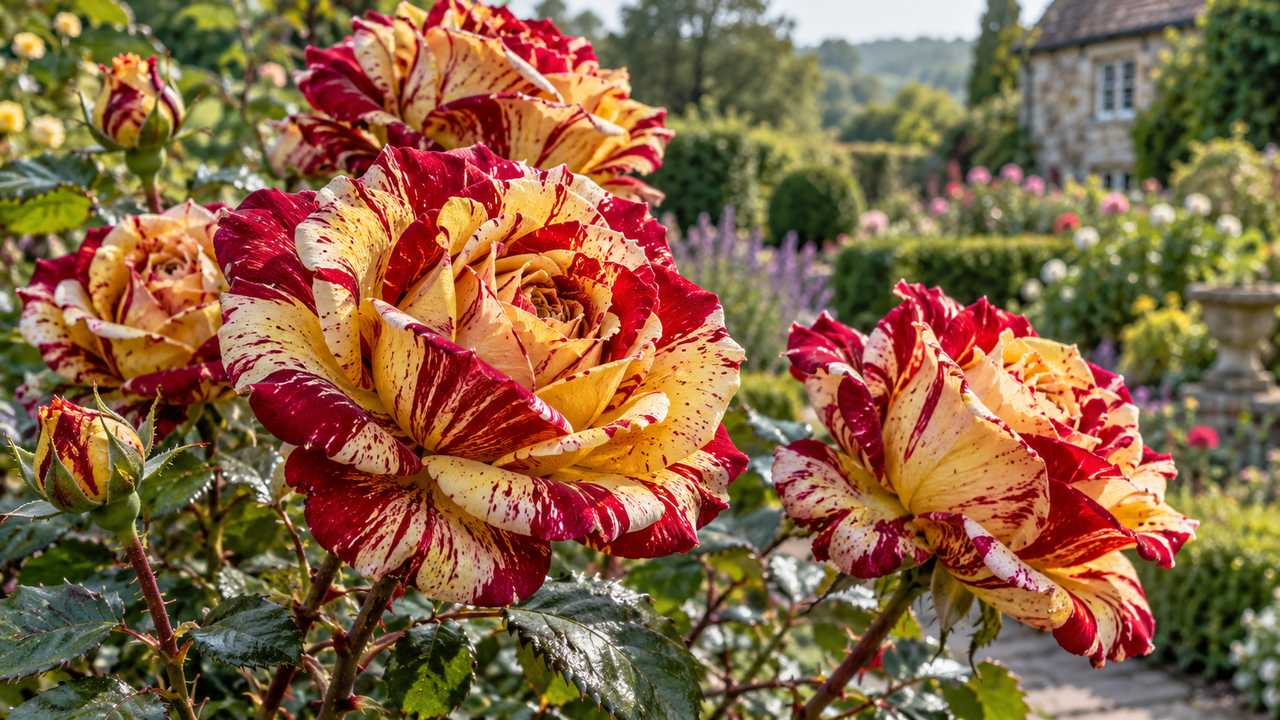
Few flowers appear as deliberately theatrical as a striped rose. Its petals may be brushed with fine lines, broken into irregular splashes, or divided into contrasting blocks of color. No two blooms are entirely alike, even when they open on the same plant. This visual unpredictability gives the striped rose its central symbolic language: playfulness, caprice, individuality, creative freedom, and the beauty of refusing to conform.
The phrase striped rose meaning: playfulness, caprice, and unique horticultural artistry describes more than an attractive color pattern. Striped roses occupy a distinctive place between traditional floral symbolism and advanced plant breeding. They can communicate flirtation without the intensity of a solid red rose, admiration without excessive formality, and affection shaped by wit, surprise, or artistic personality. In the garden, they are living demonstrations of genetic variation, selective breeding, and occasionally spontaneous mutation.
What Does a Striped Rose Symbolize?
A striped rose most commonly symbolizes playful affection, charming unpredictability, originality, and delight in difference. Unlike a single-color rose, which often carries a relatively focused message, a striped bloom combines several visual signals. Its contrasting pigments suggest that feelings can be layered rather than simple: affection may coexist with amusement, admiration with curiosity, or romance with a spirited sense of independence.
“Caprice” is especially useful when interpreting these flowers. In this context, the word does not necessarily imply unreliability. Instead, it evokes spontaneous changes of mood, imaginative impulses, and freedom from rigid convention. The irregular markings look as though an artist changed direction while painting each petal. Consequently, striped roses suit people who are inventive, charismatic, unconventional, or pleasantly difficult to predict.
Their symbolism can also include uniqueness and self-expression. Because stripe placement varies from flower to flower, a bouquet becomes a collection of individual compositions. This makes striped roses appropriate for celebrating someone who follows a personal path, embraces complexity, or turns difference into strength.
How Color Combinations Change the Message
There is no single universal meaning for every striped rose. The underlying colors remain important. Red and white stripes can blend romance with candor, while pink and cream markings feel lighter, sweeter, and more companionable. Yellow mixed with red or orange often creates the most exuberant interpretation, suggesting energy, humor, transformation, and sociable warmth.
| Striped Color Pattern | Principal Meaning | Emotional Tone | Suitable Occasion |
|---|---|---|---|
| Red and white | Passion balanced by sincerity | Romantic, dramatic, expressive | Anniversaries or bold declarations |
| Pink and cream | Gentle affection and playful grace | Tender, cheerful, refined | Birthdays, friendship, or thanks |
| Yellow and red | Joy energized by desire | Lively, extroverted, adventurous | Celebrations and new ventures |
| Purple or mauve with white | Enchantment and cultivated individuality | Mysterious, elegant, imaginative | Artistic milestones or sophisticated gifts |
| Orange, coral, or salmon-striped | Enthusiasm, attraction, and warm friendship | Confident, warm, energetic | Congratulations or emerging romance |
Subtle warm combinations may overlap with the welcoming associations discussed in Apricot Rose Meaning: Sincere Hospitality, Warmth, and Family Affection. Purple-striped cultivars, meanwhile, can carry the cultivated mystery explored in Mauve Rose Meaning: Decadence, Victorian Royalty, and Enchanting Affection. The pattern modifies these established color meanings by adding spontaneity and individuality.
Why Roses Develop Stripes
Genetics, Pigments, and Cell Layers
Rose striping is not painted onto the bloom by environmental conditions. In established striped cultivars, it usually results from genetically controlled differences in pigment production across petal tissue. Anthocyanins supply many red, pink, crimson, and purple shades, while carotenoids contribute yellow and orange tones. Variations in where and when pigment-related genes are expressed create streaks, sectors, flecks, and marbled effects.
A rose’s growing tip is organized into layers of cells. A mutation arising in one layer may alter the color of only certain tissues, producing a chimera: a plant containing genetically distinct cell populations. This can generate striped or partially striped flowers. Some mutations remain stable through vegetative propagation; others are unstable and may produce branches that revert to a solid ancestral color.
Growers call such an altered branch a “sport.” If its characteristics remain consistent, the sport can be propagated by budding, grafting, or cuttings and eventually introduced as a named cultivar. This is one reason striped roses represent horticultural artistry: breeders must recognize promising variation, test it over several seasons, and preserve it through careful propagation.
Breeding for Pattern and Performance
Appearance alone does not make a successful garden rose. Breeders also evaluate vigor, repeat flowering, fragrance, disease resistance, stem strength, bloom form, heat tolerance, and pattern stability. Selecting for all these traits is comparable to engineering a high-performance touring car: dramatic styling may attract attention, but reliability, handling, and durability determine whether the design succeeds in daily use.
A spectacular striped seedling may be rejected if it develops weak stems or severe black spot. Conversely, a robust plant may progress through trials even if its markings vary somewhat, because variation is part of the cultivar’s charm. The best selections combine recognizable striping with sound garden performance.
Historical and Cultural Context
Striped roses have fascinated European and American gardeners for centuries, particularly as nursery breeding expanded during the eighteenth and nineteenth centuries. Variegated forms stood apart from restrained formal beds and appealed to collectors interested in botanical novelties. Their appearance also complemented an era in which flowers were assigned elaborate emotional meanings.
However, historical flower dictionaries were not standardized. One source might interpret a striped rose as refusal, another as diversity, and a modern florist as playful romance. Meanings changed according to period, region, and color. It is therefore more accurate to treat floral symbolism as an evolving cultural vocabulary rather than a fixed code.
Modern interpretations tend to emphasize creativity, nonconformity, and joyful surprise. These meanings align naturally with the flower’s physical character. A striped rose does not repeat a mechanical graphic; it produces biological variation. Its artistry lies in the tension between an inherited pattern and the unpredictable way that pattern appears on each bloom.
Notable Striped Rose Types
Several celebrated cultivars demonstrate how diverse striping can be. ‘Rosa Mundi,’ a historic Gallica associated with the older ‘Officinalis’ rose, carries crimson-pink petals splashed with pale pink or white. Its semi-double flowers and strong historical presence make it especially valuable in heritage gardens, though it generally flowers once rather than continuously.
Modern striped roses may offer repeat bloom and a wider range of colors. Cultivars such as ‘Scentimental’ display burgundy-red and creamy white patterning, while ‘Fourth of July’ combines red, white, and flashes of yellow in vigorous climbing growth. ‘George Burns’ is known for yellow petals irregularly marked with red, and ‘Purple Tiger’ offers mauve-purple tones broken by pale streaks.
Names and availability vary between countries, and performance depends on climate. Buyers should check whether a cultivar is a hybrid tea, floribunda, shrub, climber, or old garden rose rather than choosing by photographs alone. Mature height, flowering cycle, hardiness, and disease susceptibility determine where the plant will work.
Giving Striped Roses With Intention
Striped roses are particularly effective when the recipient values art, humor, gardening, fashion, or unconventional design. They can celebrate a creative achievement, career change, theatrical performance, new studio, or milestone birthday. As a romantic gift, they convey attraction with personality rather than solemn devotion.
A coral-striped arrangement may bridge companionship and desire, echoing themes found in Salmon Rose Meaning: Bridging the Gap Between Warm Friendship and Fiery Passion. Pairing striped blooms with soft green foliage can emphasize renewal and balance; for a fuller interpretation of that palette, see Mint Green Rose Meaning: Harmony, Prosperity, and Floral Good Fortune.
- Choose red-and-white stripes for expressive romance with an unconventional edge.
- Select pink-and-cream flowers for affectionate friendship, gratitude, or a joyful birthday.
- Use yellow-and-red varieties to congratulate someone on a bold achievement.
- Give purple-striped roses to artists, collectors, or people drawn to rarity and mystery.
- Include a short note explaining the symbolism, since striped roses do not have one universally recognized message.
Growing Striped Roses Successfully
Most striped roses require the same fundamentals as other garden roses: at least six hours of direct sun, fertile but well-drained soil, consistent moisture, and adequate air circulation. Water deeply at the root zone rather than repeatedly wetting foliage. Apply organic mulch while leaving a small gap around the canes, and feed according to cultivar needs and local soil conditions.
Pattern intensity may shift with temperature, sunlight, and bloom age. Cool weather can deepen anthocyanin-based colors, while intense heat may make some flowers appear paler or cause colors to blend. These changes do not necessarily indicate mislabeling. They are part of the interaction between genetics and environment.
If one branch repeatedly produces solid-colored flowers, it may be reverting. Trace that cane to its origin and prune it below the point where the altered growth began. On grafted plants, vigorous shoots emerging from below the graft union may be rootstock suckers rather than reversions and should also be removed correctly.
A Living Emblem of Creative Difference
The striped rose ultimately represents beauty that gains power from variation. Its mixed colors acknowledge that affection, identity, and experience are rarely uniform. It can be flirtatious without being frivolous, sophisticated without becoming formal, and artistically dramatic while remaining unmistakably natural.
Whether selected as a symbolic gift or cultivated as a garden centerpiece, a striped rose rewards close attention. Every flower offers a new arrangement of pigment, and every opening bud contains an element of suspense. That combination of playfulness, caprice, and horticultural craftsmanship makes the striped rose an enduring emblem of individuality: not merely different for novelty’s sake, but memorable because no exact copy can ever bloom again.