Table of Contents
Pairing Roses with White Lilies: Majestic Grace for Formal Ceremonies
Few floral pairings possess the ceremonial presence of roses and white lilies. Roses contribute layered emotion—love, honor, friendship, devotion, or remembrance—while lilies bring sculptural height, luminous color, and associations with purity, renewal, and spiritual grace. Together, they create an arrangement that feels both intimate and dignified, making the combination especially suited to weddings, memorials, religious observances, anniversaries, and official celebrations.
The historical roots of this pairing reach across several traditions. Roses were sacred to love deities in the ancient Mediterranean world and later became emblems of courtly affection, dynastic identity, and Christian devotion. Lilies appeared in ancient Egyptian, Greek, Roman, and Near Eastern art; in Christian iconography, the white Madonna lily became closely associated with the Virgin Mary, chastity, and divine favor. During the nineteenth-century enthusiasm for floriography, flowers were arranged as coded messages. Although meanings varied between dictionaries and regions, combining roses with white lilies generally elevated personal affection into something solemn, virtuous, and enduring.
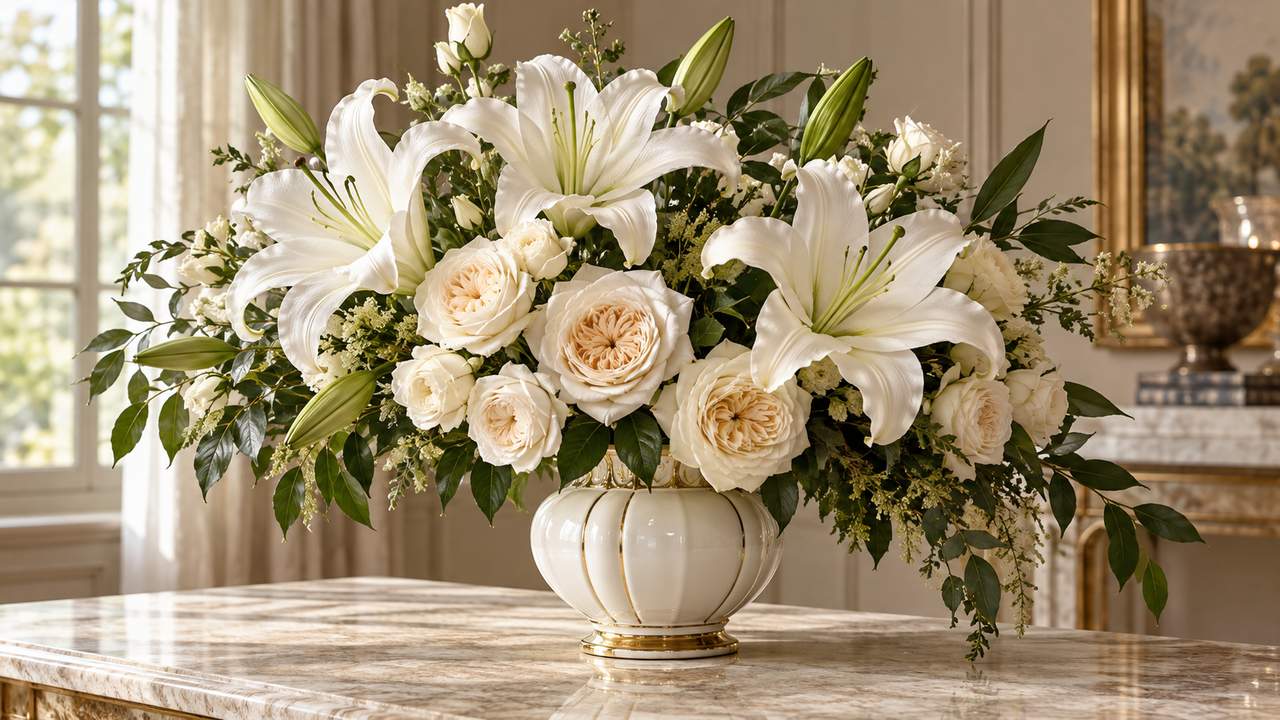
The Core Roses and Lilies Meaning
The central roses and lilies meaning is majestic love joined with purity, dignity, and renewal. A rose communicates the nature of the human bond; a white lily gives that bond ceremonial or spiritual weight. In romantic settings, the arrangement can mean, “My love for you is sincere and worthy of honor.” At a funeral, the same flowers may express enduring affection, peace, and hope beyond loss. Context, rose color, card wording, and presentation determine which interpretation comes forward.
Botanically, the pairing also succeeds because of contrast. Roses, belonging to the genus Rosa, form rounded, many-petaled focal blooms. True lilies belong to the genus Lilium and open into prominent trumpet, bowl, or star-shaped flowers. Their long stems and outward-facing blossoms give an arrangement architecture, while roses fill its center with softness and visual abundance.
Symbolism Through History and Culture
In classical Greek and Roman traditions, roses were connected with Aphrodite or Venus and therefore with beauty, desire, and love. Lilies were associated in one mythic tradition with Hera or Juno, lending them connotations of maternity, nobility, and divine legitimacy. Pairing them could consequently suggest beauty blessed by dignity or fruitful union—an idea well suited to marriage ceremonies.
Medieval and Renaissance Christian art transformed both flowers into devotional symbols. White lilies represented the Annunciation, innocence, and the Virgin Mary, while red roses could signify sacred love, martyrdom, or Christ’s sacrifice. White roses added silence, innocence, and heavenly love. Modern readers interested in these distinctions may explore white rose symbolism, particularly its dual relevance to weddings and remembrance.
In Victorian-era floriography, bouquets allowed emotions to be expressed indirectly. Red roses declared passionate love; white roses suggested innocence or worthiness; and lilies commonly conveyed purity or majesty. Yet there was no single universal floral dictionary. Meanings differed by author, variety, and social setting. An authoritative modern interpretation should therefore treat historical symbolism as a vocabulary rather than an inflexible code.
Today, Western wedding customs often use white lilies and roses to communicate elegance, sincerity, and new beginnings. In Christian funerary traditions, white lilies are strongly associated with peace and resurrection. In parts of Europe and Asia, however, white flowers may be more closely identified with mourning than celebration. Customs also vary within countries, so local practice and the recipient’s faith should guide formal gifts.
| Rose Choice | Meaning with White Lilies | Best Context | Styling Direction |
|---|---|---|---|
| Red roses | Passionate love ennobled by devotion and purity | Formal romance, milestone anniversaries | Deep greenery, restrained burgundy accents |
| White roses | Unity, innocence, reverence, and peace | Weddings, baptisms, memorials | Monochromatic ivory with varied textures |
| Pink roses | Admiration, tenderness, and gracious affection | Birthdays, honors, family celebrations | Blush tones, airy foliage, soft ribbons |
| Yellow roses | Joyful friendship, optimism, and renewal | Congratulations, recovery, friendship | Fresh green foliage and light ceramic vessels |
| Champagne roses | Refined affection, gratitude, and quiet luxury | Galas, engagements, elegant anniversaries | Ivory, taupe, gold, and olive foliage |
Color, Variety, and Bouquet Nuance
Red roses with white lilies create the most dramatic contrast. The message is unmistakably romantic, but the lilies keep it from feeling merely sensual. Choose deep crimson roses for evening ceremonies and true red varieties for traditional declarations. For a softer relationship message, pink roses express gratitude and admiration without the intensity of red.
Yellow roses introduce sunlight and companionship. Contemporary interpretations emphasize warmth and platonic joy, as explained through the yellow rose meaning. Paired with white lilies, they are excellent for retirements, graduations, recoveries, and ceremonial congratulations. Champagne and cream roses are quieter and more luxurious; the champagne rose meaning makes them particularly appropriate for refined receptions and milestone occasions.
Lily variety matters as well. Oriental lilies offer large, often fragrant flowers and a lavish appearance, but their scent can overwhelm dining tables, hospitals, or scent-sensitive guests. White Asiatic lilies are usually less fragrant and have a crisp, contemporary silhouette. Longiflorum lilies, commonly called Easter lilies, carry especially strong Christian associations. Florists may also use alstroemeria, often called Peruvian lily, but it is not a true lily and creates a lighter, less monumental effect.
Occasions, Recipients, and Modern Etiquette
- Weddings: Give white or champagne roses with white lilies to couples who favor traditional elegance. For bridal work, confirm whether the fragrance and pollen will be comfortable near faces and formal clothing.
- Anniversaries: Red roses and lilies suit a spouse or long-term partner, especially for landmark years. A personal note prevents the white lilies from being mistaken for a sympathy reference.
- Memorials and funerals: White roses and lilies express peace, honor, and remembrance; red roses can signify abiding love. Consult guidance on roses for sympathy before selecting highly romantic colors or sending flowers to a particular place of worship.
- Religious ceremonies: White combinations are appropriate for baptisms, confirmations, Easter observances, and some ordinations, provided they align with the congregation’s customs.
- Professional honors: Champagne, pale pink, or yellow roses prevent the bouquet from appearing romantic. Choose structured, moderate-sized arrangements for promotions, retirements, and awards.
Modern etiquette favors sensitivity over rigid symbolism. Include a brief card naming the occasion and your intention. Avoid sending strongly fragrant lilies to hospital rooms without checking restrictions. Most importantly, true lilies are extremely toxic to cats: pollen, petals, leaves, stems, and even vase water can cause life-threatening kidney injury. For a cat-owning household, omit lilies entirely and request a pet-safer substitute.
Companion Flowers and Formal Styling
For classical ceremony, add white hydrangea for volume, lisianthus for delicacy, and restrained eucalyptus or Italian ruscus for line. Delphinium lends vertical grandeur to large altar or entrance pieces, while stephanotis reinforces bridal tradition. In sympathy work, white chrysanthemums can add longevity and cultural resonance, although they carry strong funerary associations in several European and Asian societies.
Let lilies stand slightly above clustered roses so each bloom has space to open. Odd-numbered groupings often create a natural rhythm. A low, compact design suits a banquet table; tall trumpet-shaped arrangements belong in entrances, sanctuaries, and stages where they will not block conversation. Silver, clear glass, stone, or matte ivory vessels preserve the pairing’s formal character.
Care and Vase Longevity
Choose roses with firm petals and buds that have begun to loosen, and lilies with several closed buds plus one emerging flower. Recut stems at an angle with clean tools, remove all foliage below the waterline, and place them promptly in a disinfected vase with commercial flower food. Refresh the solution and clean the vessel every two days.
Keep the arrangement away from direct sun, heating vents, ripening fruit, and drafts. Roses may benefit from a deeper drink, while lilies need room for their buds to open; a stable vase accommodates both. As lily flowers open, carefully remove the pollen-bearing anthers before they shed. Do not brush pollen stains, which drives pigment into fabric; lift loose pollen with adhesive tape instead. With proper care, roses commonly remain attractive for about five to seven days, while lily buds may continue opening for a week or longer.
A Union of Emotion and Ceremony
The enduring roses and lilies meaning lies in balance: roses speak from the heart, while white lilies lend that message dignity, purity, and transcendence. Color determines whether the composition celebrates passion, friendship, gratitude, union, or remembrance. By considering cultural custom, fragrance, pet safety, scale, and the recipient’s relationship to the occasion, this majestic pairing becomes more than decoration—it becomes a carefully composed statement of love elevated by grace.


