Table of Contents
Pairing Roses with Ranunculus: Whimsical Swirls and Playful Romanticism
Few floral pairings balance grandeur and whimsy as gracefully as roses and ranunculus. Roses bring unmistakable emotional weight: love, admiration, secrecy, remembrance, or friendship, depending on their color and context. Ranunculus contributes a lighter enchantment. Its densely layered petals unfurl in delicate spirals, giving bouquets movement, softness, and an almost storybook quality. Together, the flowers express romance without becoming overly formal and affection without losing nuance.
Understanding the roses and ranunculus meaning begins with both history and botany. Roses belong to the genus Rosa, a diverse group of woody perennials cultivated for thousands of years. Ranunculus—particularly the florist’s Persian buttercup, Ranunculus asiaticus—grows from claw-like tuberous roots and produces many-petaled blooms on slender stems. Although their growth habits differ dramatically, their rounded forms and concentric petals make them natural visual companions.
Historical Roots of the Pairing
Roses have carried symbolic importance since antiquity. The Greeks connected them with Aphrodite, while Romans associated them with Venus, celebration, luxury, and confidentiality. The expression sub rosa, or “under the rose,” arose from the flower’s connection with secrecy. In medieval Christian imagery, roses acquired meanings ranging from martyrdom to divine love, while courtly poets used them as emblems of beauty and desire.
Ranunculus entered European ornamental culture much later. Native across parts of the Mediterranean, southwestern Asia, and northeastern Africa, Persian ranunculus became highly prized among European collectors during the sixteenth and seventeenth centuries. Its tightly packed petals and brilliant colors suited an era fascinated by botanical rarity. In traditional flower lore, ranunculus came to signify radiant charm, attraction, and the message, “I am dazzled by your charms.”
By the nineteenth century, flowers had become a coded social vocabulary. Guides to the Victorian language of flowers offered lovers and friends a way to communicate sentiments that etiquette discouraged them from stating openly. A rose could declare the nature of affection, while ranunculus praised the recipient’s captivating presence. Although historical dictionaries were never entirely consistent, this complementary message remains persuasive: “My feelings are sincere, and your charm delights me.”
What Roses and Ranunculus Mean Together
At their heart, roses represent emotionally significant attachment, while ranunculus represents magnetic charm. Combined, they symbolize affectionate fascination: love that feels sincere but also lively, admiring, and newly discovered. Their shared layers suggest emotional depth, yet their contrasting structures keep the arrangement from feeling solemn. Roses provide stability and recognizable symbolism; ranunculus adds curiosity, spontaneity, and playful romance.
The pairing can therefore communicate several overlapping ideas:
- Romantic enchantment: “I love you, and I remain captivated by you.”
- Joyful admiration: appreciation for someone’s beauty, personality, talent, or warmth.
- Layered affection: a relationship whose meaning deepens gradually over time.
- Elegant celebration: heartfelt happiness appropriate for weddings, anniversaries, and milestones.
- Hopeful beginnings: tenderness and anticipation at the start of a relationship or new chapter.
Color Meanings and Emotional Variations
Color determines whether the bouquet reads as passionate, friendly, ethereal, or ceremonial. Florists should consider not only each bloom individually but also the emotional effect created by their interaction.
| Color Pairing | Combined Meaning | Best Context |
|---|---|---|
| Red roses and burgundy ranunculus | Passion, devotion, and irresistible attraction | Anniversaries and committed romance |
| Pink roses and blush ranunculus | Tender admiration, sweetness, and gratitude | New romance, birthdays, and thank-you gifts |
| White roses and white ranunculus | Sincerity, unity, peace, and refined new beginnings | Weddings, sympathy, and elegant ceremonies |
| Yellow roses and golden ranunculus | Friendship, optimism, and cheerful appreciation | Congratulations and platonic affection |
| Orange roses and coral ranunculus | Enthusiasm, desire, energy, and fascination | Bold romance and creative milestones |
| Lavender roses and lilac ranunculus | Enchantment, wonder, and distinctive affection | First attraction and imaginative celebrations |
Red combinations make the strongest romantic declaration. Pink is gentler and more versatile, especially when affection is genuine but not intensely passionate. Orange arrangements feel energetic and confident; the history of orange rose symbolism reinforces themes of enthusiasm, attraction, and desire. Lavender creates an otherworldly mood, and the traditional lavender rose meaning of enchantment harmonizes beautifully with ranunculus.
White requires sensitivity. At weddings it conveys unity and fresh beginnings, but in memorial arrangements it can express peace, reverence, and remembrance. Cultural context matters as well: white flowers are strongly associated with mourning in several East Asian traditions. Red may signify romance in much of Europe and North America, yet it also represents luck, vitality, and celebration in Chinese contexts. Always interpret color through the recipient’s customs rather than treating floriography as a universal code.
Occasions, Recipients, and Modern Etiquette
For a romantic partner, roses and ranunculus suit first dates, proposals, anniversaries, and spontaneous declarations. A lavish red bouquet communicates commitment, while blush, peach, or lavender feels more exploratory. Flower count can sharpen the message: incorporating the tradition of three roses meaning—often interpreted as “I love you”—creates a discreet symbolic foundation surrounded by charming ranunculus.
For friends, colleagues, hosts, or relatives, select yellow, peach, cream, or mixed pastel blooms rather than deep red. These palettes emphasize gratitude and joy without implying romance. A bright arrangement is appropriate for birthdays, graduations, promotions, housewarmings, and creative achievements. For a grieving recipient, choose restrained whites, creams, and pale pinks, avoid overly celebratory wrapping, and include a simple condolence message.
Modern etiquette favors clarity over secret codes. If a bouquet could be misread, use the card to state your intention. Consider fragrance sensitivity, allergies, pets, and the recipient’s ability to care for cut flowers. Send wedding flowers only when invited by the couple or directed through a registry, and confirm local customs before sending blooms to a funeral or hospital.
Companion Flowers and Bouquet Styling
Because both focal flowers are rounded and petal-rich, successful arrangements benefit from contrasting lines and textures. Sweet peas introduce fluttering movement; tulips add clean silhouettes; lisianthus creates airy transitions; anemones provide graphic dark centers. Delphinium or snapdragon adds height, while spirea, jasmine vine, or clematis lends garden-like looseness. Fine-textured foliage such as maidenhair fern softens the composition, whereas eucalyptus produces a cooler, contemporary finish.
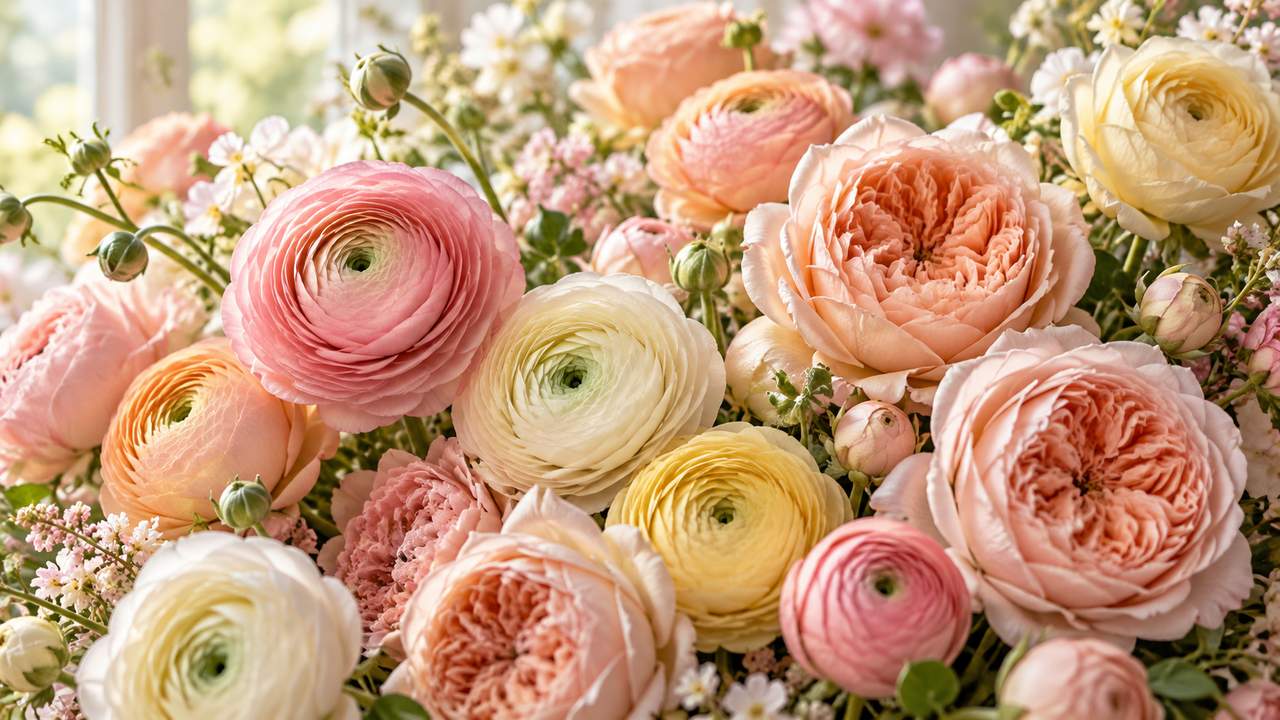
For playful romanticism, cluster garden roses and ranunculus asymmetrically rather than forming a perfect dome. Vary stem heights so several ranunculus appear to float beyond the roses. Limit the palette to three related hues for sophistication, or combine coral, apricot, butter yellow, and blush for a painterly spring effect. Silk ribbon, handmade paper, or a low ceramic vessel supports the flowers’ old-world character without overpowering them.
Care, Longevity, and Botanical Practicalities
Cut roses generally last five to ten days, while ranunculus often lasts seven to twelve days under good conditions. Begin with a scrupulously clean vase. Recut stems at an angle using a sharp knife or floral snips, remove all foliage below the waterline, and place the flowers in cool water with commercial preservative. Refresh the water every one or two days and keep the arrangement away from direct sun, radiators, drafts, and ripening fruit, which releases bloom-aging ethylene.
Ranunculus stems are slender and can bend or decay in deep, stagnant water, so use only enough water to keep them hydrated and replenish it frequently. Roses are thirstier; check the level daily. If a rose droops prematurely, recut its stem and hydrate it separately before returning it to the arrangement.
In the garden, roses prefer abundant sun, fertile well-drained soil, and steady air circulation. Ranunculus thrives in cool growing conditions and is commonly planted from corms in autumn in mild climates or late winter to early spring in colder regions. Since their flowering schedules vary by climate and cultivar, growers planning a combined cutting garden should select repeat-flowering roses or coordinate greenhouse production with the ranunculus season.
A Romance of Depth and Delight
The enduring roses and ranunculus meaning lies in its balance: roses articulate the seriousness of affection, while ranunculus celebrates the delight of being captivated. Color, number, cultural custom, and presentation can shift that message from passionate devotion to cheerful gratitude or serene remembrance. Thoughtfully chosen and properly cared for, this pairing becomes more than a fashionable bouquet—it is a layered floral statement in which enduring love meets radiant charm.