Table of Contents
Osiria Rose Meaning: Complex Emotions, Inner Duality, and Striking Passion
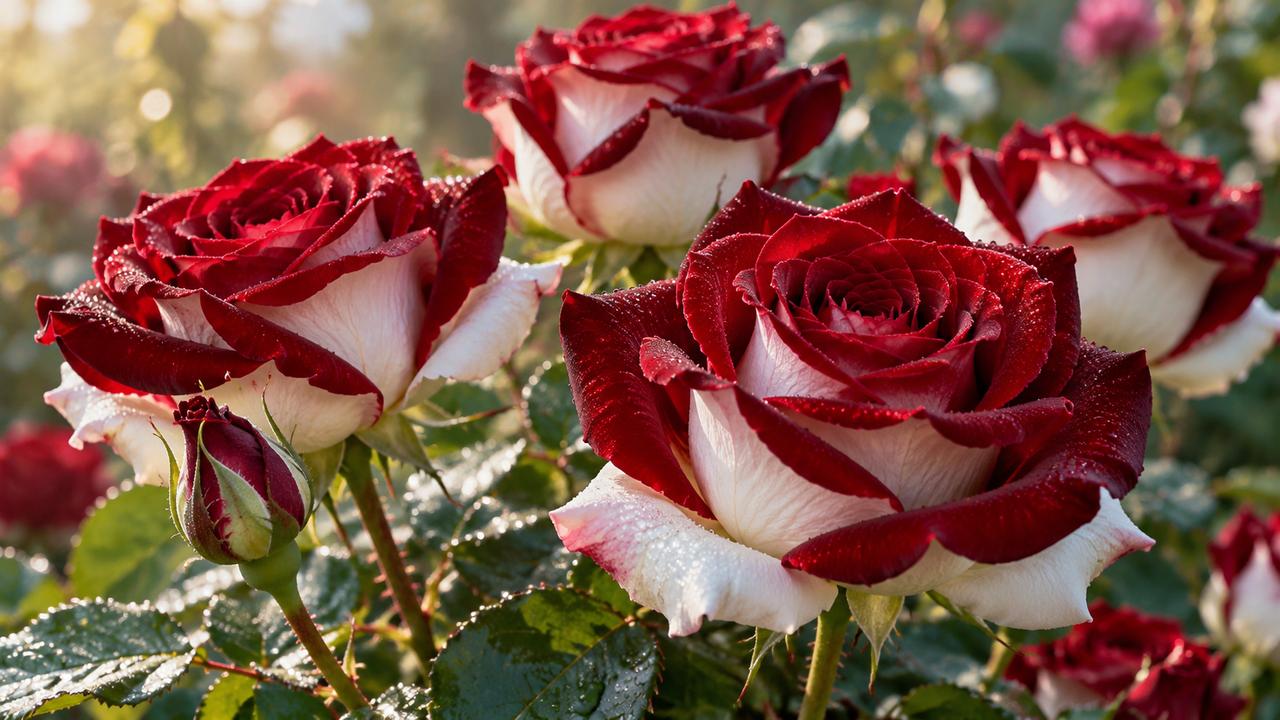
The Osiria rose is famous for its theatrical contrast: velvety crimson petals edged or reversed in silvery white. A single bloom can appear divided between flame and frost, making it a compelling emblem of complex emotions, inner duality, and striking passion. Its beauty suggests a love that is neither simple nor predictable—desire tempered by restraint, confidence concealing vulnerability, or devotion shaped by hardship.
Unlike roses rooted in ancient myth, Osiria is a modern hybrid tea cultivar. It was bred in Germany by Reimer Kordes and introduced commercially in 1978. Its name evokes Osiris, the legendary lost land sometimes imagined as a counterpart to Atlantis, although that romantic association belongs more to modern storytelling than documented botanical history. The cultivar’s dramatic bicolor appearance nevertheless fits naturally into the symbolic traditions described by the Victorian language of flowers, in which color, condition, and presentation could transform a rose into a carefully coded message.
What Is the Primary Osiria Rose Meaning?
The central Osiria rose meaning is passionate love complicated by contrasting feelings. Its red surfaces convey romance, courage, desire, and sacrifice, while its pale reverse introduces ideas of innocence, honesty, distance, or emotional reserve. Together, these colors portray the coexistence of apparent opposites.
- Complex love: A profound attachment containing joy, uncertainty, longing, and emotional risk.
- Inner duality: The private self beneath a bold exterior, or the tension between reason and desire.
- Passion with purity: Intense romantic feeling guided by sincerity, loyalty, or honorable intention.
- Reconciliation: Two perspectives meeting without either losing its identity.
- Transformation: Beauty and strength emerging from contrast, adversity, or personal change.
- Rare fascination: Attraction to someone distinctive, enigmatic, or difficult to forget.
For anyone interpreting rose color meanings, Osiria offers an important lesson: multicolored roses should be read as a conversation between hues rather than as separate symbols. Red does not erase white, and white does not cool the red completely. Their interaction creates the flower’s distinctive emotional vocabulary.
Historical and Cultural Interpretations
Ancient and Medieval Context
Osiria itself did not exist in antiquity, so claims that ancient Egyptians, Greeks, or Romans assigned a special meaning to this cultivar are historically inaccurate. Its component colors, however, carry old associations. Red roses became linked with Aphrodite or Venus, desire, blood, and mortal devotion. White roses represented purity, sacred love, and spiritual illumination. Medieval Christian imagery sometimes used red and white roses to contrast suffering with innocence.
Victorian Interpretation
Victorian flower dictionaries predate Osiria, but their conventions help explain how the cultivar is understood today. A red rose commonly declared love, while white suggested innocence or worthiness. A hypothetical bicolor bloom combining both could therefore communicate, “My passion is sincere,” or “Love unites our different natures.” The message would also depend on whether the bloom was open, how it was positioned, and which companion flowers appeared beside it.
Modern Symbolism
Contemporary floristry treats Osiria as a statement rose. It can represent unconventional romance, emotional depth, creative individuality, or the acceptance of contradictory qualities within oneself. In relationship bouquets, it may acknowledge that genuine love includes both intensity and patience. Outside romance, it can celebrate a person who combines softness with courage.
Cultural customs still affect interpretation. Red roses may be reserved primarily for romantic partners in many Western settings, while white flowers can have bridal associations or, in some East Asian traditions, connections with mourning. Because Osiria contains both colors, a short card clarifying the giver’s intention is courteous when cultural expectations are uncertain.
| Visual Feature | Symbolic Meaning | Best Context |
|---|---|---|
| Deep crimson face | Passion, courage, desire, sacrifice | Romantic declarations and anniversaries |
| White or silvery reverse | Sincerity, restraint, innocence, hidden tenderness | Reconciliation and heartfelt promises |
| Strong bicolor contrast | Duality, complexity, unity of opposites | Milestones and personal transformations |
| Partially opened bud | Emerging emotion and guarded affection | New relationships |
| Fully opened bloom | Emotional honesty and love revealed | Commitments and major anniversaries |
Shades, Variations, and Authentic Appearance
Osiria’s coloring varies with climate, season, cultivation, and the age of each flower. Some blooms show a clear white reverse and red face; others develop cream, blush, or pink margins. Heat may soften the contrast, while favorable cool conditions can produce richer red pigmentation. As the flower ages, its pale areas may become rosy.
Buyers should also approach spectacular online photographs cautiously. Heavily edited images often exaggerate Osiria into an impossibly sharp red-and-white spiral. Real plants can be beautiful, but their coloring is less uniform, and individual blooms may differ considerably. Florists should describe this natural variability rather than promise photographic perfection.
When and to Whom Should You Give Osiria Roses?
Osiria is especially appropriate for an established partner, spouse, or someone with whom the giver shares a layered history. It suits anniversaries, Valentine’s Day, engagements, reconciliation after conflict, or the renewal of a commitment. One bloom can communicate rare fascination; three may express a focused declaration of love; a fuller bouquet makes a lavish statement.
The rose can also honor a close friend, artist, performer, or resilient family member, provided the card emphasizes admiration or personal transformation rather than romance. It is less suitable for casual workplace thanks, a first date, or a new acquaintance because its intense red coloring may imply more intimacy than intended. For warm, gracious appreciation without such romantic force, flowers associated with the apricot rose meaning are often a gentler choice.
Modern Etiquette
- Explain the symbolism in a handwritten note when the recipient may not know the cultivar.
- Confirm availability early; genuine Osiria cut roses are not standard stock in every flower shop.
- Avoid presenting them as apology flowers unless the apology itself is direct and sincere.
- Consider local funeral and wedding color customs before sending red-and-white arrangements.
- Choose an odd number for a contemporary European-style hand-tied bouquet, unless local tradition favors pairs or dozens.
Companion Flowers and Bouquet Styling
Osiria benefits from restrained companions that preserve its visual drama. White lisianthus, ivory spray roses, or ranunculus echo the pale petal reverse and create an elegant romantic arrangement. Burgundy scabiosa or dark red carnations deepen its passionate character, while eucalyptus and olive foliage add calm, silvery structure.
For a reconciliation bouquet, combine Osiria with white tulips and soft greenery to emphasize peace and renewal. For an anniversary, pair it with deep red roses and a few white garden roses, allowing Osiria to serve as the transition between the two colors. Avoid mixing it with too many vivid hues; bright yellow, orange, and purple can turn its meaningful contrast into visual noise. Matte ceramic vessels, dark glass, or simple ivory wrapping generally complement it better than glittered or highly patterned packaging.
Botanical Care and Vase Longevity
As a hybrid tea rose, Osiria usually produces large, high-centered flowers on upright stems. Garden performance can be demanding: it prefers at least six hours of sun, fertile but well-drained soil, consistent deep watering, and good air circulation. Water at soil level to reduce fungal pressure, remove diseased foliage promptly, and prune in late winter or early spring according to the local climate.
For cut flowers, recut stems diagonally with clean shears, remove all foliage below the waterline, and place them immediately in a clean vase containing fresh water and floral preservative. Keep the arrangement away from direct sun, heating vents, and ripening fruit. Change the water every one or two days and recut the stems when necessary. Vase life varies with harvest stage and handling, but careful conditioning may provide roughly five to eight days of display.
To preserve a meaningful gift, select a newly opened, unblemished bloom and begin preservation before it wilts. A controlled drying roses technique can retain more of the flower’s form and color, although the white reverse may mellow toward cream.
A Rose of Beautiful Contradictions
The Osiria rose is most persuasive not as a symbol of flawless romance, but as an emblem of love’s contrasts. Its crimson and white petals speak of ardor and restraint, strength and tenderness, mystery and truth. Historically modern yet symbolically connected to centuries of floral tradition, it is an expressive choice for relationships and milestones shaped by emotional depth. Given with thoughtful companions, culturally aware etiquette, and a clear personal message, Osiria says something more memorable than “I love you”: it says, “I recognize every side of you, and my feeling endures.”