Table of Contents
Violet Rose Meaning: Spiritual Wisdom, Royalty, and High Intuition
The violet rose occupies a fascinating place between botanical reality and symbolic imagination. Unlike red, pink, or white roses, naturally grown roses do not produce a perfectly spectral violet pigment. Flowers sold as violet roses are usually lavender, mauve, lilac, plum, or smoky purple cultivars, although florists may deepen their color through tinting or dyeing. This rarity gives the violet rose meaning an immediate sense of mystery: it represents something beautiful, unusual, and difficult to define.
Historically, roses carried elaborate messages in Persian poetry, European court culture, religious art, and nineteenth-century floriography. Purple, meanwhile, was associated with costly dyes, imperial authority, spiritual rank, and ceremonial dignity. Modern violet-rose symbolism combines these traditions with contemporary ideas of intuition, transformation, and enchantment. The result is a flower that can express admiration, romantic fascination, inner wisdom, or respect for someone whose presence feels extraordinary.
What Is the Meaning of a Violet Rose?
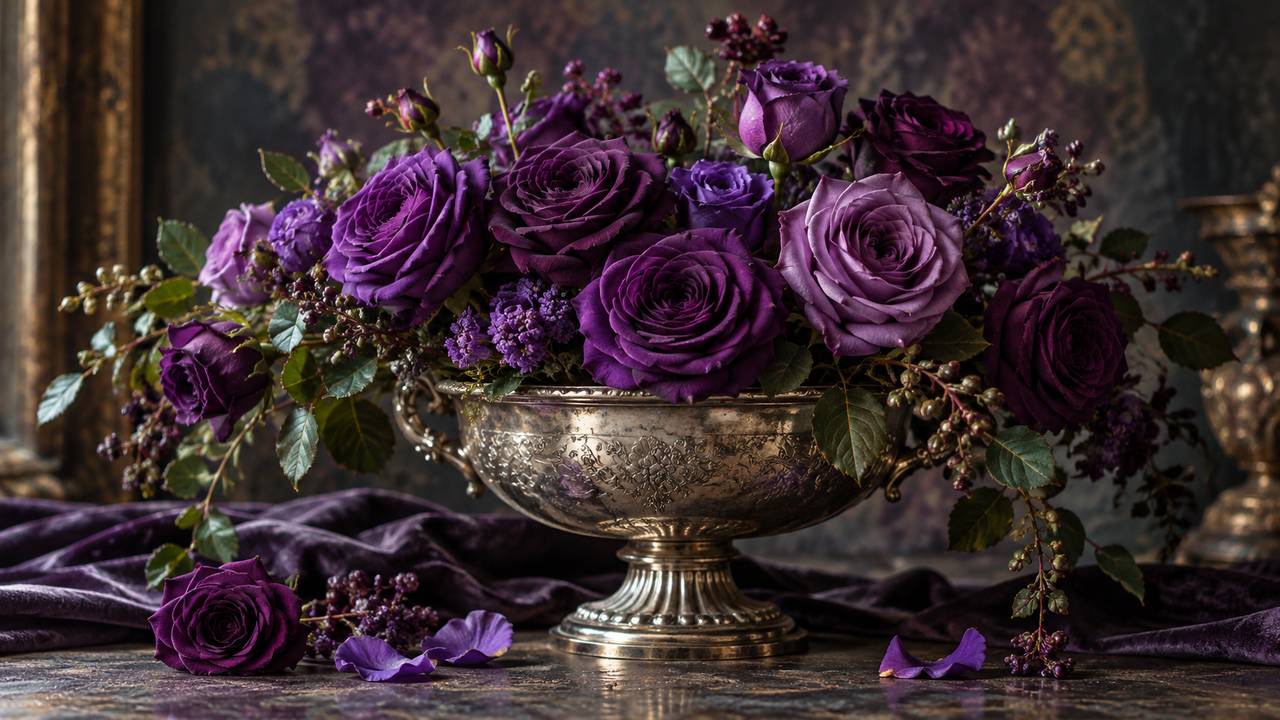
The primary meanings of violet roses are spiritual wisdom, royalty, enchantment, heightened intuition, and rare love. Their symbolism is more contemplative than the direct passion of red roses and more mysterious than the gentle affection conveyed by pink ones. A violet rose suggests that the recipient possesses unusual depth, magnetic individuality, or a refined understanding of life.
- Spiritual wisdom: Violet roses evoke contemplation, higher consciousness, prayer, and the search for meaning beyond ordinary appearances.
- Royalty and dignity: Purple dyes were historically expensive, making violet shades emblems of sovereign power, prestige, and elevated social standing.
- Intuition: In modern spiritual color systems, violet is connected with insight, imagination, and sensitivity to subtle emotions.
- Enchantment: Lavender and violet roses often signify fascination, wonder, or the feeling of being irresistibly drawn to someone.
- Transformation: Because violet sits symbolically between warm red and cool blue, it can represent the reconciliation of passion and calm, or the passage from one life chapter to another.
- Individuality: Their uncommon color honors people who resist convention and follow an original path.
Historical and Cultural Interpretations
Royal Purple and the Ancient World
Ancient roses were prized throughout Persia, Greece, Rome, and the eastern Mediterranean, but true violet cultivars did not exist in the form familiar to modern floristry. The flower’s royal meaning comes chiefly from the history of purple itself. Tyrian purple, made from marine mollusks, required immense labor and became a luxury reserved for rulers, magistrates, and wealthy elites. When purple tones appear in a rose today, they inherit this visual language of sovereignty and privilege.
Religion, Mysticism, and Spiritual Authority
In Christian liturgical tradition, violet signifies penitence, solemn preparation, and spiritual reflection, particularly during Advent and Lent. In esoteric and New Age systems, violet is associated with the crown chakra, transcendence, and expanded awareness. A violet rose can therefore communicate reverence for a spiritual teacher, gratitude after a period of healing, or recognition of someone’s intuitive gifts. It should not, however, be presented as the universal symbol of a single religion; its spiritual meaning changes according to personal and cultural context.
Victorian Floriography and Modern Romance
Victorian flower dictionaries assigned detailed messages to roses, but many modern claims about “violet roses” are retrospective because deeply purple garden roses were not widely available. The symbolism developed from older associations of purple with majesty and from the language attached to lavender hues, especially wonder and distinction. Twentieth- and twenty-first-century floristry strengthened the romantic interpretation: lavender or violet roses now commonly express enchantment, love at first sight, and fascination with someone exceptional.
This is a more mysterious declaration than the warmth associated with salmon rose meaning, which often balances friendship and desire. It is also less nostalgic than dusty rose colors, whose muted character suggests memory, mature affection, and understated romance.
Meanings by Shade and Presentation
| Violet Rose Style | Principal Meaning | Best Occasion |
|---|---|---|
| Pale lavender | Enchantment, graceful admiration, new fascination | Early romance, congratulations, creative milestones |
| Clear violet | Intuition, spiritual insight, individuality | Retreats, ordinations, personal transformations |
| Deep purple | Royalty, achievement, dignity, mature devotion | Promotions, anniversaries, formal celebrations |
| Smoky mauve | Memory, sophistication, reflective love | Milestone birthdays, reunions, remembrance |
| Dyed electric violet | Fantasy, theatricality, bold self-expression | Theme parties, performances, unconventional gifts |
Shade changes emotional intensity. Pale lavender feels airy, romantic, and approachable, while saturated purple communicates grandeur and confidence. Mauve introduces restraint and nostalgia. A single violet rose can suggest private fascination; a dozen makes a pronounced romantic or ceremonial statement. Mixed bouquets soften the message and allow the giver to create a more specific emotional vocabulary.
When and to Whom Should You Give Violet Roses?
Violet roses suit recipients who value symbolism, originality, art, or spirituality. Give them to a romantic partner when you want to say, “You fascinate me,” particularly at the beginning of a relationship or during an anniversary that celebrates renewed wonder. They are also appropriate for mentors, artists, counselors, spiritual teachers, graduates, or friends entering a transformative stage.
For professional occasions, choose a restrained arrangement of deep purple roses with elegant foliage. This communicates esteem without necessarily implying romance. For sympathy, use dusty lavender or mauve roses rather than brilliant dyed violet; subdued colors convey dignity and reflection. Violet roses can also honor retirement, recovery, a creative debut, a meditation retreat, or the completion of demanding personal work.
Modern Etiquette
- Include a note clarifying your intention when the relationship is new or non-romantic, since lavender roses can imply enchantment or love at first sight.
- Choose naturally lavender cultivars for formal, sustainable, or botanically minded recipients; intensely dyed roses may appear playful rather than traditional.
- Avoid highly romantic wrapping for workplace gifts. Matte paper, a simple vase, and botanical greenery keep the gesture professional.
- For bereavement, confirm local customs and the family’s preferences. Violet can be spiritually comforting, but some cultures favor white funeral flowers.
- Consider fragrance sensitivity and hospital restrictions before sending a large arrangement.
Companion Flowers and Bouquet Styling
Violet roses pair beautifully with flowers that clarify their message. Combine them with pale pink roses for tender admiration and emerging romance. Add white lisianthus, sweet peas, or ranunculus for an ethereal wedding arrangement. For composed elegance, cream rose symbolism introduces warmth, thoughtfulness, and grace without competing with violet’s mystery.
Silver foliage, dusty miller, eucalyptus, and olive leaves enhance cool violet tones. Delphiniums add height and ceremony, while clematis creates a loose, garden-like silhouette. For an autumnal design, combine plum roses with burgundy dahlias, copper foliage, and chocolate cosmos. Avoid mixing too many saturated jewel tones unless the desired effect is theatrical; violet appears most sophisticated when balanced by cream, blush, soft green, or restrained burgundy.
Botanical Care and Vase Longevity
Most cut lavender and purple roses last approximately five to ten days, depending on cultivar, freshness, and care. Select stems with firm necks, unblemished outer petals, and buds that are beginning to loosen. Remove foliage that would sit below the waterline, then recut one to two centimeters from each stem at a diagonal with clean, sharp shears.
Place the roses promptly in a disinfected vase filled with fresh water and commercial flower food. Keep them away from direct sun, radiators, drafts, and ripening fruit, which releases ethylene gas and accelerates aging. Change the water every one or two days, rinse the vase, and recut the stems if they become sealed or soft. If the roses are dyed, protect pale linens and porous surfaces because colored water may stain.
Gardeners seeking violet effects should select named lavender, lilac, or mauve cultivars suited to their climate rather than expecting a genetically pure violet-blue rose. Rose color is influenced by anthocyanin pigments, soil conditions, temperature, light, and flower age. Good air circulation, at least six hours of sun, deep watering at soil level, and regular removal of diseased foliage support healthy growth and stronger blooms.
The Enduring Message of Violet Roses
The violet rose meaning unites rarity, spiritual perception, royal dignity, and emotional enchantment. It can honor an intuitive friend, celebrate an unconventional love, recognize hard-won wisdom, or mark a profound transition. Its message becomes most powerful when the precise shade, bouquet companions, occasion, and recipient are considered together. Whether naturally lavender, richly plum, or artistically tinted, the violet rose does not speak of ordinary affection: it recognizes a person or moment that feels singular, elevated, and unforgettable.