Table of Contents
Peace Rose Meaning: Historical Reconciliation, Global Hope, and Serenity
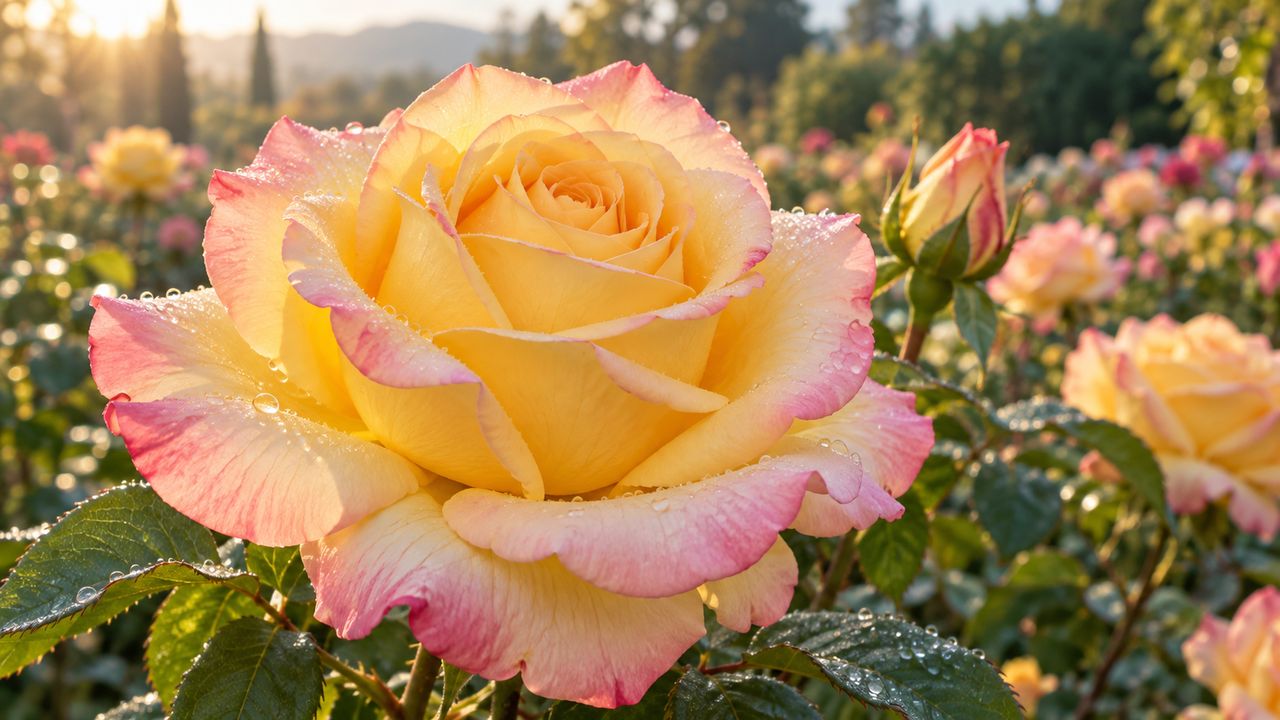
The peace rose meaning is unusually rich because it belongs not only to flower symbolism but also to documented world history. The celebrated hybrid tea rose known as ‘Peace’ bears luminous yellow petals brushed with pink, a combination often interpreted as hope emerging from hardship, friendship tempered by compassion, and serenity restored after conflict. Unlike many floral meanings that accumulated anonymously over centuries, this rose’s identity is closely connected to the end of the Second World War.
Botanically, the Peace rose is a large-flowered hybrid tea cultivar developed by French rose breeder Francis Meilland. Its high-centered blossoms open into broad, softly cupped flowers, often reaching 12 to 15 centimeters across. Color varies with climate and maturity: buds may appear golden yellow with vivid rose-pink edges, while fully opened flowers often fade to cream, ivory, and blush. This gradual transformation gives the rose much of its emotional nuance. It does not symbolize peace as passive silence, but as something living, vulnerable, and continuously renewed.
The Historical Origin of the Peace Rose
Francis Meilland selected the seedling that would become Peace in France during the 1930s. As war threatened Europe, cuttings were sent to growers in other countries so the cultivar might survive if the Meilland nursery were destroyed. The rose consequently acquired different early names: ‘Madame A. Meilland’ in France, honoring Francis’s mother; ‘Gloria Dei,’ or “Glory of God,” in Germany; and ‘Gioia,’ meaning “joy,” in Italy.
In the United States, the Conard-Pyle Company introduced it as ‘Peace’ on April 29, 1945—the day Berlin fell to Allied forces. Later that year, roses were presented to delegates at the opening conference of the United Nations in San Francisco, accompanied by a message expressing hope for everlasting world peace. These associations transformed an exceptional garden rose into an international emblem of reconciliation. It came to represent not victory over an enemy, but the more difficult work of rebuilding trust after devastation.
Primary Meanings and Symbolism
- Reconciliation: Peace roses acknowledge conflict while expressing a sincere desire to repair a relationship.
- Global hope: Their wartime history makes them appropriate symbols of diplomacy, humanitarian ideals, and cooperation between nations.
- Serenity: The gentle transition from yellow to blush suggests emotional calm, relief, and the return of inner balance.
- Remembrance: They honor lives affected by war without emphasizing grief alone; their message includes renewal and a better future.
- Friendship and compassion: Yellow traditionally conveys friendship, while pink contributes tenderness, gratitude, and empathetic affection.
- Resilience: The survival and international preservation of the cultivar symbolize beauty protected through danger.
In Victorian floriography, the Peace cultivar did not yet exist, but its colors draw upon older conventions. Yellow roses once carried inconsistent meanings, including jealousy in some nineteenth-century dictionaries, yet modern Western usage strongly favors friendship, warmth, and happiness. Pink signifies grace and gentle affection, while cream suggests thoughtfulness and refinement. Peace therefore unites several emotional registers rather than delivering the romantic declaration associated with a red rose.
Color, Form, and Cultural Interpretation
No two Peace blooms look precisely alike. A flower with a golden center and strong cerise margins feels optimistic and celebratory. A paler bloom, fading toward ivory with a faint pink edge, communicates quiet remembrance, forgiveness, or spiritual calm. Warm weather may intensify pink edging, whereas growing conditions, season, and bloom age can soften the entire flower.
This color sensitivity matters in bouquets. Strongly pink Peace roses can bridge yellow flowers with coral or salmon varieties; exploring salmon rose meaning helps distinguish energetic affection from Peace’s more reflective message. Muted arrangements inspired by dusty rose colors emphasize memory and mature romance. Pairing Peace with pale pink roses adds admiration and sweetness, while cream rose symbolism reinforces grace, consideration, and understated elegance.
Culturally, Peace is particularly resonant in European and North American commemorations because of its Second World War associations. In international or interfaith settings, it can function as a nonsectarian emblem of shared humanity. In East Asian-inspired floral design, a single carefully positioned bloom may suggest harmony through restraint and space. Nevertheless, customs differ: recipients may not know the cultivar’s history, so a brief card explaining its significance is both helpful and gracious.
| Context | Principal Message | Recommended Presentation |
|---|---|---|
| Reconciliation | Forgiveness, humility, and renewed trust | Three or five blooms with olive or eucalyptus |
| Memorial | Remembrance joined with hope | Pale blooms with white stock or lilies |
| Friendship | Loyalty, warmth, and gratitude | Bright yellow-pink blooms in a garden-style bouquet |
| Wedding or anniversary | A harmonious life and enduring partnership | Peace roses with cream and blush companions |
| Diplomatic or civic event | Cooperation and common purpose | A potted rose or formally arranged stems |
When and How to Give Peace Roses
Peace roses are especially suitable after an argument, during mediation, or when contact is being gently restored. Give them to a partner, relative, friend, colleague, or community leader when the intention is sincere reconciliation rather than pressure for immediate forgiveness. A card might say, “With hope for understanding and a peaceful new beginning.” Avoid language that minimizes the original hurt.
They are also thoughtful for remembrance ceremonies, armistice observances, retirements from public service, diplomatic gatherings, housewarmings, and recovery from illness. At weddings, they represent harmony and the ability to meet difficulty with grace. For bereavement, choose paler blooms and restrained foliage; their hopeful character can comfort, but local religious and funeral customs should always be respected.
Modern etiquette favors clarity. If sending cut flowers, identify them as the historic Peace rose rather than merely “peace-colored roses.” For apologies, include a direct personal note: flowers should support accountability, not replace it. A living potted specimen is ideal for gardeners and commemorative planting, but confirm that the recipient has suitable space, sunlight, and interest in ongoing care.
Companion Flowers and Bouquet Styling
White lilies add solemnity and renewal, making them effective for memorial designs. Olive branches provide an immediately recognizable peace motif, though silvery eucalyptus is often easier for florists to source. White stock contributes fragrance and sincerity; chamomile or feverfew creates a gentler cottage-garden mood. Delphiniums introduce blue, a color associated with trust and tranquility, while blush peonies make wedding arrangements abundant and romantic.
Allow Peace roses visual room. Their large, multicolored blooms can become muddled among too many competing flowers. For a modern arrangement, group five to seven roses asymmetrically with airy foliage in a low ceramic vessel. For formal occasions, use long stems with cream roses and minimal greenery. Avoid pairing them with an overwhelming mass of deep red roses unless romantic passion is intentionally part of the message.
Care, Vase Life, and Cultivation
For cut stems, use a clean vase and fresh lukewarm water with floral preservative. Recut 2 to 3 centimeters from each stem at an angle, remove foliage below the waterline, and keep the arrangement away from direct sun, heaters, ripening fruit, and drafts. Refresh the water every two days. With good care, blooms commonly remain attractive for about five to seven days, although garden-cut flowers vary.
In cultivation, Peace performs best in fertile, well-drained soil with at least six hours of sun and good air circulation. Water deeply at soil level rather than repeatedly wetting the foliage. Mulch to moderate moisture and temperature, feed during active growth according to local conditions, and prune dead, damaged, or crossing wood in the appropriate season. Like many hybrid teas, it may require monitoring for black spot, mildew, aphids, and other regional problems.
A Living Emblem of Hope
The enduring peace rose meaning comes from the union of history, color, and living beauty. Its golden heart suggests hope and friendship; its pink margins add compassion; its fading cream tones evoke calm, memory, and grace. Whether offered after conflict, planted as a memorial, or carried at a wedding, the Peace rose communicates an ideal that remains both intimate and global: harmony is precious, reconciliation requires care, and hope can survive even the darkest season.