Table of Contents
Pairing Roses with Bleached Ruscus: Bohemian Modernity and Neutral Aesthetics
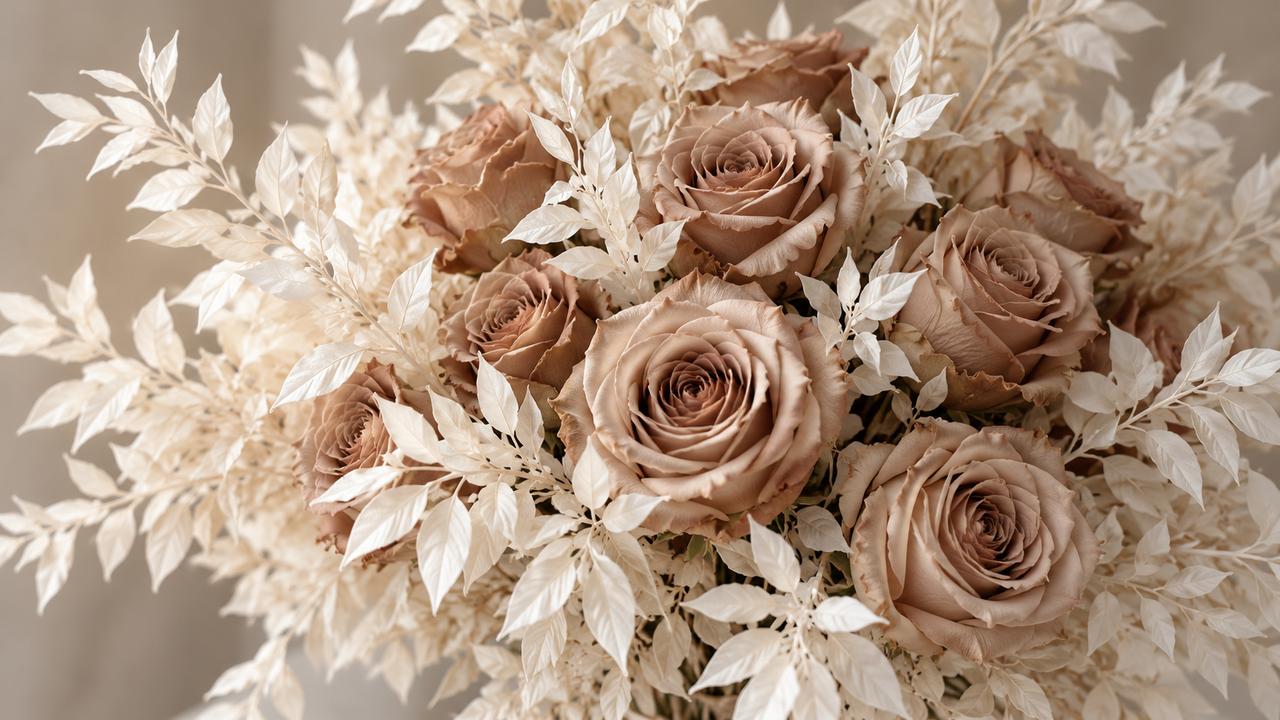
The art of bleached ruscus with roses styling brings together two contrasting floral languages. Roses carry centuries of romantic, religious, political, and personal symbolism, while bleached ruscus supplies an airy, sculptural framework associated with contemporary bohemian design. One is soft, fragrant, and emotionally explicit; the other is pale, architectural, and deliberately understated. Their union creates arrangements that feel at once historical and modern.
Roses belong primarily to the genus Rosa, a diverse group of woody perennials cultivated across Asia, Europe, the Middle East, and North America. Ruscus, by contrast, is an evergreen Mediterranean genus whose apparent “leaves” are flattened stems called cladodes. Most bleached ruscus sold by florists has been cut, chemically lightened, preserved, and sometimes dyed ivory or champagne. It is therefore not a naturally white variety but a botanical material transformed for decorative use.
From Ancient Roses to Modern Neutral Floristry
Roses were associated with Aphrodite and Venus in the classical Mediterranean world, while Roman banquets used rose petals to communicate luxury, pleasure, and confidentiality. The expression sub rosa, or “under the rose,” came to signify secrecy. In medieval Europe, roses acquired Christian meanings: the white rose suggested purity and the red rose sacrifice, martyrdom, or divine love. Roses later became political emblems, most famously in the dynastic symbolism retrospectively attached to England’s Wars of the Roses.
During the nineteenth-century fashion for floriography, especially in Britain, France, and the United States, rose color, maturity, and presentation could modify a message. A red rosebud did not communicate precisely the same sentiment as an open red rose, and a thornless rose might imply love at first sight. Flower dictionaries were never entirely standardized, but they encouraged people to read bouquets as emotional compositions rather than simple decorations.
Ruscus has a quieter symbolic record. As a hardy evergreen, it can suggest endurance, protection, continuity, and resourcefulness. Species such as butcher’s broom, Ruscus aculeatus, were historically used in European households and shops, while the plant also had a place in traditional herbal practice. Bleached ruscus itself belongs to a much newer design vocabulary. Its ivory color removes the foliage’s natural green vitality and replaces it with associations of stillness, minimalism, memory, and permanence. In twenty-first-century weddings and interiors, it often represents refined neutrality rather than a fixed traditional message.
Core Meaning of the Pairing
Roses surrounded by bleached ruscus can be interpreted as living emotion held within calm structure. The rose supplies warmth and vulnerability; the preserved foliage contributes resilience and composure. Because the ruscus is pale and long-lasting, it may also evoke a treasured feeling preserved beyond a particular season.
The emotional balance changes dramatically with rose color. Ivory and cream roses create the most harmonious tonal effect. Their associations with grace, consideration, and understated affection are explored further in this guide to cream rose symbolism. Blush roses make the composition tender and romantic, while terracotta, toffee, or dusty peach roses lend an earthy, fashion-forward mood. Deep burgundy roses create dramatic contrast and can imply devotion, maturity, or sensuality.
| Rose choice | Combined symbolism | Best context | Styling direction |
|---|---|---|---|
| Cream or ivory | Grace, thoughtfulness, serenity | Weddings, thanks, elegant sympathy | Soft, tonal, and minimal |
| Blush pink | Gentle romance, admiration, sweetness | Engagements, anniversaries, new babies | Garden-inspired and airy |
| Toffee or terracotta | Warmth, stability, mature affection | Autumn weddings, housewarmings | Earthy, bohemian, textural |
| Red or burgundy | Passion tempered by permanence | Romantic milestones, winter events | Dramatic and editorial |
| Black or near-black | Transformation, farewell, mystery | Alternative ceremonies, artistic gifts | Gothic and high contrast |
Unusual Colors and Cultural Interpretations
Novelty roses require careful interpretation. Multicolored petals can introduce exuberance into the restrained palette; the rainbow rose meaning centers on joy, individuality, and celebration, making it suitable for playful events rather than solemn occasions. Dyed blue roses carry associations of rarity and the impossible. Paired with pale ruscus, the blue rose mystery becomes dreamlike and surreal.
So-called black roses are generally extremely dark red or purple cultivars, or artificially colored flowers. Their significance varies from grief and finality to rebellion and renewal. Understanding the black rose meaning is especially important before gifting them, since one recipient may see sophisticated transformation while another perceives mourning.
Cultural context should always take precedence over a generalized flower dictionary. Red roses are widely romantic in Western gift culture, but colors may carry additional familial, religious, or ceremonial meanings elsewhere. White flowers are bridal symbols in many Western settings yet are closely connected with funerals and mourning in parts of East Asia. A neutral arrangement is not automatically culturally neutral.
Occasions, Recipients, and Modern Etiquette
- Weddings: Cream, blush, and muted apricot roses with bleached ruscus suit bohemian, coastal, minimalist, and desert-inspired ceremonies. Confirm that preserved foliage is permitted at the venue.
- Anniversaries: Choose the recipient’s preferred rose color rather than relying solely on conventional symbolism. Red expresses passion; dusty pink or caramel feels intimate but less formal.
- Housewarmings: A vase-ready arrangement in cream and warm beige complements neutral interiors and communicates welcome without romantic overtones.
- Sympathy: Use restrained ivory roses and only a modest amount of bleached material. Include a clear personal note so the arrangement’s pale palette conveys remembrance rather than impersonality.
- Birthdays and congratulations: Peach, yellow, or multicolored roses prevent the bouquet from appearing bridal and introduce optimism.
For a new romantic relationship, avoid an oversized arrangement unless grand gestures are already welcome. For professional gifts, cream, peach, or soft yellow roses are generally more appropriate than scarlet. Ask about fragrance sensitivity, pets, and cultural preferences. Bleached foliage may retain a processing odor or shed pale residue, so it is not ideal near food, infant spaces, or anyone with chemical sensitivities.
Companion Flowers and Composition
For a soft garden bouquet, combine roses with ranunculus, lisianthus, sweet peas, or spray roses. Dried lunaria adds translucent discs, while bunny tails, pampas grass, and bleached fern strengthen the bohemian character. Use these materials sparingly: too many beige textures can flatten the roses and make the bouquet appear dusty rather than intentional.
Build visual hierarchy by placing three to seven focal roses at varied depths, then allowing ruscus stems to extend beyond the flower heads. A hand-tied bouquet benefits from asymmetry, negative space, and one or two directional branches. For a cleaner modern arrangement, group roses in blocks instead of distributing every color evenly. Matte ceramic, smoked glass, stoneware, and aged brass vessels complement the neutral palette particularly well.
Fresh green foliage can keep the composition botanically grounded. Olive, eucalyptus, jasmine vine, or delicate pittosporum provides a bridge between living roses and preserved ruscus. Avoid overcrowding the vase neck; bleached ruscus is most expressive when its branching silhouette remains visible.
Care, Longevity, and Handling
Recut fresh rose stems at an angle with clean, sharp shears and remove all leaves that would sit below the waterline. Place them promptly in a sanitized vase containing fresh water and correctly measured floral preservative. Change the water every one to two days, recut the stems as needed, and keep the arrangement away from direct sun, heaters, drafts, and ripening fruit, which releases ethylene gas and accelerates aging.
Preserved bleached ruscus does not need water, although its stems can usually share a vase with fresh roses. Keep its foliage above the waterline to reduce discoloration and transfer of processing residue. If possible, insert it after the hydrated flowers are arranged. Never mist it: moisture and high humidity may cause spotting, softening, color bleed, or mildew. After the roses fade, remove the ruscus, let the stems dry completely, and display them separately. With gentle handling and protection from sunlight, preserved stems may remain decorative for months or longer.
A Lasting Floral Dialogue
Pairing roses with bleached ruscus succeeds because it balances opposites: fragrance and restraint, softness and structure, fleeting bloom and preserved form. Thoughtful color selection determines whether the result feels romantic, consoling, celebratory, or avant-garde. By respecting cultural context, handling the treated foliage carefully, and giving the roses enough space to remain the emotional focus, this distinctive combination becomes more than a neutral trend. It is a layered floral dialogue between inherited symbolism and contemporary bohemian modernity.