Table of Contents
Koko Loko Rose: The Mesmerizing Milk Chocolate to Lavender Tan Chameleon
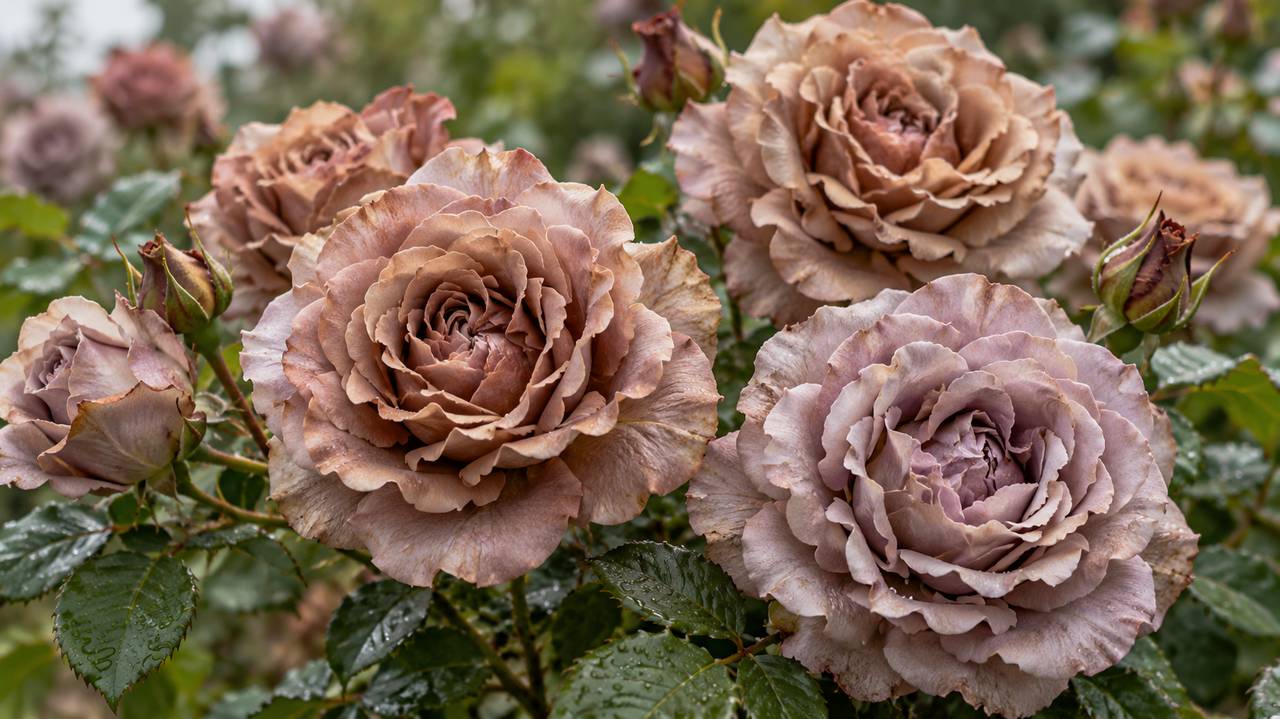
Few roses transform as dramatically—or inspire as much curiosity—as the Koko Loko rose. Its buds often begin in a warm café-au-lait, cocoa, or milk-chocolate tone, then unfurl into smoky beige before fading toward lavender, mauve, and parchment-tan. Because several stages may appear on one flowering plant, a single cluster can resemble an artfully arranged antique bouquet.
Koko Loko is a modern floribunda rose bred by Christian Bédard in the United States and introduced by Weeks Roses in the early 2010s. It is commonly associated with the parentage of the lavender-flowered ‘Blueberry Hill’ and the golden-yellow ‘Pot O’ Gold.’ The result is a compact, repeat-flowering shrub whose unusual coloring bridges warm brown and cool lilac. Although Koko Loko has no separate entry in traditional Victorian flower dictionaries—it was created long after that era—its symbolism can be interpreted through historical rose lore, modern color psychology, and the emotional effect of its changing shades.
Primary Meaning: Transformation with Grace
The central meaning of the Koko Loko rose is graceful transformation. Its flowers do not remain visually fixed: their coloring develops as they mature, moving from creamy coffee and cocoa toward dusty lavender. This makes the rose an eloquent emblem of personal growth, changing identity, recovery, and the beauty of life’s transitions.
Unlike a conventional red rose, which makes an immediate declaration of passion, Koko Loko speaks in subtler language. It suggests, “I appreciate every version of you,” or “Change has made you more beautiful, not less.” It is especially meaningful for someone beginning a new chapter after uncertainty, completing a difficult period, or learning to embrace maturity.
Symbolism of Mystery, Individuality, and Refined Affection
Brown roses do not exist as a simple, naturally occurring chocolate pigment; what the eye reads as brown usually results from complex blends of muted red, yellow, mauve, and beige. In Koko Loko, this optical complexity contributes to associations with mystery and individuality. The bloom resists an easy color label, making it suitable for people whose character cannot be reduced to a single role or expectation.
Its smoky neutrality also gives it a cultivated, old-world elegance. While the burgundy rose passion tradition conveys deep desire and mature beauty, Koko Loko expresses affection in a quieter register: thoughtful admiration, emotional intelligence, and intimacy built through understanding. It can be romantic without being flamboyant and luxurious without appearing ostentatious.
The flower’s shadowed tones occasionally invite comparison with so-called black roses. Yet the black rose meaning is more closely connected with endings, mourning, rebellion, and rebirth. Koko Loko is softer and less final. Rather than symbolizing an ending, it represents the nuanced middle ground in which one state gradually becomes another.
How Its Changing Shades Affect the Message
Color varies with bloom age, temperature, light, soil conditions, and season. Cooler weather often encourages richer mauve, mocha, or lavender notes, while heat may produce paler tan, blush, and gray-beige flowers. This variation is not a defect; it is the defining charm of the cultivar.
| Shade or Stage | Symbolic Interpretation | Best Bouquet Context |
|---|---|---|
| Milk chocolate or café-au-lait bud | Warmth, reliability, grounded affection | Thank-you gifts, autumn arrangements, intimate romance |
| Caramel, taupe, or mushroom | Sophistication, composure, unconventional taste | Professional milestones, housewarmings, modern weddings |
| Smoky mauve or lavender | Enchantment, intuition, emotional depth | Anniversaries, artistic celebrations, romantic gestures |
| Faded parchment or antique blush | Memory, maturity, enduring beauty | Renewal of vows, remembrance, milestone birthdays |
Historical and Cultural Interpretation
In nineteenth-century European and American floriography, roses were interpreted principally by species, color, and presentation. Red signified love, white innocence, pink admiration, and yellow meanings ranged from jealousy to diminished affection. Modern culture has largely rehabilitated yellow as a color of happiness and companionship, as reflected in contemporary discussions of yellow rose meaning.
Koko Loko belongs to a newer floral vocabulary shaped by hybridization and design culture. Its muted palette resonates with contemporary preferences for authenticity, natural textures, and understated luxury. In Western weddings, it can symbolize mature commitment rather than fairy-tale infatuation. In Japanese-inspired minimalist arrangements, its changing form and subdued color can evoke transience and an appreciation of imperfect, passing beauty. These are sensitive modern interpretations, not rigid historical customs.
Across cultures, brown is commonly connected with earth, stability, humility, and nourishment, while lavender suggests refinement, spirituality, and fascination. Koko Loko unites these associations: it is simultaneously grounded and dreamlike. By contrast, the warm exuberance described by coral rose symbolism is more animated and openly social. Pairing coral and Koko Loko roses creates a compelling message of enthusiasm tempered by wisdom.
When to Give Koko Loko Roses
- Anniversaries: Give them to a long-term partner to honor love that has deepened and changed over time.
- Career transitions: They recognize promotion, retirement, graduation, or a courageous professional reinvention.
- Milestone birthdays: Their mature palette suits recipients who value artistry, gardening, interiors, or unusual flowers.
- Housewarmings: Taupe and lavender blooms convey comfort, stability, and sophisticated new beginnings.
- Recovery and encouragement: Their gradual transformation can gently acknowledge resilience without the cheerfulness feeling forced.
- Weddings: They are particularly effective in autumn, bohemian, vintage, editorial, and neutral-toned ceremonies.
Modern etiquette depends on clarity. Because brownish flowers can be interpreted as faded or somber by someone unfamiliar with the cultivar, include a note explaining their meaning. A message such as “For the beauty of every new chapter” prevents misunderstanding. For romance, choose an odd-numbered hand-tied bouquet or combine Koko Loko with warmer blooms. For condolences, use restrained foliage and avoid describing the color as “dead” or “faded”; terms such as antique mauve, cocoa, and café-au-lait are more gracious.
Companion Flowers and Bouquet Styling
Koko Loko’s nuanced color is easily overwhelmed by highly saturated flowers, so let it serve as the visual center. Cream garden roses, ivory ranunculus, white lisianthus, blush spray roses, and pale sweet peas preserve its quiet elegance. Lavender, lilac, scabiosa, or mauve stock draw out its cool undertones, while apricot ranunculus and muted coral roses reveal its caramel warmth.
For texture, add chocolate cosmos, burgundy dahlias, astrantia, smokebush, or dried seed heads. Eucalyptus, olive, dusty miller, and jasmine vine provide complementary gray-green foliage. Avoid crowding the arrangement: negative space allows each stage of the chameleon coloring to remain visible. A matte ceramic vessel, aged brass urn, smoke-gray glass vase, or simple stoneware pitcher enhances the rose more effectively than bright primary-colored containers.
Botanical Care and Cultivation
Koko Loko is a floribunda, typically producing flowers in clusters on a bushy plant approximately 90 to 120 centimeters tall, though size varies by climate and pruning. It performs best with at least six hours of direct sun, fertile well-drained soil, and consistent deep watering. In very hot regions, light afternoon shade can protect petals from scorching and slow rapid fading.
Mulch around the root zone while keeping mulch away from the crown. Feed with a balanced rose fertilizer as active growth begins and repeat according to the product label. Deadhead spent clusters to encourage repeat bloom, cutting back to a healthy outward-facing leaf. Maintain airflow and water at soil level to reduce black spot and powdery mildew; local disease pressure will determine whether additional treatment is necessary.
For cut flowers, harvest when the sepals have lowered and the outer petals are beginning to loosen. Use clean shears, recut stems at an angle, and remove all foliage below the waterline. Place the stems promptly in a disinfected vase with fresh water and commercial flower food. Change the solution every two days and keep the arrangement away from direct sun, heaters, drafts, and ripening fruit. With careful conditioning, vase life is commonly around five to seven days, sometimes longer when stems are freshly harvested.
A Rose for Beautiful Complexity
The Koko Loko rose is compelling not because it carries one fixed message, but because it embodies emotional complexity. Cocoa warmth becomes smoky lavender; novelty settles into elegance; and each bloom records time through color. Whether planted in a garden, carried in a bridal bouquet, or offered to mark a personal transformation, it communicates admiration for beauty that evolves. For recipients who value subtlety, individuality, and stories without simple endings, few roses speak more eloquently.