Table of Contents
Bi-Color Rose Meaning: Decoding the Symbolism of Petals with Two Distinct Hues
Roses have long served as nature’s ultimate canvas for human emotion, diplomacy, and artistic expression. While single-colored blooms tell a straightforward story—red for passionate love, yellow for friendship, and white for purity—the natural world and modern floriculture frequently produce something far more complex. The bi-color rose meaning: decoding the symbolism of petals with two distinct hues opens up an entirely new dimension of floral language. When a single blossom features a dynamic contrast of dual colors, it moves past basic emotions to represent duality, transitional feelings, complex relationships, and breathtaking visual harmony.
Whether created by Mother Nature’s genetic marvels or through artisan cultivation, these multi-hued florals command attention. To truly understand these blooms, we must look beyond their immediate aesthetic appeal and explore the historical context, horticultural science, and emotional weight carried by their contrasting petals. In this comprehensive guide, we will decode the layered messages behind bi-color roses, examining how specific color combinations alter their underlying meaning.
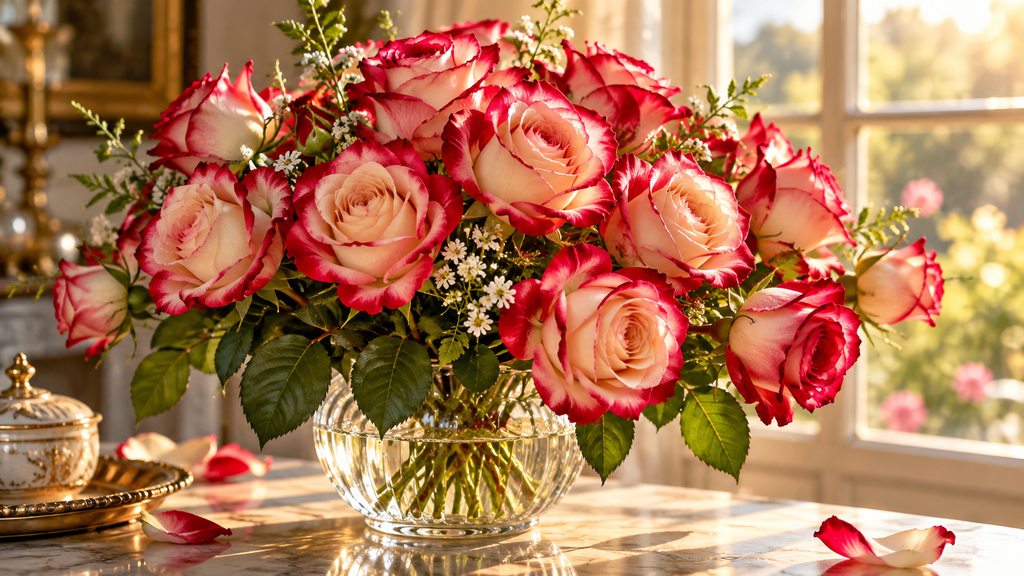
The Horticultural Marvel: Natural vs. Cultivated Bi-Color Roses
Before diving into the symbolic implications, it is vital to understand how bi-color roses come into existence. In the botanical world, dual-toned roses generally fall into two distinct categories: biological sports (natural mutations) and bred cultivars.
A “sporting” event occurs when a single bud on a rose bush suddenly mutates genetically, producing a branch with entirely different petal coloration from the rest of the plant. Master propagators then isolate these unique cuttings to establish a new stable variety. Alternatively, meticulous cross-pollination over generations yields hybrid roses designed specifically to exhibit striking edge coloration, reversed reverse-petals (where the underside contrasts with the face), or distinct gradient shifts. This scientific marvel mirrors the intricate artistry found in other unique floral variations, much like the vibrant expressions seen in the Rainbow Rose Meaning: Joy, Diversity, Celebration, and Modern Artistry, which celebrates the absolute spectrum of human emotion and artistic potential.
Core Symbolism: What Do Bi-Color Roses Generally Represent?
At their core, bi-color roses represent duality, balance, and multifaceted relationships. Because they feature two separate colors fused into a single organic structure, they are frequently used to express complex feelings that cannot be neatly summarized by a single shade. Common generalized meanings include:
- Duality and Balance: Representing the harmonious coexistence of two contrasting ideas, such as passion and innocence, or strength and vulnerability.
- Transition and Change: Capturing a moment of shifting dynamics within a personal journey or a relationship.
- Complexity of Emotion: Acknowledging that human feelings are rarely black-and-white; they often encompass multiple, simultaneous truths.
- Uniqueness and Individuality: Celebrating someone who stands out from the crowd and defies standard categorization.
However, to unlock the true message of a bi-color rose, one must analyze the specific pairing of the two hues. Just as darker, moody tones carry heavy historical weight—similar to the profound sentiments explored within the Black Rose Meaning: Myth, Mourning, Rebirth, and Gothic Romantic Symbolism—lighter or warmer dual-tones shift the conversation toward evolving affection and modern romance.
Decoding Specific Bi-Color Rose Combinations
The language of flowers (or floriography) relies heavily on color theory. When two distinct colors merge on a single rose, their individual meanings interact, sometimes blending harmoniously and other times creating a striking juxtaposition.
1. Red and White Bi-Color Roses
Perhaps the most famous bi-color combination is the red-and-white rose (often associated with historical emblems like the Wars of the Roses).
- Symbolism: Unity, coming together, and an alliance of passion (red) and purity or truth (white).
- Best Occasions: Weddings, anniversaries, or peace offerings where two distinct entities or families unite as one.
2. Yellow and Red Bi-Color Roses
Vibrant and eye-catching, these roses typically feature golden-yellow bases that bleed into fiery red margins or tips.
- Symbolism: Falling in love, the spark of transition from friendship to romance, and sheer jubilation.
- Best Occasions: Expressing a developing crush, or celebrating a joyous, energetic milestone. For those exploring gentle, emerging attachments, this tone shares conceptual territory with the delicate sentiments found in the Coral Rose Meaning and Symbolism: Modesty, Sympathy, and Emerging Romance.
3. Pink and White Bi-Color Roses
Soft, delicate, and immensely romantic, these roses feature gentle gradients of cream, ivory, and blush pink.
- Symbolism: Grace, elegance, gentle happiness, and innocent admiration.
- Best Occasions: Expressing appreciation for a mentor, celebrating a new baby, or conveying gentle, unassuming affection.
4. Deep Crimson and Dark Violet Bi-Color Roses
For those drawn to dramatic, moody aesthetics, dark bi-color variations offer an aura of mystery. They often complement the rich, velvety undertones celebrated in the Burgundy Rose Meaning: Deep Passion, Unconscious Beauty, and Victorian Allure, providing a sophisticated nod to Victorian-era floral poetry.
Comprehensive Reference Guide: Bi-Color Rose Meanings & Characteristics
To help you select the ideal bloom for your specific arrangement or message, consult the detailed reference table below detailing color pairings, primary symbolism, and ideal gifting contexts:
| Color Combination | Primary Symbolism | Emotional Message | Ideal Occasion |
|---|---|---|---|
| Red & White | Unity, Alliance, Harmony | “We are stronger together; our bond bridges different worlds.” | Weddings, Business Partnerships, Reconciliations |
| Yellow & Red | Joy, Transition, Awakening | “My feelings for you are shifting from friendship to passionate love.” | New Romances, Graduations, Celebrations |
| Pink & White | Innocence, Grace, Admiration | “I deeply admire your elegance, kindness, and gentle spirit.” | Mother’s Day, Birthdays, Expressing Gratitude |
| Orange & Yellow | Enthusiasm, Energy, Fascination | “You captivate my mind and fill my days with vibrant energy.” | Creative Collaborations, Encouragement |
| Burgundy & Pink | Deep Passion & Soft Affection | “My love is profound, yet tender and deeply respectful of you.” | Anniversaries, Long-Term Commitments |
| Purple & Lavender | Enchantment, Royalty, Mystery | “You possess a rare, magical quality that leaves me spellbound.” | Artistic Milestones, Unique Romantic Gestures |
Cultural and Historical Perceptions of Multi-Hued Florals
Throughout history, multi-colored flowers have held specialized places in cultural mythos. In Victorian England, where floriography reached its peak as a codified secret language, sending a mixed or bi-color rose required careful thought. A miscalculated stem could send an unintended mixed signal. While solid colors were preferred for direct declarations, bi-color roses were utilized by poets and aristocracy to express nuanced feelings—such as jealousy mixed with desire, or uncertainty paired with hope.
In modern floral design, bi-color roses break the monotony of traditional monochrome bouquets. Floral artists prize them for their ability to create natural depth and focal points within a larger arrangement without requiring secondary flower species. They serve as a bridge between contrasting color palettes, effortlessly tying together complementary or analogous design elements in high-end arrangements.
How to Style and Gift Bi-Color Roses Effectively
Gifting bi-color roses is an art form in itself. Because these blooms naturally draw the eye, they require thoughtful presentation to maximize their visual and emotional impact:
- Let Them Stand Alone: Because each individual rose tells a complex visual story, arranging a dozen bi-color roses in a simple, clear glass vase allows their unique petal patterns to take center stage.
- Match the Wrapper to the Minor Hue: When wrapping a bouquet, select tissue paper or ribbon that echoes the secondary accent color of the petals (e.g., pairing a yellow-and-red rose with a subtle golden ribbon) to create a cohesive, professional aesthetic.
- Include a Personalized Note: Because bi-color roses are rich in ambiguity, always include a handwritten card clarifying your intent. Let the recipient know whether the dual hues represent your journey together, your admiration for their complex personality, or simply the joy of their unique presence in your life.
Conclusion
The world of roses is vast, but few specimens capture the imagination quite like those adorned with two distinct hues. By examining the bi-color rose meaning: decoding the symbolism of petals with two distinct hues, we unlock a richer appreciation for nature’s complexity. These flowers remind us that beauty often lies in contrast, and that human relationships—much like the petals of a bi-color rose—are beautifully multifaceted, ever-changing, and wonderfully unique.