Table of Contents
Teal Rose Meaning: Calm Confidence, Deep Spiritual Connection, and Uniqueness
The teal rose meaning brings together two powerful visual languages: the rose’s long association with love, beauty, secrecy, and emotional devotion, and teal’s modern symbolism of tranquility, self-possession, renewal, and spiritual depth. The result is a flower that feels serene yet striking. A teal rose can say, “Your individuality is beautiful,” “I trust the path you are taking,” or “Our connection reaches beyond ordinary words.”
Unlike red, white, yellow, and pink roses, teal roses do not have a continuous historical tradition extending back through classical mythology or Victorian floriography. Teal-colored roses do not occur naturally: roses lack the genetic pathway needed to produce a true blue pigment, and no garden cultivar opens in a saturated blue-green teal. Florists create the color by dyeing fresh white or cream roses, tinting petals with floral spray, or preserving roses with colored glycerin solutions. Consequently, teal rose symbolism is a contemporary interpretation—one shaped by color psychology, modern floral design, and the ancient symbolic prestige of the rose itself.
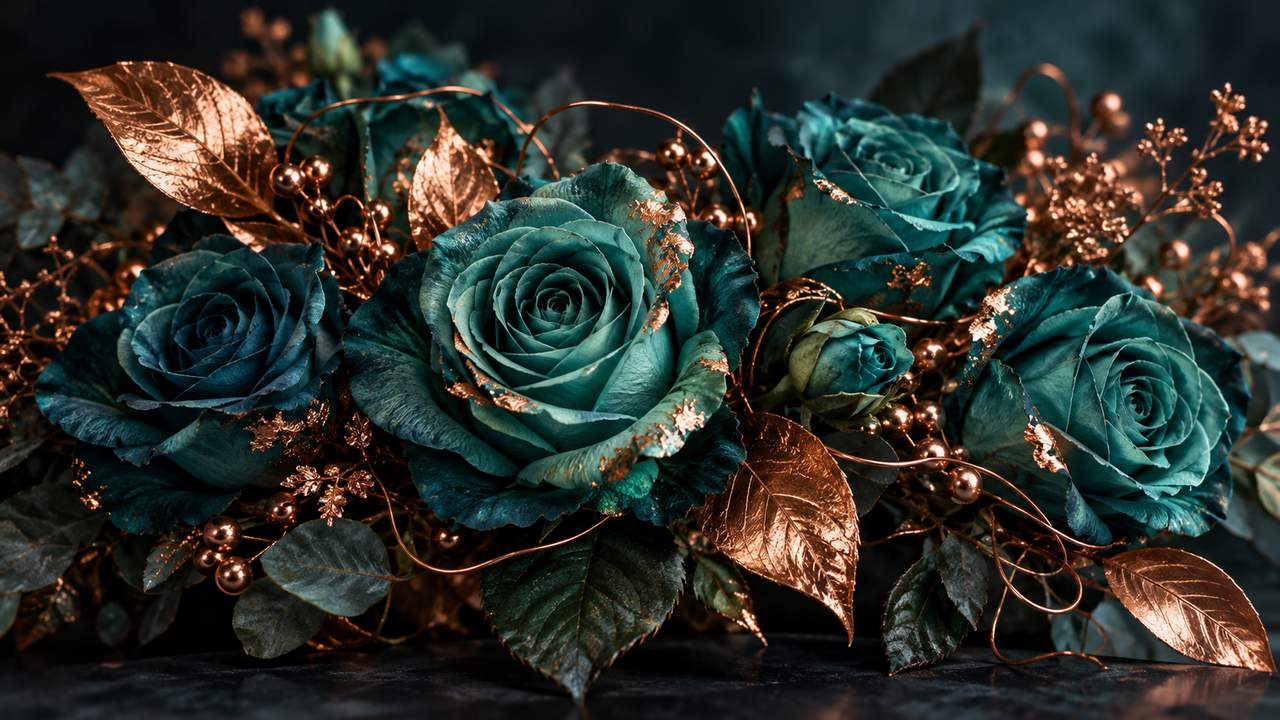
What Does a Teal Rose Mean?
At its heart, a teal rose represents calm confidence. Blue contributes peace, trust, contemplation, and emotional steadiness, while green suggests growth, restoration, balance, and life. Because teal sits between these two colors, it conveys a composed strength: confidence without arrogance, originality without restlessness, and sensitivity without fragility.
Teal roses are also associated with individuality and the courage to resist convention. Their visibly unusual color immediately separates them from familiar rose palettes. Giving one can honor a person who follows an independent path, has overcome pressure to conform, or expresses a distinctive creative identity.
- Calm confidence: Quiet strength, self-knowledge, emotional balance, and graceful leadership.
- Deep spiritual connection: Intuition, meditation, inner healing, and a bond that feels soulful or transcendent.
- Uniqueness: Originality, unconventional beauty, personal freedom, and authenticity.
- Renewal: Recovery, fresh perspective, emotional restoration, and movement into a healthier chapter.
- Mystery: The fascinating, rare, or seemingly impossible—an interpretation inherited partly from blue-flower symbolism.
- Trust and communication: Honest conversation, loyalty, and the safety to reveal one’s true self.
Historical and Cultural Context
Traditional European flower dictionaries of the nineteenth century assigned roses meanings according to established colors, species, and stages of bloom. Red commonly signified passionate love, white innocence, and yellow meanings ranged from jealousy to friendship depending on the source and period. Teal was not part of this standardized floral vocabulary. Modern readers interested in how yellow changed from a sometimes-ambivalent Victorian color into a cheerful emblem of companionship can compare the history of yellow rose meaning.
The broader idea of an impossible blue rose, however, has a long imaginative history. In literature and folklore, blue flowers often represent yearning for the unattainable, spiritual aspiration, mystery, or a miraculous achievement. Teal roses inherit some of this aura, but their green undertone makes them feel more restorative and grounded than vivid blue roses.
In contemporary Western gifting, teal is frequently linked with emotional wellness, coastal calm, and refined nonconformity. In spiritual and New Age color systems, it may be interpreted as bridging heart-centered green with communicative blue, suggesting compassionate truth. This is a modern association rather than an ancient universal doctrine. Cultural interpretations should therefore be offered thoughtfully, especially when a bouquet marks a religious or ceremonial event.
Elsewhere, turquoise and blue-green hues may evoke protective stones, water, craftsmanship, status, or regional identity. These associations vary widely; teal does not carry one fixed meaning across Asian, Middle Eastern, Indigenous, African, or Pacific cultures. The recipient’s personal and cultural relationship with the color should always take precedence over a generalized chart.
Teal Rose Shades and Their Messages
| Teal Variation | Primary Meaning | Best Occasion | Ideal Pairing |
|---|---|---|---|
| Pale aqua-teal | Peace, clarity, gentle renewal | Recovery, new home, self-care | White roses and eucalyptus |
| True blue-green teal | Balance, confidence, originality | Graduation or promotion | Cream ranunculus and greenery |
| Dark teal | Mystery, wisdom, deep loyalty | Milestone birthday or intimate event | Burgundy blooms and plum foliage |
| Teal with gold accents | Distinctive success and abundance | Achievement or luxury celebration | Champagne roses and dried grasses |
| Iridescent teal | Transformation, fantasy, creative freedom | Artistic launch or themed celebration | Delphinium and silver foliage |
When and to Whom Should You Give Teal Roses?
Teal roses suit people who appreciate symbolism, unusual design, or bold color. They are especially meaningful for artists, entrepreneurs, spiritual friends, mentors, and anyone beginning a new chapter. For a graduation, career change, business opening, or personal milestone, they praise both achievement and the courage required to pursue an original direction.
In romance, teal roses communicate fascination, trust, and a rare emotional bond rather than traditional passion. They work well for a partner whose favorite color is teal or for a relationship built on friendship and honest conversation. Include a note explaining your intention, since this color has no universally fixed romantic meaning.
For weddings, teal roses can represent a calm, distinctive partnership and coordinate beautifully with oceanic, jewel-toned, or Art Deco palettes. Combining them with ivory blooms introduces the purity and ceremonial grace associated with white rose symbolism. Champagne roses soften the contrast and add mature warmth; their associations are explored in this guide to champagne rose meaning.
Teal may be appropriate for encouragement during healing, particularly when it is a favorite color or represents an awareness cause meaningful to the recipient. It requires more caution at funerals. Because artificially colored roses can appear festive or highly stylized, consult the family or florist before using them. Traditional guidance on choosing roses for sympathy can help prevent an unintended message.
Modern Teal Rose Etiquette
- Explain the symbolism in a handwritten card rather than assuming the recipient knows it.
- Confirm that dyed flowers are acceptable for formal, religious, or memorial ceremonies.
- Warn recipients that heavily dyed petals or stem water may stain pale fabric and surfaces.
- Choose professionally tinted roses with even coloration and firm, unbruised guard petals.
- Avoid presenting teal roses as a rare natural variety; honesty about the coloring method preserves their meaning.
Companion Flowers and Bouquet Styling
For an airy, restorative arrangement, pair pale teal roses with white lisianthus, hydrangea, waxflower, and eucalyptus. A luxurious bouquet can combine deep teal with champagne roses, cream ranunculus, bronze foliage, and restrained gold ribbon. For dramatic evening florals, use burgundy dahlias, black-centered anemones, or plum calla lilies, allowing teal to act as a cool visual counterpoint.
Yellow roses add energetic warmth and make the message more clearly friendly. Coral blooms create a playful complementary contrast, while white flowers keep teal refined and meditative. Because teal is visually dominant, use it as a focal color rather than mixing it indiscriminately with many saturated hues. Matte foliage, natural linen, ceramic vessels, and minimal wrapping prevent the arrangement from looking artificial or costume-like.
Care, Longevity, and Botanical Reality
Fresh dyed teal roses generally last about five to ten days, depending on their age and coloring process. Recut one to two centimeters from each stem at a diagonal with clean shears, remove leaves below the waterline, and place the flowers in a thoroughly washed vase with fresh water and floral preservative. Keep them away from direct sun, heaters, ripening fruit, and strong drafts. Replace the water every two days; wear gloves if the dye transfers.
Some teal roses are created by placing pale roses in colored solution, which travels through the xylem into the petals. Others are surface-sprayed, producing a more uniform and saturated finish. Preserved teal roses may last one to three years when kept dry, shaded, and protected from humidity, but they should never be watered.
Gardeners should be wary of seeds advertised as producing naturally teal roses. No true teal rose cultivar currently grows from seed or cutting. Blue-lavender cultivars can provide a cool-toned starting point, but achieving teal still requires post-harvest coloring. Purchase from reputable growers and regard photographs of intensely teal garden roses with appropriate skepticism.
A Rare Color with a Clear Emotional Voice
The teal rose meaning is ultimately one of composed individuality: peace joined with courage, emotional depth joined with honest expression, and beauty that refuses to be ordinary. Although teal roses belong to modern floral artistry rather than historic botanical tradition, that does not make their message less sincere. Chosen with care, paired thoughtfully, and accompanied by a few personal words, they become a memorable tribute to confidence, spiritual connection, renewal, and the freedom to bloom differently.


