Table of Contents
Nostalgie Rose Meaning: Sweet Reminiscence, Enduring Affection, and Elegance
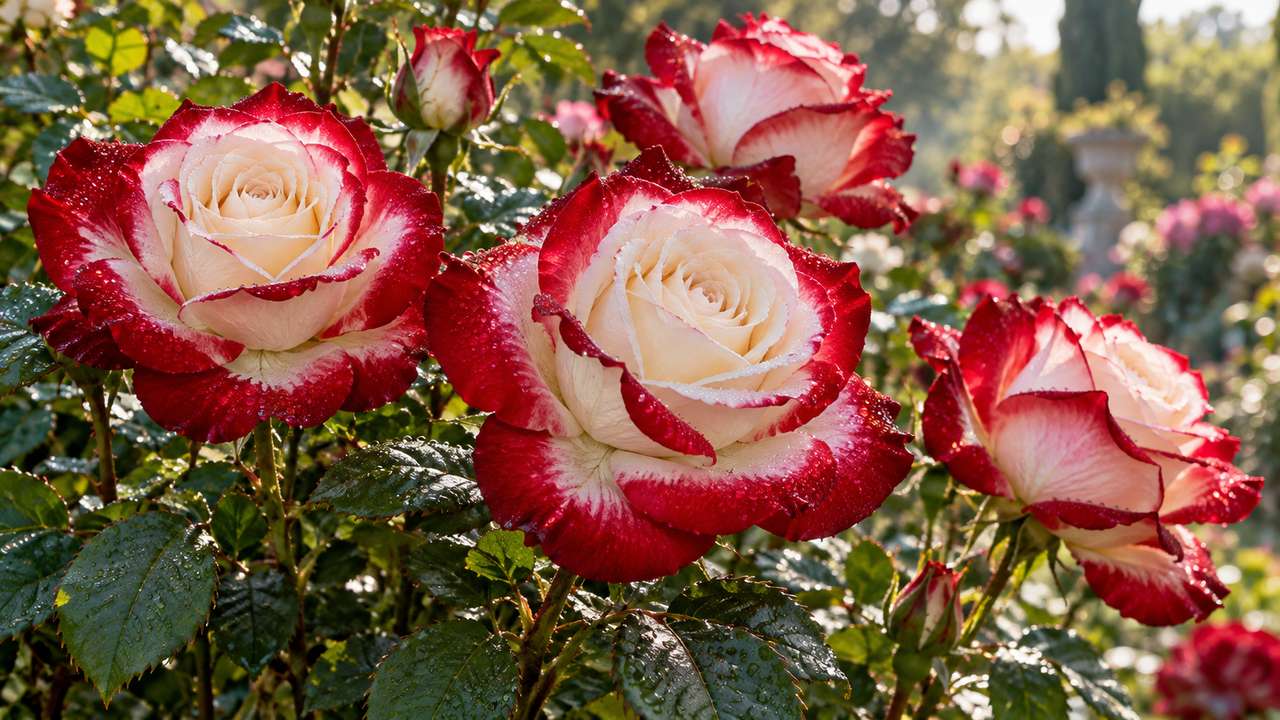
The nostalgie rose meaning centers on sweet remembrance, enduring affection, emotional reunion, and mature elegance. With creamy white petals dramatically edged in cherry red, the flower appears almost as though cherished memories have left their color around its margins. Its symbolism is not inherited directly from ancient mythology or Victorian flower dictionaries; rather, it emerges from the rose’s evocative modern name, its two-tone coloring, and the centuries-old symbolic traditions associated with red and white roses.
Nostalgie is a celebrated hybrid tea rose introduced by the German breeder Rosen Tantau in the 1990s. Its large, high-centered blooms open from pale buds into rounded flowers with ivory or cream interiors and increasingly vivid crimson edges. Glossy, dark green foliage intensifies this theatrical contrast. The cultivar’s formal shape, light fragrance, and excellent performance as a cut flower have made it popular in gardens, floral arrangements, and commemorative bouquets.
Although nostalgia can imply sadness, this rose conveys more than longing for what has passed. It suggests that affection can survive time and change. Nostalgie therefore speaks not only of looking backward, but also of carrying treasured people, places, and experiences gracefully into the present.
Primary Meanings of the Nostalgie Rose
- Sweet reminiscence: Its name naturally evokes fond memories, sentimental journeys, and moments worth revisiting.
- Enduring affection: The persistent red border surrounding a pale heart suggests love that protects and preserves what is precious.
- Reunion: The meeting of red and white can represent two people, families, or periods of life brought together again.
- Elegance and refinement: Its sculpted hybrid tea form communicates dignity, cultivated taste, and formal beauty.
- Love matured by time: Unlike a uniformly red rose associated with immediate passion, Nostalgie expresses romance enriched by shared history.
- Grateful remembrance: In sympathy or memorial flowers, it honors a life through affectionate memories rather than emphasizing grief alone.
How Its Colors Shape the Symbolism
The symbolism of Nostalgie depends upon the dialogue between its colors. White and cream traditionally signify sincerity, peace, innocence, reverence, and new beginnings. Red represents love, courage, devotion, and vitality. Because neither color completely overtakes the other, the bloom can be read as purity surrounded by passion, a peaceful bond kept alive by love, or an old affection that remains emotionally vivid.
The balance changes as each flower develops. A newly opening bloom, still predominantly cream, feels restrained and hopeful. A mature flower with broad crimson margins appears more romantic and celebratory. Environmental conditions also affect the presentation: cool weather often produces stronger coloration, while heat may soften or alter the intensity of the red edging. Every stem can therefore express a slightly different emotional emphasis.
This nuanced palette differs from the exuberance associated with coral rose symbolism, which often conveys desire, enthusiasm, and developing romance. It is also gentler than the deep sensuality of burgundy rose passion. Nostalgie occupies an elegant middle ground: romantic but composed, sentimental without appearing mournful.
Historical and Cultural Interpretations
In classical antiquity, roses were connected with love, beauty, secrecy, celebration, and mortality. Medieval Christian imagery gave red and white roses additional associations with sacrifice, purity, divine love, and spiritual devotion. Later European traditions used contrasting rose colors to represent reconciliation and unity, most famously through heraldic and dynastic imagery.
During the nineteenth-century flowering of floriography, especially in Britain, France, and the United States, individual rose colors acquired elaborate social meanings. Red roses communicated love; white roses suggested innocence or silence; rosebuds could indicate youth; and bouquets became discreet emotional messages. Nostalgie itself did not exist in this period, so it has no authentic entry in Victorian flower dictionaries. Nevertheless, a historically informed modern interpretation combines the era’s red-and-white symbolism with the cultivar’s name: sincere love preserved through memory.
In contemporary European floristry, bicolored hybrid teas are often valued for sophistication and visual drama. In wedding work, Nostalgie can signify the union of two lives and the honoring of family history. In memorial arrangements, its pale center offers serenity while the red edge retains warmth and vitality. This is distinct from the more complex associations of the black rose meaning, where endings, mystery, mourning, rebellion, and rebirth may overlap.
| Flower Presentation | Suggested Meaning | Best Occasion | Message to Include |
|---|---|---|---|
| Single Nostalgie rose | One unforgettable memory or singular devotion | Private romantic gesture | “I still treasure our beginning.” |
| Dozen Nostalgie roses | Lasting love shaped by shared experience | Anniversary or reunion | “Every year with you becomes a cherished memory.” |
| Nostalgie with white flowers | Peaceful remembrance and sincere respect | Memorial or condolence | “May loving memories bring you comfort.” |
| Nostalgie with yellow roses | Happy memories, gratitude, and loyal friendship | Birthday or friendship reunion | “The good times we shared still make me smile.” |
| Garden-grown potted rose | Affection that continues to grow | Housewarming, retirement, or milestone | “May beautiful memories keep blooming.” |
When and to Whom Should You Give Nostalgie Roses?
Nostalgie roses are particularly appropriate for anniversaries, vow renewals, homecomings, retirements, milestone birthdays, family celebrations, and reunions between old friends. They suit a spouse or long-term partner because they recognize both romance and history. Given to a parent, grandparent, mentor, or former colleague, they can express gratitude for a lasting influence without necessarily implying romantic attraction.
They are also meaningful for weddings. A bride or groom might carry them to honor the couple’s courtship, include them in centerpieces celebrating two families, or place a single bloom near a photograph of an absent loved one. For funerals and remembrance ceremonies, combine them with pale flowers and restrained greenery so that their message reads as loving tribute rather than passionate declaration.
Modern etiquette favors clarity. Bicolored red-and-white roses may be interpreted romantically, so include a thoughtful card when sending them to a friend, coworker, or bereaved acquaintance. Avoid language such as “I will always love you” unless that sentiment is appropriate. A message about gratitude, happy memories, or enduring friendship makes the intention unmistakable.
Companion Flowers and Bouquet Styling
For a timeless arrangement, pair Nostalgie roses with white lisianthus, ivory spray roses, ranunculus, or delicate waxflower. Eucalyptus, olive foliage, or ruscus gives the bouquet structure without competing with the distinctive petals. Burgundy dahlias or scabiosa deepen the palette for autumn anniversaries, while blush carnations and dusty miller create a softer, vintage character.
For friendship, add golden blooms informed by the cheerful yellow rose meaning. Their associations with joy and companionship shift the arrangement away from romance. For a modern presentation, use an asymmetrical grouping of five to seven Nostalgie stems with airy grasses in a low ceramic vessel. For formal occasions, arrange long stems in a clear glass vase and keep supporting flowers minimal.
Because the blooms are already strongly patterned, avoid mixing them with too many other bicolored varieties. Cream, deep red, muted green, and one secondary accent color usually produce the most coherent result. Natural linen ribbon gives a nostalgic garden feeling, while velvet ribbon emphasizes ceremony and old-world luxury.
Botanical Care and Vase Longevity
As a hybrid tea rose, Nostalgie performs best in full sun, fertile well-drained soil, and a location with good air circulation. Water deeply at soil level rather than wetting the foliage, and apply an organic mulch to moderate moisture and temperature. Feed during active growth with a balanced rose fertilizer, following local timing and product instructions. Remove spent blooms above a healthy outward-facing leaf to encourage repeat flowering, and prune according to the climate during the plant’s dormant or early growth period.
For cut stems, choose flowers whose outer petals have loosened but whose centers remain firm. Recut one to two centimeters from each stem at a diagonal with clean, sharp tools. Remove foliage that would sit below the waterline, place the roses promptly in a spotless vase with commercial flower food, and change the water every two days. Keep the arrangement away from direct sun, heating vents, and ripening fruit, which releases ethylene gas. Under favorable conditions, the flowers may remain attractive for approximately seven to ten days.
A Rose That Keeps the Past Alive
The nostalgie rose meaning is ultimately one of memory transformed into living beauty. Its creamy heart conveys sincerity and peace; its crimson border supplies devotion, vitality, and emotional depth. Together they create a flower suited to mature romance, affectionate reunion, grateful tribute, and elegant commemoration.
Whether planted beside a family home, carried at a vow renewal, or sent to someone whose influence has endured, Nostalgie says that the past need not be lost. The most meaningful experiences continue to color the present—and, like this remarkable rose, can bloom again with grace.