Table of Contents
Pairing Roses with Lisianthus: Gentle Resilience, Charisma, and Rose Lookalikes
The pairing of roses and lisianthus brings together two flowers that appear closely related yet tell distinct emotional stories. Roses, cultivated for thousands of years, carry an extraordinary inheritance of mythology, courtship, devotion, secrecy, and political symbolism. Lisianthus entered European and American horticulture much later, but its delicate, rose-like flowers quickly became associated with appreciation, composure, and quiet endurance. Together, they express affection strengthened by respect: love with grace, charisma softened by sincerity, and beauty that survives difficulty.
Understanding the roses and lisianthus meaning begins with their botanical differences. True roses belong to the genus Rosa in the Rosaceae family. Lisianthus, botanically Eustoma grandiflorum, belongs to the Gentianaceae family and is native to the grasslands and prairies of the southern United States, Mexico, the Caribbean, and northern South America. Its cup-shaped, layered blooms resemble roses, but its slender stems, smooth leaves, and thornless character give it a lighter, more open presence.
Historical Roots and the Language of Flowers
Roses held sacred and secular meanings long before formal floriography developed. Ancient Greeks and Romans connected them with Aphrodite or Venus, beauty, desire, and the brevity of life. In Christian symbolism, red roses came to evoke martyrdom and divine love, while white roses represented purity and the Virgin Mary. By the Victorian era, roses had become essential to a coded floral vocabulary in which color, condition, and presentation could communicate feelings that etiquette discouraged people from speaking aloud.
Lisianthus does not possess an equally ancient European symbolic record. Its modern name derives from Greek elements often interpreted as “smooth flower,” while Eustoma is commonly rendered as “beautiful mouth,” an image suggestive of eloquence and gracious expression. In contemporary floriography, lisianthus signifies appreciation, gratitude, charm, gentleness, and resilience. That last association is especially fitting: despite its refined appearance, the plant evolved in warm, exposed grassland environments and is more tenacious than its petals suggest.
When roses and lisianthus share a bouquet, the rose supplies emotional intensity and historical gravitas, while lisianthus contributes gratitude, calm, and steadfastness. The arrangement can therefore say, “I love you, I admire you, and I value the strength beneath your gentleness.”
Primary Meanings of Roses and Lisianthus
- Romantic affection: Roses establish love and attraction, while lisianthus makes the message tender, considerate, and less theatrically passionate.
- Gentle resilience: The fragile-looking lisianthus symbolizes strength without hardness, making the pairing meaningful after illness, grief, upheaval, or personal change.
- Gratitude and admiration: Lisianthus is strongly associated with appreciation; roses add warmth, esteem, or intimacy according to their color.
- Charisma and elegance: Both flowers have layered forms, but their contrasting silhouettes create a sophisticated expression of charm rather than ostentation.
- Enduring connection: Multi-bloom lisianthus stems unfold gradually, complementing the rose as a symbol of affection that continues to develop.
Color Meanings and Emotional Nuance
| Combination | Core Meaning | Best Context |
|---|---|---|
| Red roses and white lisianthus | Passionate love balanced by sincerity | Anniversaries, proposals, devoted partners |
| Blush roses and pink lisianthus | Tenderness, admiration, graceful affection | Weddings, birthdays, new relationships |
| Yellow roses and cream lisianthus | Friendship, encouragement, cheerful gratitude | Thank-you gifts, congratulations, recovery |
| Coral roses and apricot lisianthus | Enthusiasm, attraction, sociable warmth | Hosts, mentors, creative celebrations |
| Burgundy roses and purple lisianthus | Mature passion, dignity, fascination | Milestone anniversaries, formal evenings |
| White roses and white lisianthus | Purity, peace, remembrance, new beginnings | Weddings, sympathy, spiritual ceremonies |
Red roses remain the clearest declaration of romantic love, but lisianthus moderates their intensity and makes them suitable for an elegant anniversary rather than an overtly dramatic gesture. Deep red or wine-colored designs communicate devotion with greater gravity; the tradition surrounding burgundy rose passion is especially effective when paired with mauve or violet lisianthus.
Pink combinations suggest sweetness, admiration, and emotional generosity. Pale blush feels bridal and innocent, whereas saturated pink conveys confidence and gratitude. Coral introduces appetite for life, fascination, and warmth; understanding coral rose symbolism helps distinguish its lively attraction from the solemn passion of red.
Yellow arrangements are ideal for platonic relationships, housewarmings, and congratulations. Modern interpretations of the yellow rose meaning emphasize friendship and joy, although Victorian recipients might once have read yellow roses as jealousy or fading affection. White combinations can honor marriage, innocence, peace, or bereavement. Very dark roses create a more ambiguous design: because most “black” roses are actually deep burgundy, their message may involve farewell, transformation, or rebirth. Consult the history of black rose meaning before using them for a sensitive occasion.
Cultural Interpretations and Customs
Meanings vary by culture and setting. In much of Europe and North America, red roses are romantic, white flowers are common at weddings, and pale arrangements may also express sympathy. In several East Asian contexts, white flowers can be strongly associated with mourning, so an all-white bouquet should be chosen thoughtfully. Red, meanwhile, is auspicious in Chinese celebrations, though romantic symbolism may still depend on local custom and the recipient’s age.
Numbers matter too. A dozen roses is a familiar declaration of complete devotion in Western floristry, while odd-numbered bouquets are customary in parts of Europe. Even numbers may be reserved for funerals in some Eastern European traditions. Lisianthus stems carry several blooms, making literal flower counts less obvious; if number symbolism matters, count the prominent rose heads and explain the intention on a card.
Occasions, Recipients, and Modern Etiquette
For a partner, choose red, burgundy, blush, or coral roses with lisianthus in a harmonizing shade. For a friend, colleague, teacher, or host, favor yellow, peach, cream, or soft pink and avoid an overwhelming mass of red. White and green arrangements suit sympathy gifts, but include a brief, direct message rather than relying on flowers alone to communicate condolence.
The pairing is particularly appropriate for weddings. Garden roses provide focal blooms, while lisianthus bridges visual gaps and adds movement without competing for attention. It also suits graduations, career milestones, retirement, recovery, and thank-you gifts because its central message combines admiration with perseverance.
Modern etiquette favors personal knowledge over rigid symbolism. Check for fragrance sensitivity, pet safety, and cultural preferences. Roses are generally considered non-toxic to cats and dogs, although thorns and floristry chemicals still pose risks; lisianthus is also widely regarded as non-toxic. Remove thorns for hand-tied gifts, use discreet packaging, and never send an intimate-looking bouquet anonymously in a professional context.
Companion Flowers and Bouquet Styling
For a romantic garden style, combine roses and lisianthus with sweet peas, ranunculus, scabiosa, or trailing jasmine. Delphinium adds height and a cool blue contrast; stock contributes fragrance and vertical structure. For restrained contemporary work, use fewer varieties and add olive, eucalyptus, or airy grasses. Avoid overcrowding: lisianthus needs negative space around its branching stems to display both open blooms and buds.
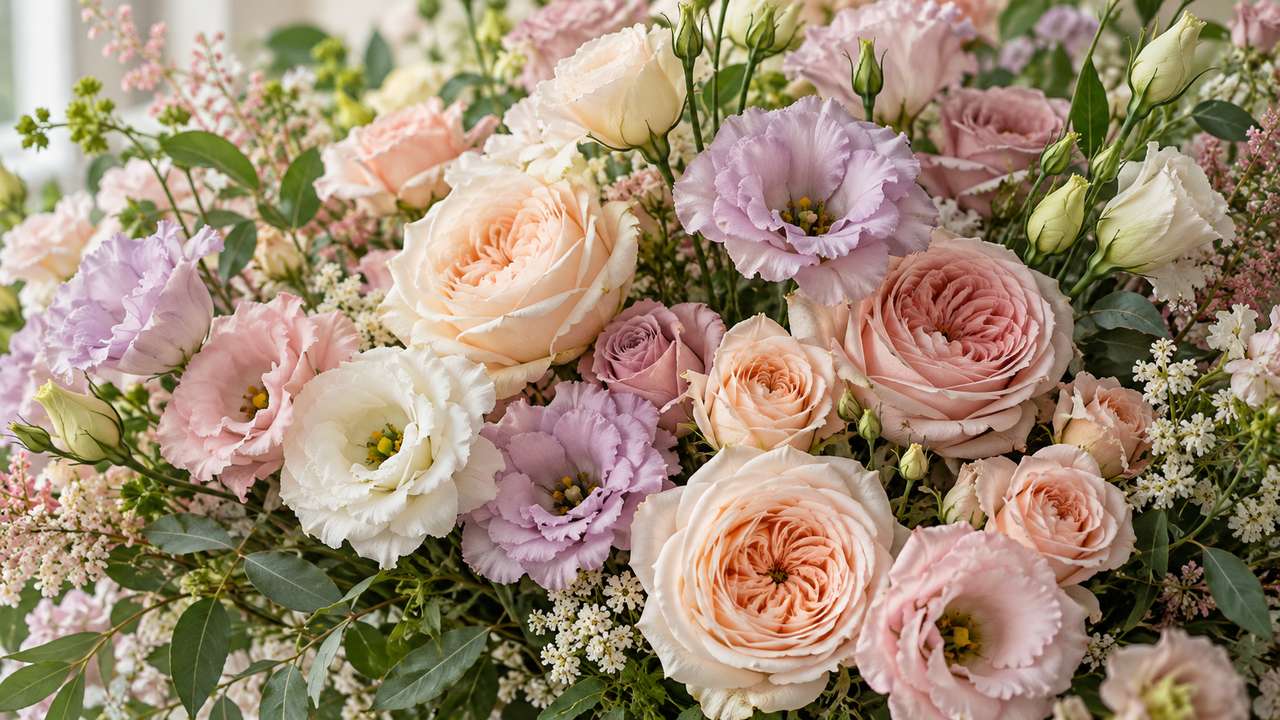
Varying scale prevents the flowers from looking repetitive. Use large garden roses as focal points, standard lisianthus as transitional blooms, and unopened buds as delicate accents. A tonal palette of cream, blush, and antique pink feels soft and ceremonial; coral, apricot, and butter yellow appear energetic; burgundy, plum, and mauve create a dramatic, painterly arrangement.
Care, Vase Life, and Cultivation
Lisianthus is an excellent cut flower, commonly lasting 10 to 14 days, while roses often last about five to ten days depending on cultivar and freshness. Recut all stems at an angle with a clean blade, remove foliage below the waterline, and place them in a thoroughly washed vase with commercial flower food. Refresh the water every two days and keep the arrangement away from direct sun, heaters, ripening fruit, and strong drafts.
Because roses can develop bent necks when stems become blocked, recut them promptly if they droop. Remove fading rose heads while leaving healthy lisianthus buds; these may continue opening and extend the arrangement’s beauty. Gardeners should know that lisianthus is slow from seed and requires warmth, excellent light, and patience. Roses vary enormously by class but generally need good air circulation, fertile well-drained soil, and several hours of sun.
A Message of Beauty with Backbone
The enduring appeal of the roses and lisianthus meaning lies in balance. Roses speak of love, beauty, courage, and desire; lisianthus answers with gratitude, gentleness, eloquence, and resilience. Their resemblance creates visual harmony, while their different histories prevent the bouquet from becoming emotionally one-dimensional. Chosen with attention to color, culture, recipient, and occasion, this pairing can honor romance, friendship, remembrance, or achievement with unusual precision. It is not merely a collection of rose lookalikes, but a layered floral statement: tenderness can be strong, admiration can deepen into devotion, and elegance can endure.