Table of Contents
Pairing Roses with Dusty Miller: Velvety Frosted Silver Foliage Balance
Few floral pairings unite emotion and texture as gracefully as roses and dusty miller. Roses bring centuries of romantic symbolism, ceremonial importance, and color-coded meaning; dusty miller contributes soft, silvery foliage that resembles velvet touched by frost. Together, they create a bouquet that feels expressive yet composed, opulent yet restrained. The central roses and dusty miller meaning is enduring affection balanced by calm, wisdom, and protection.
Roses have carried symbolic weight since antiquity. Greeks and Romans associated them with love, beauty, secrecy, and divine favor, while medieval and Renaissance traditions connected them with devotion, purity, sacrifice, and political identity. By the nineteenth century, European and American floriography manuals had transformed rose colors and stages of bloom into a nuanced vocabulary. Dusty miller never acquired an equally standardized Victorian definition, but its pale foliage became valued for contrast, harmony, and the visual impression of constancy. In modern floral language, its silver-gray leaves suggest serenity, remembrance, maturity, and the quiet strength that supports passionate feeling.

Botanical Character and Symbolic Contrast
Florists commonly call several silver-foliaged plants “dusty miller,” although the name most often refers to Jacobaea maritima, formerly classified as Senecio cineraria. Native to the Mediterranean region, it bears deeply divided leaves covered with fine hairs. These hairs reflect light, producing the plant’s characteristic frosted appearance and helping it tolerate dry, sunny conditions.
That botanical resilience enriches its symbolism. Dusty miller does not compete with a rose’s form or perfume; it frames the flower, softens intense colors, and connects separate blooms into a coherent design. Symbolically, roses may represent the heart’s declaration, while dusty miller represents steadiness, perspective, and the grace that allows love to mature. Its foliage can also evoke winter, moonlight, age, and memory, making the pairing especially effective for weddings, anniversaries, sympathy arrangements, and seasonal celebrations.
Historical and Cultural Interpretations
In classical mythology, the rose was linked to Aphrodite or Venus and became an emblem of beauty and desire. Roman banquets used roses as signs of luxury and confidentiality, an association preserved in the phrase sub rosa, or “under the rose.” Christian art later gave roses devotional meanings: red could signify martyrdom and sacred love, while white suggested innocence and spiritual purity.
Victorian flower language intensified these distinctions. A red rose communicated passionate love; white conveyed innocence or reverence; pink expressed admiration; and yellow, whose historical meanings once included jealousy or fading affection, gradually became associated with warmth and friendship. Anyone using yellow in a contemporary arrangement should understand this evolution; the modern yellow rose meaning is generally cheerful, affectionate, and platonic.
Dusty miller entered formal gardens and floral design principally for its unusual foliage rather than for a fixed coded message. Consequently, its meaning remains contextual. In Western weddings, it often signifies timeless elegance and committed companionship. In memorial work, its ash-silver coloring can convey peaceful remembrance. In winter bouquets, it resembles snow-covered greenery, while in Mediterranean-inspired arrangements it suggests endurance under sun and wind. Across these contexts, the foliage moderates the rose’s emotional intensity without diminishing it.
Meanings by Rose Color
| Rose Color | Meaning with Dusty Miller | Best Context |
|---|---|---|
| Red | Passionate love grounded by loyalty and emotional maturity | Romance, proposals, anniversaries |
| White | Purity, peace, remembrance, and timeless commitment | Weddings, sympathy, spiritual ceremonies |
| Blush or Pink | Gentle admiration, gratitude, and tender affection | Birthdays, thank-you gifts, new relationships |
| Coral | Enthusiasm and romantic interest softened by discretion | Celebrations, courtship, summer events |
| Burgundy | Profound devotion, refined beauty, and enduring desire | Formal romance, autumn weddings, milestone anniversaries |
| Yellow | Joyful friendship supported by trust and constancy | Congratulations, friendship, recovery wishes |
| Very Dark Red or Black-Dyed | Transformation, farewell, mystery, or rebirth framed by reflection | Theatrical designs, memorials, major transitions |
Color selection should reflect the recipient rather than fashion alone. Coral blooms add warmth without the unequivocal declaration of red; their balance of energy and delicacy is explored through coral rose symbolism. Deep wine-colored flowers communicate richer sensuality and sophistication, making burgundy rose passion particularly suited to candlelit celebrations and autumn ceremonies.
So-called black roses are usually extremely dark red or purple cultivars, or flowers altered with dye. Paired with silver leaves, they produce a dramatic meditation on endings and renewal. Because the black rose meaning may encompass mourning, rebellion, mystery, or rebirth, include a written note to prevent an unintended message.
Occasions, Recipients, and Modern Etiquette
- Romantic partners: Choose red or burgundy roses for established love, and blush or coral for admiration and emerging romance. Silver foliage makes either message feel thoughtful and sophisticated.
- Wedding couples: White, cream, blush, or muted peach roses with dusty miller signify harmonious commitment. Confirm cultural preferences, since white flowers may carry mourning associations in some communities.
- Friends and colleagues: Yellow, peach, or soft pink roses convey encouragement without suggesting romantic intent. Use an airy, garden-style arrangement rather than a tight dozen-red-rose presentation.
- Bereaved families: White or pale pink roses with restrained silver foliage offer peaceful remembrance. Avoid highly scented cultivars in hospitals, small homes, or fragrance-sensitive settings.
- Milestone recipients: Burgundy, antique mauve, or champagne roses suit retirements, significant birthdays, and anniversaries by suggesting wisdom, achievement, and affection refined over time.
Modern etiquette favors clarity. A bouquet’s message depends on relationship, culture, setting, and accompanying words, not on a rigid historical dictionary. Include a concise card explaining your intention when a color has multiple meanings. For hospitals, verify flower restrictions; for pet-owning households, remember that roses are generally considered non-toxic to cats and dogs, but thorns can injure, and florist treatments or companion plants may not be safe.
Companion Flowers and Styling
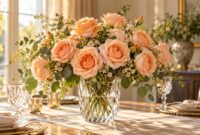
For romantic softness, combine blush roses and dusty miller with white lisianthus, ranunculus, or spray roses. Eucalyptus adds movement, though its blue-green tone should remain secondary so the silver foliage retains its distinctive role. White anemones create graphic contrast, while waxflower and astrantia introduce fine, star-like detail.
For autumn drama, pair burgundy roses with chocolate cosmos, plum scabiosa, seeded eucalyptus, and restrained copper accents. For winter, use white roses, dusty miller, brunia, hellebores, and evergreen tips. Yellow or coral roses become more contemporary beside dusty miller, chamomile, snapdragons, and pale apricot carnations.
Allow the foliage to form a broken halo rather than a dense collar. Its texture is most effective when individual leaves remain visible between rose heads. A hand-tied bouquet usually needs enough dusty miller to repeat the silver tone around the composition, but not so much that it creates a gray mass. Matte ceramic, aged brass, clear glass, and stone vessels complement the pairing particularly well.
Care, Longevity, and Cultivation
For cut arrangements, remove every leaf that would sit below the waterline. Recut rose stems at an angle with a clean, sharp knife or floral shears, then place them promptly in a scrubbed vase containing fresh water and properly measured flower food. Change the water every one to two days, recut stems as needed, and keep the bouquet away from direct sun, heaters, drafts, and ripening fruit, which releases aging-promoting ethylene.
Dusty miller may last longer than the roses and can sometimes be dried for wreaths or keepsakes. Handle it gently: bruising and prolonged wetness can mar its felted leaves. If a rose droops prematurely, recut the stem and hydrate it separately in deep, clean water before returning it to the arrangement.
In the garden, dusty miller prefers full sun and sharply drained soil. It is drought-tolerant once established but performs poorly in waterlogged ground. Often grown as an annual in cold climates, it may behave as a short-lived perennial in mild regions. Pinching growing tips encourages bushier foliage, while removing flower stalks directs attention to the silver leaves. Garden roses generally need richer soil, consistent deep watering, good air circulation, and several hours of sun, so the two plants can share a sunny design while receiving different irrigation attention.
A Balanced Floral Message
The enduring appeal of roses and dusty miller lies in meaningful contrast. Roses speak through color, fragrance, and cultural memory; dusty miller answers with composure, resilience, and luminous restraint. Whether the bouquet celebrates romance, friendship, marriage, remembrance, or personal transformation, the silver foliage gives emotional intensity room to breathe. Chosen with attention to color, culture, and recipient, this pairing communicates not merely affection, but affection steadied by loyalty, perspective, and time.