Table of Contents
Pairing Roses with Alstroemeria (Peruvian Lily): Devoted Friendship and Wealth
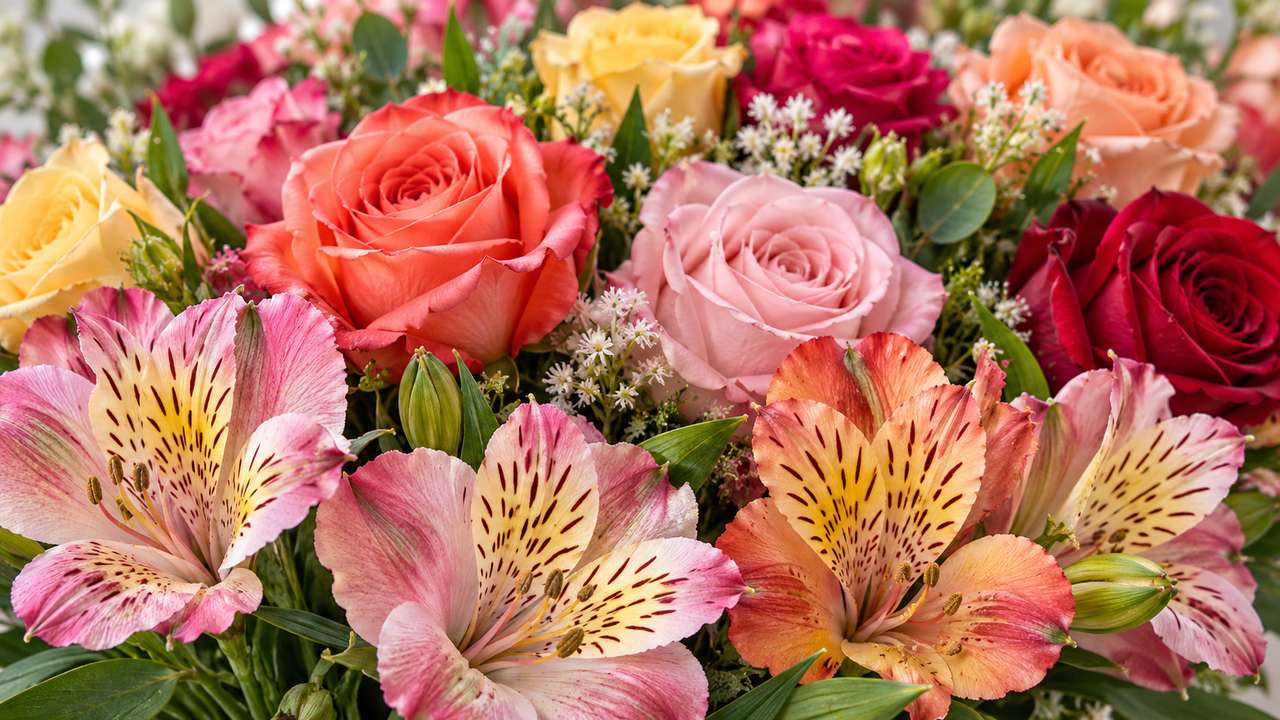
The pairing of roses and alstroemeria brings together two distinct floral traditions. Roses carry centuries of associations with love, beauty, secrecy, honor, and remembrance, while alstroemeria has become a widely recognized emblem of friendship, mutual support, prosperity, and enduring connection. In a bouquet, their combined message is affectionate but not necessarily romantic: “I value you deeply, I am grateful for your loyalty, and I wish you lasting happiness and success.”
Understanding the roses and alstroemeria meaning requires both historical and botanical context. Roses have appeared in Mediterranean myth, Persian poetry, medieval heraldry, Christian iconography, and Victorian floriography. Alstroemeria entered European botanical knowledge much later. Native to South America—especially Chile and Brazil—it was named in the eighteenth century for the Swedish botanist Baron Clas Alströmer. Although commonly called the Peruvian lily or lily of the Incas, it is not a true lily. Its six tepals, often marked with delicate streaks, give arrangements an exotic, lively character.
The Central Meaning: Affection Strengthened by Friendship
Roses usually provide the emotional heart of the arrangement. Their precise significance depends upon color: red expresses passionate love, pink conveys admiration or gratitude, yellow suggests warmth and friendship, white evokes sincerity, and peach communicates appreciation. Alstroemeria supports that message with ideas of devotion, companionship, resilience, and good fortune.
Together, the flowers can represent a relationship in which affection is sustained by trust. For romantic partners, the bouquet says that friendship is the foundation of love. For relatives or close friends, it communicates loyal attachment without requiring a romantic interpretation. In professional settings, carefully chosen colors can express congratulations, gratitude, and wishes for prosperity.
Alstroemeria’s symbolism is often linked to the plant’s growth habit. Several stems rise from spreading underground rhizomes, suggesting connection, expansion, and abundance. Its twisting leaves—botanically described as resupinate because the leaf stalk turns so that the apparent underside faces upward—have also inspired modern interpretations involving adaptability and seeing life from a different perspective. These meanings are newer symbolic readings rather than fixed rules from classical floriography, but they suit the flower’s resilient character.
Historical and Cultural Interpretations
In antiquity, roses were associated with deities of love, including Aphrodite and Venus, as well as with luxury, mortality, and secrecy. The Latin expression sub rosa, or “under the rose,” came to signify confidentiality. During the Middle Ages and Renaissance, roses acquired religious, dynastic, and political meanings. By the nineteenth century, European and American flower dictionaries transformed rose colors and stages of bloom into an elaborate social vocabulary.
Alstroemeria did not occupy the same prominent place in early Victorian flower dictionaries. Its present associations with friendship and devotion developed largely through modern floristry, popular flower lore, and the practical role it plays in bouquets. Its long vase life makes it a convincing symbol of steadfastness: unlike a fleeting blossom, it remains attractive while successive buds continue to open.
In contemporary Western gifting, yellow or pink roses with alstroemeria are commonly read as cheerful and supportive. In many Latin American contexts, abundant, colorful flowers are welcome at birthdays, family celebrations, and religious observances, although customs differ by country and household. Across some East Asian settings, color, number, and presentation can carry strong importance; red may signify luck and celebration, while white flowers may be associated with mourning. The recipient’s individual and cultural preferences should therefore take precedence over any universalized flower dictionary.
Meanings by Color Combination
| Combination | Primary Message | Best Uses |
|---|---|---|
| Red roses with red or burgundy alstroemeria | Passionate love supported by loyalty | Anniversaries, romantic milestones, committed partners |
| Pink roses with pink alstroemeria | Admiration, tenderness, and gratitude | Thank-you gifts, birthdays, mentors, close friends |
| Yellow roses with golden alstroemeria | Joyful friendship, optimism, and success | Graduations, promotions, housewarmings, reunions |
| White roses with white alstroemeria | Sincerity, peace, remembrance, and faithful support | Weddings, condolences, spiritual occasions |
| Peach roses with orange alstroemeria | Appreciation, enthusiasm, and opportunity | Hosts, colleagues, new ventures, achievements |
| Lavender roses with purple alstroemeria | Enchantment, distinction, and creative admiration | Artistic celebrations, new romance, distinctive gifts |
Shade changes the emotional temperature. Pale blush feels gentle and intimate; saturated magenta appears celebratory and confident. Dark pink roses are especially suitable when heartfelt recognition matters, and a fuller exploration of the dark pink rose meaning shows why they work so well for teachers, hosts, caregivers, and trusted colleagues.
When and to Whom Should You Give This Pairing?
- A close friend: Choose yellow, coral, or bright pink flowers to celebrate loyalty, shared history, and optimism.
- A romantic partner: Combine red or blush roses with pink alstroemeria to suggest love rooted in companionship.
- A graduate or newly promoted colleague: Yellow, peach, and orange tones express confidence, prosperity, and forward momentum.
- A parent, sibling, or mentor: Pink and cream varieties convey affection, admiration, and gratitude without romantic ambiguity.
- A grieving recipient: Use white, cream, or subdued pink flowers. For sensitive choices and delivery customs, consult guidance on roses for sympathy.
Modern etiquette favors clarity over rigid symbolism. Include a short card explaining your intention, particularly when red roses might imply romance or white flowers might be interpreted differently across cultures. Avoid sending heavily fragrant arrangements to hospitals unless permitted, and verify whether the recipient has pollen sensitivities or pets. Alstroemeria can cause contact dermatitis in some people, while plant material should be kept away from animals and young children.
Numbers can add another symbolic layer. A compact arrangement of three focal roses surrounded by alstroemeria may communicate a concise declaration while remaining affordable and elegant. The traditional three roses meaning is often rendered as “I love you,” so reserve that composition for romance or explain it clearly in the accompanying message.
Companion Flowers and Bouquet Styling
For a garden-inspired arrangement, pair spray roses and alstroemeria with lisianthus, waxflower, scabiosa, or airy foliage. Eucalyptus introduces cool gray-green structure, while ruscus gives a cleaner, more formal outline. Avoid overcrowding: alstroemeria opens generously and needs visual space around its striped petals.
For luxurious romance, use richly cupped David Austin English roses with restrained clusters of alstroemeria. Their abundant forms and fragrance create a sumptuous focal point, while the smaller Peruvian lily blooms add rhythm and movement. For modern styling, group flowers by variety rather than mixing every stem evenly. An asymmetrical arrangement in peach, rust, cream, and raspberry feels sophisticated; yellow, white, and fresh green creates a crisp friendship bouquet.
Wedding bouquets benefit from blush roses, white alstroemeria, sweet peas, and trailing greenery. For professional congratulations, use peach roses, golden alstroemeria, and structured foliage in simple paper wrapping. Sympathy designs should remain quiet and spacious, with cream roses, white alstroemeria, and soft green leaves rather than highly contrasting colors.
Care, Vase Life, and Botanical Insights
Alstroemeria commonly lasts seven to fourteen days in a vase, often outliving standard cut roses. Select stems with several colored buds beginning to open rather than fully expanded flowers. Choose roses with firm, hydrated petals and buds that yield slightly when gently pressed near the base.
- Wash the vase thoroughly and fill it with fresh, room-temperature water and commercial flower food.
- Remove all leaves that would sit below the waterline, since submerged foliage encourages bacterial growth.
- Recut one to two centimeters from each stem at an angle with clean, sharp snips.
- Change the water every two days, clean the vase, and trim the stems again as needed.
- Keep the arrangement away from direct sun, radiators, drafts, and ripening fruit, which releases aging-accelerating ethylene.
Remove fading rose heads while allowing unopened alstroemeria buds to develop. In gardens, alstroemeria prefers fertile, well-drained soil and sun to partial shade, with hardiness varying greatly by cultivar. Its rhizomatous roots resent rough disturbance. Gardeners should also note that sap may irritate sensitive skin, so gloves are sensible when dividing plants or handling many stems.
A Message of Loyalty and Abundance
The enduring appeal of roses and alstroemeria lies in balance. Roses contribute emotional depth and centuries of cultural resonance; alstroemeria adds friendship, resilience, abundance, and a hopeful wish for prosperity. Color determines whether the result feels romantic, grateful, celebratory, consoling, or professionally appreciative.
Ultimately, the most authoritative interpretation is the one shaped by recipient, occasion, and personal intention. Choose shades thoughtfully, respect cultural customs, and write a sincere card. Presented with care, this pairing becomes more than an attractive bouquet: it is a layered promise of affection strengthened by loyalty, and of friendship blessed with the hope of flourishing fortune.