Table of Contents
Meaning of Half a Dozen Roses: The Gentle Gesture of Sweet Intention
The half dozen roses meaning is best understood as a message of sincere affection expressed with grace rather than extravagance. Six roses are generous enough to feel deliberate, yet restrained enough to remain intimate. In contemporary flower symbolism, a half dozen commonly conveys admiration, growing attachment, romantic interest, or the tender sentiment, “I want to be yours.” Depending on color and context, however, the same number can also celebrate friendship, gratitude, encouragement, remembrance, or family love.
Roses have carried emotional meaning for thousands of years. They were associated with Aphrodite and Venus in the classical Mediterranean world, cultivated in Persian gardens, praised in poetry, and later adopted as religious, dynastic, and political emblems. During the nineteenth-century fashion for floriography—especially in Britain, France, and the United States—people used flower varieties, colors, and presentation styles to suggest feelings that social convention made difficult to speak aloud. Historical flower dictionaries were not entirely consistent, and most focused more closely on color and species than on exact stem counts. The precise “six roses” message is therefore largely a modern development built upon older rose traditions.
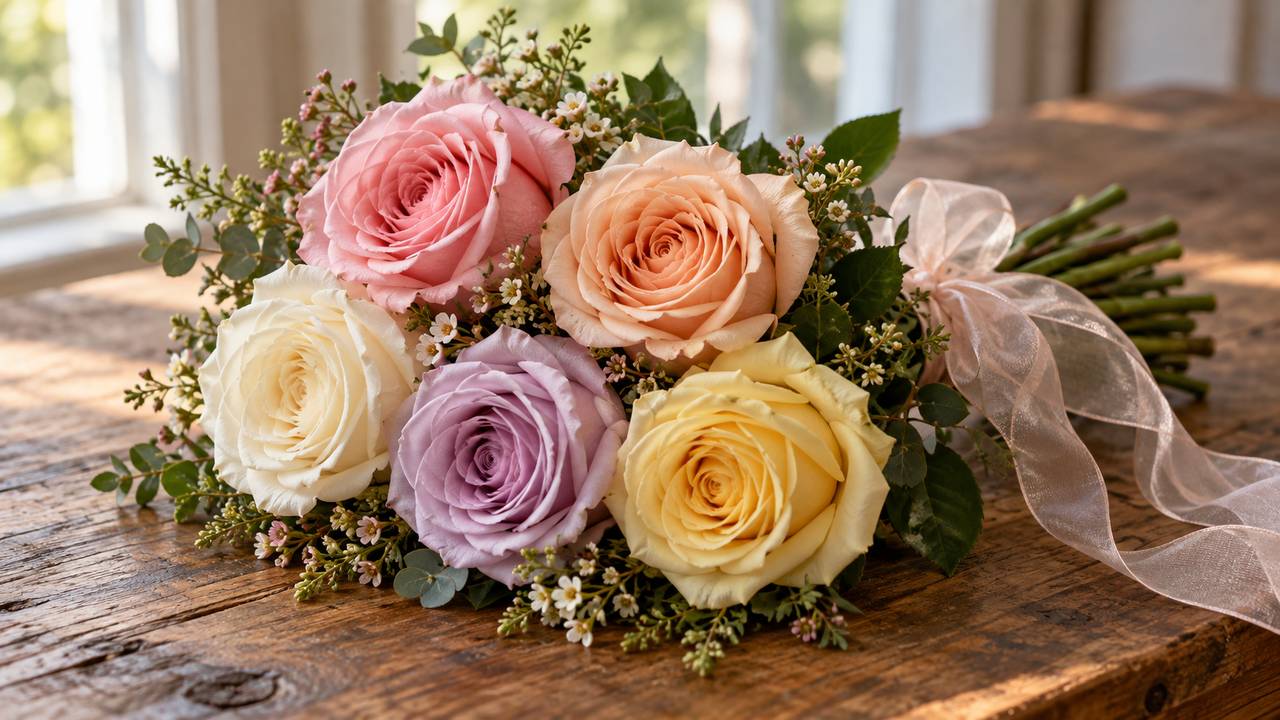
Botanically, roses belong to the genus Rosa, a diverse group of woody perennials whose wild ancestors generally bear five-petaled flowers. Centuries of hybridization have produced the densely petaled hybrid teas, floribundas, garden roses, and spray roses used by florists today. Six standard roses create a naturally balanced bouquet: substantial enough to display the architecture, fragrance, and color of the blooms without overwhelming the recipient.
The Primary Symbolism of Six Roses
The central meaning of six roses is sweet intention. It suggests that the giver has moved beyond a casual thought and chosen to make an affectionate gesture, but it does not necessarily carry the ceremonial weight of twelve or more stems. This makes a half dozen especially useful in relationships where warmth is genuine but emotional tone still requires sensitivity.
- Romantic interest: Six roses can express attraction, fascination, or the hope that a relationship will become more meaningful.
- Affection and care: In an established relationship, they say, “You matter to me,” without requiring a major anniversary or formal occasion.
- Admiration: A carefully selected half dozen honors someone’s character, beauty, kindness, or achievement.
- Harmony: The even number creates visual balance and can symbolize partnership, reciprocity, and emotional steadiness.
- Thoughtful restraint: Six stems feel personal rather than ostentatious, making the bouquet suitable for everyday expressions of tenderness.
Modern stem-count guides sometimes interpret six roses specifically as “I want to be yours.” This is a useful romantic shorthand, but it should not be treated as an ancient or universal code. The card, color, relationship, and local customs usually communicate more clearly than the number alone.
Historical and Cultural Interpretations
In classical symbolism, the rose represented love, beauty, secrecy, and the fleeting nature of life. The Latin expression sub rosa, or “under the rose,” associated the flower with confidentiality. Christian traditions later connected red roses with sacrifice and divine love, while white roses suggested purity and spiritual devotion. None of these systems assigned one fixed historical definition to a six-stem bouquet, but they established the emotional vocabulary from which its modern meaning developed.
Victorian floriography made bouquet composition especially nuanced. A red rose could signify love, a white rose innocence, and a yellow rose could carry interpretations ranging from jealousy in some period sources to warmth and friendship today. The direction of a flower, whether it had thorns or leaves, and how it was presented could alter the message. A modern half dozen continues this principle: its meaning is created by the interaction of number, color, style, and circumstance.
Cultural etiquette also affects the choice. Even-numbered bouquets are ordinary and attractive in Britain, North America, and many other regions. In parts of Eastern Europe and Central Asia, however, even numbers of flowers are traditionally associated with funerals or memorial observances, while odd numbers are preferred for birthdays, dates, and celebrations. Customs vary by country and family, so local knowledge should take priority over generalized flower-number symbolism.
What Six Roses Mean by Color
| Rose Color | Meaning of Six | Best Context |
|---|---|---|
| Red | Romantic attraction, devotion, and a wish for deeper intimacy | Dating, anniversaries, or a private romantic surprise |
| Pink | Admiration, sweetness, gratitude, and gentle affection | New romance, thanks, birthdays, or family gifts |
| White | Sincerity, peace, remembrance, or a fresh beginning | Weddings, sympathy, reconciliation, or new chapters |
| Yellow | Cheerful friendship, optimism, and supportive affection | Congratulations, recovery, friendship, or encouragement |
| Coral or Orange | Enthusiasm, desire, fascination, and lively warmth | Flirtation, creative milestones, or energetic celebrations |
| Burgundy | Mature passion, profound beauty, and sophisticated love | Evening romance, anniversaries, or elegant occasions |
| Lavender | Enchantment, mystery, and love at first sight | A new crush or an imaginative, unconventional recipient |
Color changes the emotional temperature of the gift. Red is unmistakably romantic, whereas blush pink is softer and safer for developing relationships. For a cheerful, non-romantic gesture, understanding the modern yellow rose meaning helps distinguish friendship from courtship. Coral sits between pink and orange; the warmth of coral rose symbolism makes six stems ideal for expressing attraction with playful elegance.
Deep wine-colored flowers communicate richer intensity. A bouquet inspired by burgundy rose passion feels dramatic, mature, and luxurious. So-called black roses are usually extremely dark crimson or purple cultivars rather than botanically black blooms. Because the black rose meaning can include farewell, transformation, mourning, or rebellion, six dark roses should be accompanied by a clear note to prevent misunderstanding.
When and How to Give Half a Dozen Roses
Six roses are particularly effective for a first or early date because they communicate effort without creating the pressure of a grand declaration. They also suit monthly anniversaries, spontaneous “thinking of you” moments, apologies, welcome-home gestures, promotions, graduations, and recovery wishes. For a spouse or long-term partner, a half dozen can revive the charm of everyday courtship, especially when paired with a personal message.
Match the bouquet to the recipient. Choose red, coral, or lavender for romantic interest; pink for a parent, mentor, or gracious host; yellow for a friend; and white for peaceful support or remembrance. In professional settings, avoid red unless the relationship is clearly romantic. Yellow, cream, peach, or a mixed seasonal palette is usually more appropriate.
Modern etiquette favors clarity over coded guessing. Include a short card explaining the intention, particularly for apologies, sympathy, or new romance. Have workplace flowers delivered only if the recipient enjoys public attention. Remove excessive plastic wrapping before presenting the bouquet in person, and consider giving the stems in a simple vase if the recipient is traveling, hosting, or unlikely to have one available. Always investigate local number customs before sending six flowers internationally.
Companion Flowers and Bouquet Styling
A half dozen standard roses can stand alone in a narrow-necked vase, arranged at slightly different heights to create movement. For a romantic garden style, combine them with ranunculus, lisianthus, sweet peas, or fragrant stock. Baby’s breath creates an airy, traditional effect, while waxflower offers a subtler contemporary texture. Eucalyptus adds silvery movement; ruscus produces a cleaner, architectural outline.
Companion flowers also refine the message. White freesias suggest trust and add fragrance, chamomile-like feverfew brings cheerful informality, and forget-me-nots reinforce remembrance. Keep secondary blooms smaller than the roses so the symbolic focal point remains clear. For modern presentation, use tonal shades—such as blush, apricot, and coral—or place six identical roses in an asymmetrical arrangement with abundant foliage. A hand-tied bouquet should feel intentional, not padded merely to appear larger.
Care and Vase Longevity
Fresh florist roses commonly last five to ten days, depending on cultivar, handling, and room conditions. Begin with a scrupulously clean vase, because bacteria can block the stems’ water-conducting tissues. Trim one to two centimeters from each stem at a sharp angle with clean pruners or a knife. Remove every leaf that would sit below the waterline, but leave healthy upper foliage to support the arrangement.
- Use fresh room-temperature water mixed with commercial flower food at the recommended strength.
- Change the water and rinse the vase every two days, recutting the stems when possible.
- Keep roses away from radiators, direct sunlight, drafts, and ripening fruit, which releases aging-promoting ethylene gas.
- Remove fading petals or blooms promptly so decay does not spread through the arrangement.
- If a rose droops, recut its stem and place it in deep, clean water for several hours to encourage rehydration.
Gardeners who wish to grow roses for cutting should provide at least six hours of sunlight, fertile but well-drained soil, regular deep watering, and good air circulation. Cutting stems early in the morning, when plants are fully hydrated, generally produces the longest vase life.
A Small Bouquet with a Clear Heart
The meaning of half a dozen roses lies in proportion: six blooms offer more emphasis than a token stem but more intimacy than a lavish armful. They can say “I admire you,” “I am thinking of you,” or, in romantic tradition, “I want to be yours.” Their true message emerges from the combination of color, recipient, occasion, cultural setting, and written note. Chosen thoughtfully and cared for well, a half dozen roses becomes a gentle but memorable expression of affection—proof that sincerity does not need excess to feel abundant.