Table of Contents
Pairing Roses with Queen Anne’s Lace: Dainty Meadow Airiness and Cottage Charm
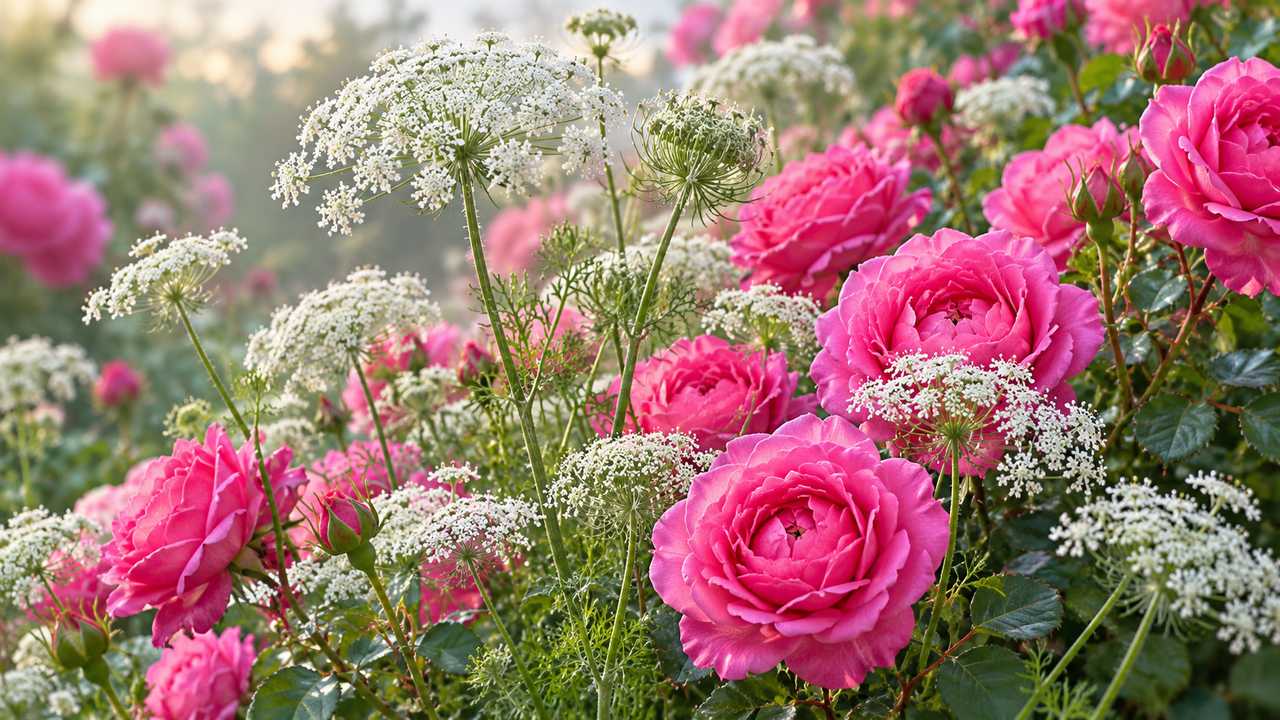
The pairing of roses and Queen Anne’s lace brings two contrasting floral personalities into graceful conversation. Roses are lush, cultivated, and rich with centuries of romantic symbolism; Queen Anne’s lace is airy, untamed, and suggestive of summer meadows. Together, they express affection softened by delicacy: love without ostentation, beauty without stiffness, and devotion that still feels natural and free.
Understanding the roses and queen anne’s lace meaning requires both history and botanical context. Roses have carried ceremonial and emotional significance since antiquity, appearing in Greek and Roman mythology, Persian poetry, medieval Christian imagery, and Victorian flower dictionaries. Queen Anne’s lace, usually identified as Daucus carota, is the wild ancestor of the cultivated carrot. Its white compound umbels resemble intricate lace, often with a tiny dark red or purple floret near the center. Folklore connects that detail with a drop of blood shed by Queen Anne while making lace, although traditions disagree about which queen inspired the name.
The Core Symbolism of Roses and Queen Anne’s Lace
In floriography, roses communicate love, admiration, desire, loyalty, innocence, or remembrance according to their color and context. Queen Anne’s lace is commonly associated with sanctuary, protection, delicacy, refuge, and feminine artistry. Some modern interpretations also assign it the meaning “do not refuse me,” but flower-dictionary definitions varied substantially by publisher and period; there was never one universally enforced Victorian code.
When combined, the flowers most naturally symbolize protected love, graceful devotion, and affection that feels sincere rather than formal. The rose supplies emotional intensity, while Queen Anne’s lace surrounds it with a visual halo. This can suggest that precious feelings are being sheltered, or that deep love has grown within the ordinary beauty of daily life.
- Romantic devotion: A declaration of love made gentler, more intimate, and less ceremonious.
- Sanctuary and trust: The idea that a loving relationship provides safety, rest, and emotional refuge.
- Natural beauty: Appreciation for someone whose charm seems effortless and authentic.
- Enduring tenderness: A fitting message for affection strengthened through shared years and memories.
- Cottage simplicity: Happiness found in home, garden, family, and uncomplicated pleasures.
Historical and Cultural Interpretations
In classical cultures, the rose was linked with love deities, beauty, secrecy, and the fleeting nature of life. Medieval Europeans layered it with courtly and Christian meanings: red roses could signify sacrifice or passionate love, while white roses represented purity and spiritual devotion. By the nineteenth century, elaborate floral dictionaries encouraged senders to construct bouquets as coded messages, although meanings changed between Britain, Europe, and North America.
Queen Anne’s lace belonged less to aristocratic floristry than to hedgerows, roadsides, and household folklore. Its finely divided leaves and embroidered-looking blooms made it an emblem of craftsmanship and pastoral elegance. The plant’s cup-shaped umbels can curl inward as seeds mature, producing a “bird’s nest” form that reinforces associations with refuge and protection.
Modern Western weddings frequently use the pairing to evoke English-country gardens, rustic celebrations, or relaxed romance. In contemporary bouquets, it can also communicate sustainability and seasonality when flowers are responsibly grown nearby. Cultural interpretation remains important, however: Daucus carota is considered a weed or invasive plant in some regions, so its pastoral charm is not universally admired.
How Rose Color Changes the Message
| Rose Color | Meaning with Queen Anne’s Lace | Best Occasion |
|---|---|---|
| Red | Passionate love protected by trust and loyalty | Anniversary, proposal, romantic declaration |
| Pale pink | Sweet admiration, gentleness, and budding affection | New romance, birthday, thank-you gift |
| Cream | Thoughtfulness, quiet charm, and gracious support | Wedding, hostess gift, friendship |
| Salmon or coral | Warm enthusiasm, affection, and lively attraction | Celebration, friendship, emerging romance |
| Dusty rose | Nostalgia, mature romance, and treasured memories | Milestone anniversary, reunion, vintage wedding |
| White | Innocence, reverence, peace, and spiritual protection | Wedding, christening, memorial |
| Yellow | Joyful friendship and the comfort of companionship | Congratulations, recovery, friendly appreciation |
Color should reflect both the relationship and the recipient’s tastes. A bouquet of pale pink roses and white lace feels youthful and affectionate, whereas dusty rose colors create a more nostalgic, heirloom mood. For refined neutrality, explore cream rose symbolism. Coral-toned blooms add animation and align with the warmth described in salmon rose meaning.
Occasions, Recipients, and Modern Etiquette
This pairing suits garden weddings especially well. It can appear in bridal bouquets, aisle arrangements, bud vases, or loose centerpieces, conveying romance without the rigid formality of tightly packed roses. For anniversaries, red or dusty roses acknowledge enduring passion; for a new relationship, blush, peach, or salmon tones avoid making an excessively solemn declaration.
Give pink, cream, or yellow roses with Queen Anne’s lace to close friends, mothers, mentors, or hosts. Such combinations communicate admiration and gratitude without necessarily implying romance. White arrangements may be appropriate for sympathy or remembrance, but local customs matter: in some communities, all-white flowers are strongly associated with funerals, while in others they are standard wedding flowers.
Modern etiquette favors clarity over secret codes. Include a short card explaining the personal message rather than expecting the recipient to know historical floriography. Avoid wild-picking from protected land, private property, or roadsides exposed to pollution and herbicides. Most importantly, never gather a white umbellifer unless its identity is certain. Queen Anne’s lace can be confused with highly poisonous poison hemlock and other related plants; purchasing florist-grown material is the safest choice.
Companion Flowers and Styling
Queen Anne’s lace should create movement and negative space rather than burying the roses. Use several branching stems around focal blooms, allowing the umbels to sit at varied heights. A loose, asymmetrical silhouette enhances meadow character, while a compact dome looks more traditional.
- For cottage romance: Add sweet peas, scabiosa, feverfew, snapdragons, or garden phlox.
- For refined elegance: Pair cream roses with lisianthus, white stock, and restrained eucalyptus.
- For nostalgic warmth: Combine dusty roses with burgundy cosmos, astrantia, and trailing jasmine.
- For cheerful summer color: Mix salmon roses with apricot ranunculus, chamomile, and airy grasses.
- For woodland texture: Use ferns, herbs, olive foliage, or delicate flowering branches.
Choose ribbon and vessels to reinforce the message. Silk ribbon and weathered urns suggest heirloom romance; linen ties, ceramic pitchers, and clear bottles create homely cottage charm. Avoid excessive rustic props when the event is formal—airy botanical composition alone can provide the desired natural quality.
Botanical Care and Vase Longevity
Condition both flowers promptly. Recut stems with clean, sharp snips, remove foliage below the waterline, and place them in a disinfected vase filled with fresh water and commercial flower food. Roses drink heavily, so check the water level each day. Keep the arrangement away from direct sun, heating vents, drafts, and ripening fruit, whose ethylene gas accelerates aging.
Queen Anne’s lace can wilt quickly if collected when stressed or overly mature. Select firm, newly opened umbels and hydrate them separately for several hours before arranging. Refresh the vase water every one or two days and recut stems when possible. Florist-grown laceflower, such as Ammi majus, is often substituted for true Daucus carota; it offers a similar effect and may be more practical for event work.
Gardeners should check regional regulations before cultivating Queen Anne’s lace because it self-seeds freely and is invasive or restricted in some locations. Where permitted, grow it in full sun and well-drained soil, deadheading before seed set if spread is undesirable. Wear gloves when handling the plant, as sap may cause skin sensitivity in some people, particularly with sun exposure.
A Message of Love Made Natural
Roses and Queen Anne’s lace unite cultivated splendor with meadow-like freedom. Their shared message is not merely romance, but affection made safe, graceful, and genuine. Whether arranged for a wedding, anniversary, friendship, or remembrance, the combination becomes most meaningful when rose color, cultural custom, and personal intention are considered together. With thoughtful sourcing, careful conditioning, and an airy hand, this timeless pairing offers both symbolic depth and unmistakable cottage charm.