Table of Contents
100 Roses Meaning: Absolute Devotion, 100 Percent Commitment, and Marriage
Few floral gestures are as spectacular—or as unmistakably serious—as a bouquet of 100 roses. Its message is commonly expressed as “I am completely devoted to you,” “My love is without limit,” or “I give you 100 percent of my heart.” Because one hundred suggests completeness, the arrangement has also become associated with lifelong partnership, marriage proposals, milestone anniversaries, and the promise of growing old together.
The symbolism combines several traditions. Roses have represented love, beauty, secrecy, honor, and sacred devotion since antiquity. The number symbolism is more modern: Victorian floriography gave particular importance to the selection and presentation of flowers, while contemporary florists expanded the language of roses by assigning messages to bouquet quantities. Botanically, roses belong to the genus Rosa, a diverse group of woody perennials whose layered petals, fragrance, and thorn-bearing stems naturally evoke the complexity of love—beauty protected by vulnerability, effort, and resilience.
What Is the Primary Meaning of 100 Roses?
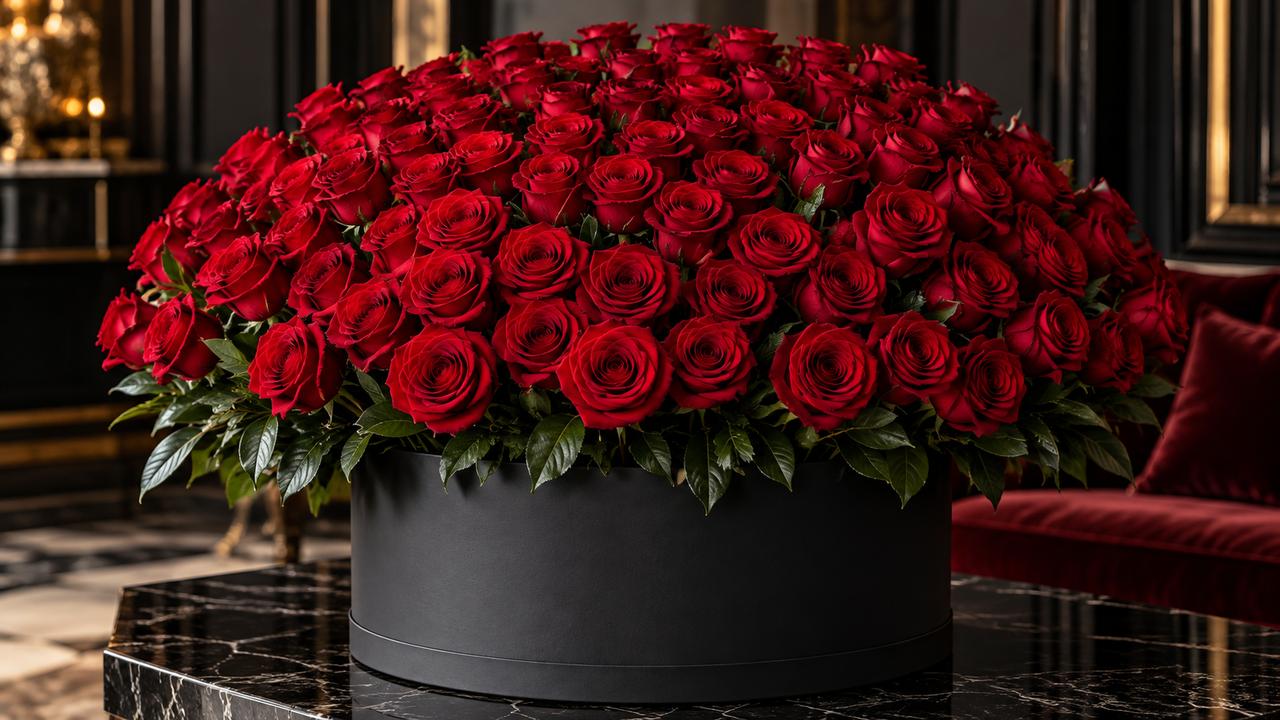
The central 100 roses meaning is absolute devotion. Unlike a dozen roses, which can communicate romance, admiration, or courtship, one hundred creates a deliberate sense of totality. It says that the giver’s affection is not casual, partial, or temporary. The number can be read as 100 percent commitment: a whole heart offered without reservation.
- Complete love: “You have all of my heart.”
- Enduring devotion: “My love is intended to last.”
- Marriage and lifelong partnership: “I want to build a future with you.”
- Grand celebration: “This moment deserves extraordinary recognition.”
- Abundance: “My gratitude, admiration, or affection cannot be measured modestly.”
The gift is often romantic, but it need not be exclusively so. One hundred roses may honor a parent’s centenary, celebrate a major professional achievement, or commemorate an institution’s hundredth anniversary. Context, color, accompanying words, and the relationship between giver and recipient determine whether the bouquet signifies passion, gratitude, remembrance, or ceremonial honor.
Historical and Cultural Interpretations
In Greek and Roman traditions, the rose was connected with deities of love, especially Aphrodite and Venus. It could also signify secrecy: the Latin expression sub rosa, “under the rose,” referred to confidential matters. Medieval Christianity reinterpreted roses as emblems of divine love, martyrdom, purity, and the Virgin Mary. During the nineteenth century, European and American enthusiasm for floriography encouraged people to communicate sentiments through flower species, colors, and arrangements.
Historical flower dictionaries did not consistently assign a fixed message to exactly 100 roses. The now-familiar numerical meaning largely belongs to modern commercial and popular flower culture. Nevertheless, it draws convincingly upon older rose symbolism and the longstanding idea of one hundred as a complete measure.
In many Western settings, 100 red roses are understood as a declaration of passionate, all-encompassing love. In Chinese-influenced gift culture, large rose counts can carry strong romantic significance, although number preferences vary by region and individual. One hundred generally suggests fulfillment and wholehearted effort, while some buyers choose 99 roses instead because it is popularly associated with love that lasts forever. In Japan and Korea, elaborate rose gifts have become especially visible in proposals, anniversaries, photography sessions, and luxury celebrations.
Cultural interpretation is never universal. Red may suggest romance in one setting and auspicious celebration in another; white may express bridal purity, spiritual reverence, or mourning. Before sending such an imposing arrangement across cultures, consult a local florist and consider the recipient’s personal associations.
How Color Changes the Message
Quantity supplies intensity, but color defines the emotional tone. A monochromatic bouquet delivers the clearest statement, while a mixed palette can tell a more layered story.
| Rose Color | Meaning in a 100-Rose Bouquet | Best Occasion |
|---|---|---|
| Red | Complete romantic love, desire, and commitment | Proposal, wedding, major anniversary |
| White | Purity, reverence, new beginnings, or remembrance | Wedding, memorial, spiritual ceremony |
| Pink | Profound admiration, tenderness, and gratitude | Birthday, achievement, romantic celebration |
| Cream or Ivory | Thoughtfulness, elegance, warmth, and graceful devotion | Sophisticated wedding or anniversary |
| Yellow | Joy, friendship, optimism, and shared success | Friendship milestone or congratulations |
| Lavender | Enchantment, fascination, and rare love | Dramatic courtship or creative celebration |
| Mixed Colors | A complete spectrum of affection and shared memories | Milestone birthday, joyful anniversary, tribute |
Cream blooms soften the declaration, making them ideal when appreciation and refinement matter as much as passion; a closer look at cream rose symbolism reveals their associations with charm and considerate affection. Multicolored arrangements may evoke the celebratory rainbow rose meaning, although commercially produced rainbow roses are usually artificially dyed.
Likewise, naturally blue roses do not exist because roses lack the genetic pathway required to produce true blue delphinidin pigment. Dyed blue flowers therefore emphasize fantasy, rarity, and the blue rose mystery. So-called black roses are generally very dark crimson or burgundy cultivars rather than botanically black blooms. Their dramatic appearance can signify farewell, transformation, or unconventional devotion; consult the broader black rose meaning before choosing them for a sensitive event.
When and to Whom Should You Give 100 Roses?
A hundred roses suit moments that can carry their emotional and physical scale. They are particularly appropriate for a marriage proposal, wedding-day surprise, significant anniversary, vow renewal, landmark birthday, retirement, or public tribute. For a romantic partner, they declare exceptional commitment. For a parent, mentor, or honoree, choose pink, cream, yellow, or mixed roses so the message reads as gratitude rather than courtship.
Modern etiquette requires sensitivity. A hundred roses can feel thrilling in an established, reciprocal relationship but overwhelming during early dating. Avoid using an extravagant bouquet to pressure someone into accepting an apology, proposal, or public display. Confirm that the recipient has room for it, especially if delivering to an office, hospital, restaurant, or small home. Fragrance sensitivity, allergies, pets, and workplace rules also matter.
Always include a card that explains the intended meaning. A simple message—“One hundred roses for 100 percent of my heart”—makes the symbolism clear. For non-romantic gifts, write explicitly about admiration, gratitude, or the milestone being celebrated.
Companion Flowers and Styling
One hundred roses already create substantial volume, so additions should support rather than compete. Baby’s breath lends an airy, romantic effect; Italian ruscus or eucalyptus introduces movement and greenery; white lisianthus adds softness; orchids elevate a luxurious formal design. Avoid excessive filler if numerical accuracy matters, and ask the florist to confirm that the arrangement contains exactly 100 rose stems.
Long-stemmed roses arranged in a hand-tied spiral appear dramatic and contemporary. A wide urn creates a ceremonial, garden-inspired display, while several coordinated vessels make the flowers easier to carry and distribute through a room. For proposals, restrained wrapping in paper, silk ribbon, or a reusable presentation box keeps attention on the roses. Florists may need advance notice because one hundred matching blooms require careful sourcing, conditioning, and transport.
Care and Vase Longevity
Roses are thirsty cut flowers. Prepare multiple clean, stable vases before unwrapping the bouquet. Trim 2 to 3 centimeters from each stem at an angle with clean, sharp cutters, remove foliage that would sit below the waterline, and place the stems promptly in fresh water mixed with commercial flower food.
- Divide the bouquet among vessels so stems are not crushed and water can circulate.
- Top up the water daily and replace it completely every one to two days.
- Re-cut stems whenever changing the water to reopen their vascular tissue.
- Keep roses away from direct sun, radiators, drafts, and ripening fruit, which releases aging-accelerating ethylene.
- Remove fading blooms promptly to keep the remaining arrangement clean and attractive.
With proper conditioning, many modern hybrid tea and floribunda roses remain presentable for roughly five to ten days, depending on cultivar, harvest freshness, temperature, and handling. Garden roses often offer magnificent fragrance and form but may have a shorter vase life.
A Complete Floral Declaration
The enduring 100 roses meaning is wholeness: complete love, total commitment, abundant gratitude, or wholehearted honor. Its roots lie in the rose’s ancient symbolic history, while its precise numerical message reflects modern floral custom. Color and context refine that message, from the passionate certainty of red to the reverence of white and the gracious warmth of cream. Chosen thoughtfully, presented without pressure, and cared for properly, 100 roses become more than an extravagant bouquet—they form a memorable declaration that nothing important has been held back.