Table of Contents
Odd vs Even Numbers of Roses: Cultural Superstitions and Floriography Rules
The odd vs even roses meaning is one of floriography’s most intriguing—and culturally sensitive—questions. A bouquet may communicate romance, gratitude, mourning, or celebration not only through its color and variety, but also through the number of stems it contains. In many Western traditions, odd-numbered arrangements appear natural, lively, and romantic. Across parts of Eastern and Central Europe, however, even-numbered bouquets are strongly associated with funerals and graves.
These customs developed from several overlapping sources. Ancient number symbolism treated odd numbers as active, indivisible, or auspicious, while even numbers suggested balance, completion, and finality. Nineteenth-century floriography later transformed flowers into an elaborate social vocabulary. Florists also discovered a practical design principle: three, five, or seven focal blooms are easier to arrange asymmetrically than paired stems. The rose itself adds another layer. Botanically, garden roses produce flowers independently of human numerology; their symbolic “rules” belong to culture, aesthetics, and ritual rather than plant science.
The Essential Rule: Culture Comes Before Arithmetic
There is no universal law declaring odd roses romantic and even roses unlucky. Meaning depends on the recipient’s cultural background, the occasion, and the bouquet’s presentation. Nevertheless, several broad conventions are useful.
- Odd-numbered bouquets commonly represent life, movement, good fortune, and growing affection. They are widely preferred for birthdays, courtship, congratulations, and informal gifts.
- Even-numbered bouquets often suggest symmetry, partnership, mutual devotion, or completeness in Western commercial floristry.
- In Russia, Ukraine, Belarus, Poland, and neighboring traditions, small even-numbered bouquets are generally reserved for mourning. Giving a living person two, four, six, or eight flowers may therefore cause genuine discomfort.
- Large formal arrangements are sometimes judged by overall appearance rather than counted stem by stem, but cultural caution is still advisable.
The safest international choice for a happy occasion is an odd number such as three, five, seven, or nine. When ordering locally, ask the florist about regional custom rather than assuming that etiquette travels unchanged.
Meanings of Common Rose Numbers
| Number | Common Floriographic Meaning | Best Context | Cultural Caution |
|---|---|---|---|
| 1 | Singular devotion: “You are the one” | First date, private romantic gesture | Usually safe across cultures |
| 2 | A pair, reciprocity, two lives joined | Couples and anniversaries in Western settings | Avoid in cultures reserving even flowers for funerals |
| 3 | Traditionally, “I love you” | Romance, anniversaries, sincere affection | A broadly fortunate choice |
| 5 | Admiration, happiness, and goodwill | Birthdays, thanks, early courtship | Generally safe for joyful occasions |
| 6 | Desire, enchantment, or cherished partnership | Romance where even counts are accepted | Potential mourning association |
| 7 | Infatuation, mystery, and good fortune | Romantic surprises and milestones | Positive in many numerological traditions |
| 9 | Enduring or eternal love | Anniversaries and commitments | Widely favorable, though meanings vary |
| 12 | Complete devotion; the classic dozen | Valentine’s Day and major anniversaries | Commercially standard in the West, but still even |
| 13 | Secret admiration, individuality, or lifelong friendship | Playful gifts and unconventional recipients | Consider Western superstition about thirteen |
Number dictionaries are modernized interpretations rather than fixed historical codes. Even Victorian flower books frequently disagreed. Three stems are among the most consistently understood romantic gestures; this detailed guide to the three roses meaning explores how the trio can signify past, present, and future as well as “I love you.”
Color, Shade, and Variety Change the Message
A stem count should never be read in isolation. Three red roses intensify romantic love, while three white roses may express innocence, remembrance, or a new beginning. Pink communicates grace and affection: pale pink is gentle and admiring, whereas the dark pink rose meaning centers on gratitude and heartfelt recognition. Yellow roses now commonly represent friendship and optimism, although older Western floriography sometimes linked yellow with jealousy or fading love. Orange suggests enthusiasm and attraction; lavender conveys enchantment; cream expresses thoughtful elegance.
Form matters too. Tight buds imply youth, possibility, or feelings not yet fully disclosed. Open blooms feel generous and emotionally mature. Garden roses, spray roses, and fragrant David Austin English roses create a romantic, old-world mood, while long-stemmed hybrid teas communicate formality and dramatic intent. A dozen red hybrid teas reads differently from twelve loose garden roses mixed with herbs, even though the count is identical.
Occasion Guide and Modern Etiquette
For a first date, one or three roses feel intentional without becoming overwhelming. Five or seven suit a birthday, graduation, hostess gift, or developing relationship. Nine roses work beautifully for an anniversary, while a Western-style dozen remains appropriate for an established partner. For professional thanks, choose five pink, peach, cream, or yellow roses rather than passionate red.
Weddings permit more flexibility because bouquets are usually interpreted as complete compositions, not arithmetic messages. Odd groupings still help designers create movement, while even groupings produce symmetry in paired altar pieces or table arrangements. In East Asian contexts, number symbolism may also matter: eight often suggests prosperity in Chinese culture, while four can sound like the word for death in several languages and may be avoided.
Funeral etiquette reverses many celebratory assumptions. Even numbers may be correct in countries where they symbolize completion and the end of life, while Western sympathy designs are more often chosen by color, relationship, and religious custom than exact count. Before sending roses for sympathy, confirm whether flowers should go to the funeral venue, graveside, or family home.
Companion Flowers and Bouquet Styling
Odd rose counts naturally support asymmetrical arrangements. Place five roses at varied heights with airy foliage rather than spacing them rigidly. Waxflower, limonium, or gypsophila adds softness; lisianthus and ranunculus reinforce romance; tulips create spring freshness. For fragrance, pair garden roses with sweet peas, stocks, rosemary, or mint. Eucalyptus offers cool-toned structure, while ruscus gives a cleaner, more formal line.
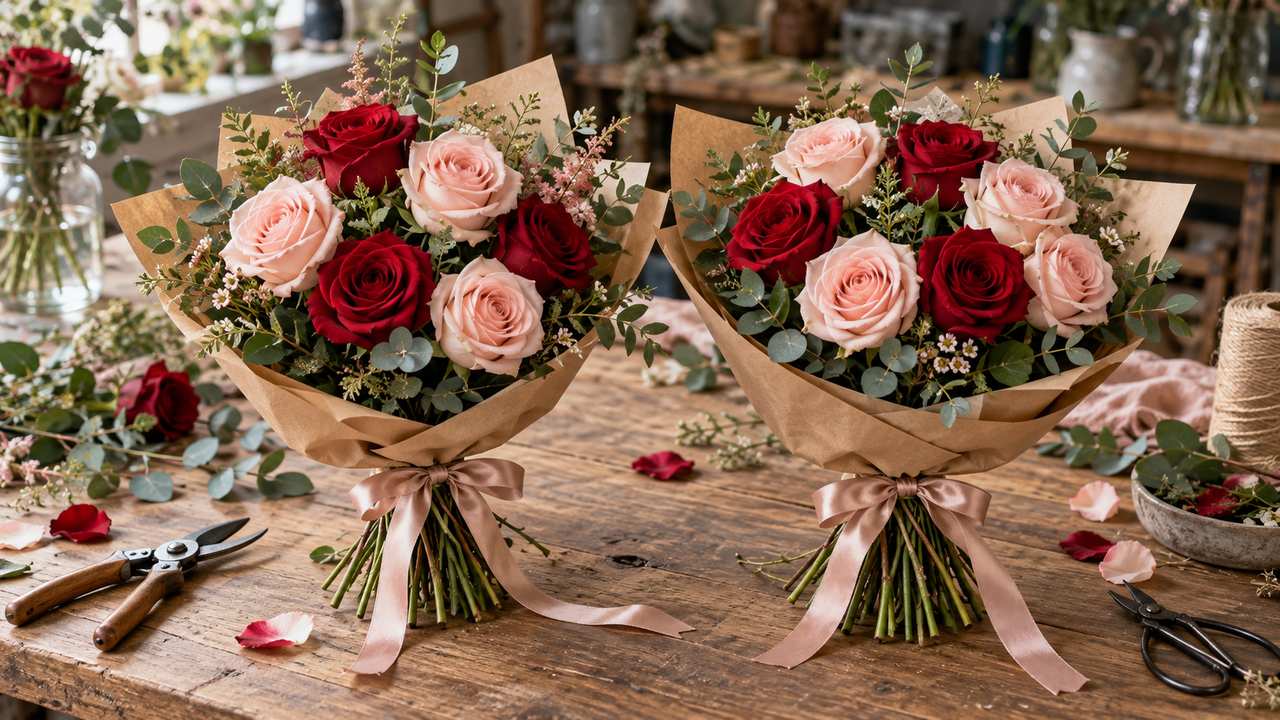
Companion blooms can obscure the numerical message, so keep roses visually dominant when the count is symbolic. If cultural etiquette demands an odd total, remember that some recipients count all prominent flowers, not only roses. Ask a knowledgeable local florist whether filler flowers are included. Wrapping also changes tone: kraft paper feels informal, silk ribbon ceremonial, and a vase arrangement more substantial.
Care and Vase Longevity
Fresh roses should have firm petals, upright necks, and healthy green sepals. Recut 1–2 centimeters from each stem at a 45-degree angle with a clean, sharp blade. Remove every leaf that would sit below the waterline, since submerged foliage encourages bacterial growth. Place the stems promptly in a sanitized vase filled with fresh water and commercial flower food.
Keep the bouquet away from radiators, direct afternoon sun, drafts, and ripening fruit; fruit releases ethylene, which accelerates floral aging. Refresh the water every one to two days and recut the stems if uptake slows. Most florist roses last five to ten days, while sturdy varieties may continue longer. Garden-grown roses are best harvested in the cool morning when the outer petals have loosened but the bloom is not fully open.
A Message Greater Than the Number
The most reliable interpretation of odd versus even roses combines number, color, variety, occasion, and culture. Odd counts are the safest celebratory choice across many regions and lend themselves to graceful naturalistic design. Even counts can beautifully express partnership and completeness, yet remain deeply connected with mourning in parts of Europe. Thoughtful gifting therefore begins not with a rigid numerology chart, but with knowledge of the recipient. Choose a culturally appropriate count, select a color that reflects the relationship, and include a sincere note so the roses’ intended message cannot be mistaken.