Table of Contents
40 Roses Meaning: Authentic Love That Has Withstood the Test of Time
The central 40 roses meaning: authentic love that has withstood the test of time expresses a bond that is established, resilient, and deeply sincere. A bouquet of 40 roses does more than communicate attraction. It recognizes a relationship that has endured ordinary pressures, difficult seasons, personal growth, and the passage of time without losing its emotional foundation.
Forty roses are therefore especially appropriate for a spouse, long-term partner, or person with whom the giver shares a substantial history. The arrangement can celebrate decades of marriage, reaffirm commitment after hardship, or mark a turning point at which affection has matured into lasting devotion. Its size gives the gesture visual authority, while the symbolism emphasizes permanence rather than short-lived excitement.
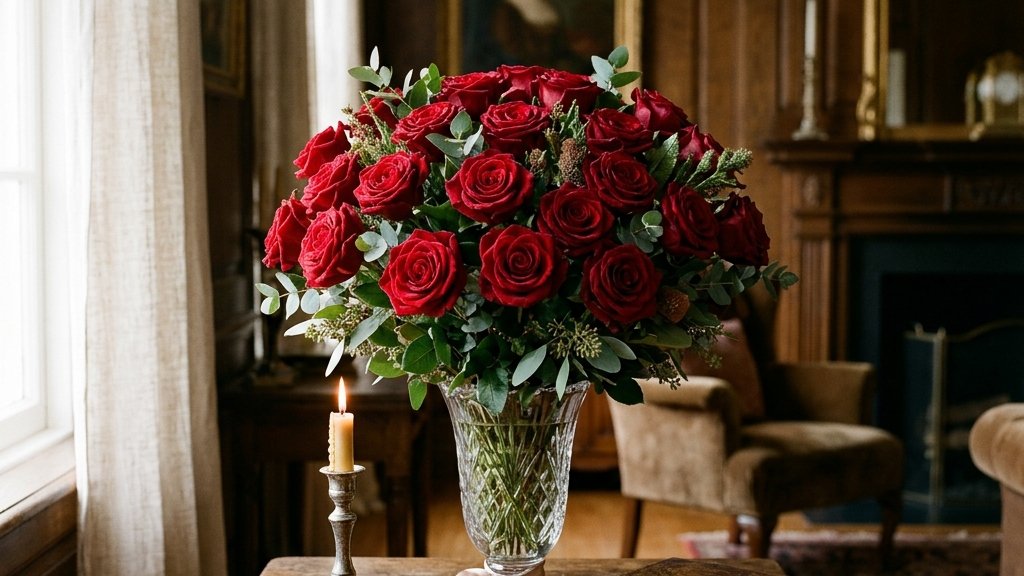
Rose-number meanings are not governed by a single historical code, and interpretations can vary among cultures and florists. Nevertheless, the contemporary floral language surrounding 40 roses is remarkably consistent: this is a declaration of genuine, steadfast love that has proven its strength through experience.
Why the Number 40 Carries Such Emotional Weight
Across history, the number 40 has frequently represented completion, endurance, testing, and transformation. It appears in religious narratives, traditional periods of reflection, and cultural descriptions of significant life stages. In a romantic context, those associations make 40 an ideal number for honoring love that has survived challenges and emerged stronger.
The message is not that a relationship has been perfect. On the contrary, the symbolism becomes more meaningful when two people have faced uncertainty, distance, changing circumstances, or competing responsibilities. Forty roses say, in effect, “Our love has been tested, and it remains real.” That distinction separates this bouquet from arrangements centered primarily on desire, infatuation, or a new romantic beginning.
The number also suggests abundance. A standard dozen is familiar and elegant, but 40 blooms create a notably generous display. The recipient immediately understands that the gift was chosen as a major statement. When presented thoughtfully, the bouquet communicates seriousness without requiring an elaborate speech.
How 40 Roses Compare with Other Bouquet Counts
Different rose quantities can emphasize remembrance, loyalty, constant thought, reconciliation, or enduring commitment. Understanding these distinctions helps a giver choose a bouquet that accurately reflects the relationship and occasion.
| Rose Count | Core Meaning | Best Context | Emotional Tone |
|---|---|---|---|
| 15 roses | Apology and a request for forgiveness | Repairing a valued relationship | Humble and conciliatory |
| 20 roses | Truthfulness and sincere intentions | Confirming loyalty or serious commitment | Earnest and reassuring |
| 24 roses | You are on my mind every hour | Birthdays, romance, or long-distance love | Attentive and affectionate |
| 36 roses | Romantic memories and overwhelming passion | Celebrating intense shared history | Passionate and nostalgic |
| 40 roses | Authentic love proven over time | Milestones, anniversaries, and renewed vows | Profound, mature, and enduring |
For a relationship centered on accountability and reconciliation, the symbolism described in 15 Roses Meaning: Sincere Apologies and Asking for Forgiveness with Grace may be more precise. If the intended message is integrity rather than longevity, 20 Roses Meaning: Unwavering Truthfulness, Loyalty, and Sincere Intentions offers a closely related but distinct expression.
The Role of Rose Color
The number establishes the bouquet’s principal message, but color determines its emotional character. Forty red roses remain the most direct declaration of enduring romantic love. Red combines desire, admiration, and commitment, making it particularly suitable for a spouse or established partner.
Red, Pink, and White Roses
Red roses deliver intensity and unmistakable romance. Deep crimson varieties feel formal and dramatic, while brighter red cultivars create a more energetic presentation. Pink roses soften the message, emphasizing gratitude, tenderness, and admiration. A 40-stem pink arrangement can honor a relationship defined by friendship and emotional support as much as passion.
White roses represent sincerity, unity, reverence, and new beginnings. Forty white blooms can suit a vow renewal or major wedding anniversary, where the couple is honoring the past while entering a new chapter. A red-and-white combination traditionally suggests unity, blending passion with faithfulness.
Yellow, Peach, and Mixed Bouquets
Yellow roses are commonly associated with friendship, warmth, and joy in modern Western floral practice. Forty yellow roses can celebrate a lifelong friend or relative, although they may not communicate romantic love unless the card explains the intent. Peach roses express appreciation and quiet sincerity, making them appropriate for understated personalities.
A mixed bouquet can represent the many dimensions of a mature relationship. Red may stand for passion, pink for gratitude, white for loyalty, and peach for appreciation. To preserve visual refinement, florists often work with two or three coordinated colors rather than combining every available shade.
Ideal Occasions for Giving 40 Roses
Forty roses work best when the scale of the bouquet matches the importance of the occasion. They are particularly meaningful for:
- A 40th wedding anniversary or another major relationship milestone
- A partner’s 40th birthday, especially when paired with a personal message
- A vow renewal after many years of marriage
- A reunion following distance, adversity, or a demanding life transition
- Valentine’s Day in a long-established relationship
- A private celebration of a bond that has survived a difficult period
For a newer relationship, a large bouquet can feel disproportionate unless both people are comfortable with bold gestures. A two-dozen arrangement may communicate consistent affection with less ceremonial weight; the symbolism is explored in 24 Roses Meaning: The Two-Dozen Bouquet: Declaring You Are on My Mind 24 Hours a Day. By comparison, 40 roses imply history, confidence, and a commitment already demonstrated through actions.
Those wishing to emphasize passionate memories rather than resilience may prefer the interpretation in 36 Roses Meaning: Remembering Romantic Memories and Overwhelming Passion. The difference is subtle but important: 36 roses look backward toward cherished romance, while 40 roses honor love’s durability across time.
Floristry, Size, and Presentation
A 40-rose bouquet is physically substantial. Depending on the cultivar and arrangement style, it may span approximately 45 to 65 centimeters and become heavy once hydrated. Long-stem roses create height and drama, while medium stems arranged in a rounded hand-tied form appear dense and luxurious.
Bloom size also matters. Large-headed hybrid tea roses produce a formal, architectural bouquet, but 40 fully open heads can appear crowded. Floribunda or spray roses offer a softer garden character, although each spray stem may carry several blooms and therefore changes the visual interpretation of “40 roses.” If numerical symbolism is important, confirm that the florist is supplying 40 individual stems and clarify whether multi-flowered sprays are included.
Supporting foliage such as eucalyptus, salal, ruscus, or fern should frame the roses rather than overwhelm them. Minimal greenery keeps attention on the count and color. A structured vase arrangement is practical because the recipient does not need to find a container large enough to hold the stems. For hand delivery, water-filled packaging helps prevent dehydration during transport.
Choosing Fresh, High-Quality Roses
Premium roses should have firm stems, healthy green foliage, and petals free from extensive bruising or browning. The outer guard petals may look slightly darker, thicker, or less perfect than the inner petals; these naturally protective petals are not necessarily a sign of poor quality. Florists sometimes leave them in place for transport and remove them before presentation.
Look for buds that are beginning to unfurl rather than tightly closed or completely open. Very tight roses may have been harvested early and can fail to develop, while fully open flowers offer a shorter display life. Fresh roses should hold their heads upright without bending at the neck.
Season, cultivar, stem length, and origin affect price. Locally grown garden roses may provide fragrance and character, whereas imported long-stem roses often deliver greater uniformity and dramatic proportions. Neither option is automatically superior; the best choice depends on freshness, desired style, and the recipient’s preferences.
How to Care for a 40-Rose Bouquet
Correct preparation can extend vase life significantly. Use a thoroughly cleaned, stable vase because bacteria in old water can block the stems’ vascular tissue. Trim one to two centimeters from each stem at an angle with clean, sharp cutters, then remove every leaf that would sit below the waterline.
- Fill the vase with fresh water and correctly measured commercial flower food.
- Replenish the water daily because 40 stems consume moisture quickly.
- Replace cloudy water and clean the vase before returning the flowers.
- Re-cut the stems every two or three days to improve water uptake.
- Keep the arrangement away from radiators, direct sun, drafts, and ripening fruit.
Ripening fruit releases ethylene, a plant hormone that accelerates floral aging. A cool room generally supports longer vase life, although roses should not be exposed to freezing temperatures. With proper care and depending on cultivar and supply-chain freshness, cut roses commonly remain attractive for about five to ten days.
Writing the Right Message
The accompanying note should explain why the number was chosen. A concise message often feels more authentic than elaborate romantic language. Appropriate examples include, “Forty roses for a love that has grown stronger with every season,” or, “What we have built has been tested by time, and I would choose you again.”
The most powerful interpretation of 40 roses is ultimately personal. Their symbolism does not replace honest communication or consistent care; it gives those qualities a memorable physical form. Presented at the right moment, 40 roses become more than an impressive arrangement. They are a living tribute to affection that has matured, endured, and remained authentic through the years.