Table of Contents
Pairing Roses with Italian Ruscus: Slender Green Trails for Grand Installations
Few floral pairings balance ceremony and movement as gracefully as roses and Italian ruscus. Roses bring concentrated color, fragrance, and centuries of emotional symbolism; Italian ruscus supplies long, supple stems that carry the eye beyond each bloom. Draped from an arch, threaded through a staircase, or allowed to spill from a pedestal urn, its greenery transforms a collection of roses into a sweeping composition. For designers exploring roses and Italian ruscus styling, the essential principle is contrast: rounded, visually weighty flowers set against slender green trails.
The rose has been cultivated since antiquity and appears in Persian gardens, Greek and Roman mythology, medieval devotion, Renaissance art, and Victorian floriography. Its meanings range from earthly love to secrecy, martyrdom, beauty, and renewal. Italian ruscus has a less formal place in historical flower dictionaries, yet its evergreen appearance naturally suggests continuity, endurance, and protection. Botanically, florist-grade Italian ruscus is generally identified as Danae racemosa, formerly classified as Ruscus racemosus. Despite its common name, it is associated botanically with western Asia rather than being exclusively Italian.

Historical Meaning and Cultural Symbolism
Roses carried sacred and social meanings long before the nineteenth-century “language of flowers.” In classical tradition, the rose was associated with Aphrodite and Venus, linking it to beauty, desire, and love shadowed by mortality. Romans used roses at banquets, funerals, and commemorations. The expression sub rosa—“under the rose”—made the flower an emblem of confidence and secrecy.
In medieval Christian imagery, red roses could represent sacrifice and divine love, while white roses suggested purity and the Virgin Mary. Courtly literature made the rose a metaphor for admired but sometimes inaccessible beauty. Islamic and Persian poetic traditions likewise treated the rose as an image of spiritual perfection, frequently paired with the nightingale as a symbol of the longing lover.
Victorian floriography refined these broad associations into color-based messages. A red rose communicated passionate love; white conveyed innocence or reverence; pink suggested admiration; and yellow, once associated with jealousy in some European dictionaries, gradually acquired happier meanings such as friendship and delight. These codes were never entirely universal. Flower dictionaries contradicted one another, and meaning depended upon social setting, presentation, and the relationship between sender and recipient.
Italian ruscus did not develop an equally standardized Victorian vocabulary. Its significance is better understood through form and evergreen character. Greenery traditionally conveys life, resilience, hope, and connection. The plant’s arching stems can also imply continuation—a relationship, memory, or promise extending beyond a single moment. In installations, its trailing habit softens rigid architecture and gives roses a sense of growth rather than confinement.
Rose Colors and the Messages They Create
| Rose Color | Primary Meaning | Effect with Italian Ruscus | Ideal Context |
|---|---|---|---|
| Red | Passion, devotion, courage | Dramatic, classical, formal | Romantic weddings and anniversaries |
| White or Ivory | Purity, remembrance, new beginnings | Fresh, architectural, serene | Weddings, memorials, formal ceremonies |
| Blush Pink | Tenderness, admiration, grace | Soft, garden-inspired, romantic | Bridal work and affectionate gifts |
| Apricot or Salmon | Warmth, enthusiasm, sociability | Luminous, welcoming, abundant | Hospitality, celebrations, friendship |
| Mauve or Lavender | Enchantment, rarity, refinement | Moody, decadent, editorial | Luxury events and artistic installations |
| Yellow | Joy, friendship, optimism | Bright, informal, celebratory | Congratulations and cheerful gatherings |
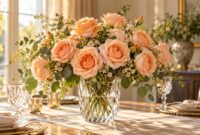
Subtle shades require equally subtle interpretation. Apricot roses are especially effective at entrances and dinner tables because their warmth feels generous rather than overtly romantic; a fuller discussion of apricot rose meaning reveals why they suit welcoming arrangements. Coral-pink varieties communicate liveliness and emotional warmth, while the salmon rose meaning occupies an appealing middle ground between friendship and passion.
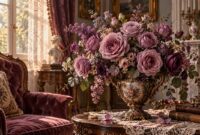
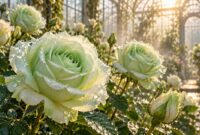
Dusty lavender, lilac, and antique plum roses create a more enigmatic mood. Their cool petals against glossy green ruscus feel theatrical and sophisticated, consistent with traditional ideas surrounding mauve rose symbolism. Artificially tinted green roses can be used for fashion-led work, although they should be identified honestly. The ideas of balance and abundance attached to mint green rose significance make that shade suitable for contemporary celebrations, but natural cream or pale yellow-green cultivars usually appear more botanical.
Designing Grand Installations
Begin with a clear visual hierarchy. Cluster roses at structural points—arch corners, urn rims, mantel ends, or the base of suspended forms—then extend Italian ruscus outward in tapering lines. This makes each stem appear to grow from the floral mass. Avoid distributing roses at mechanically equal intervals; varied clusters look more natural and create stronger rhythm.
- Use long ruscus stems to establish the silhouette before placing focal roses.
- Angle some trails downward and others laterally to prevent a curtain-like effect.
- Repeat rose colors in uneven groups of three, five, or seven for visual cohesion.
- Keep foliage away from candles, food, doorways, and guest sightlines.
- Secure overhead work with rated mechanics and an independent safety attachment.
For arches and staircases, Italian ruscus can form elegant asymmetry: one densely flowered section may be balanced by a long, lightly adorned trail. In ceiling installations, the greenery reads best when layered at several depths. On tables, shorter pieces should be tucked into arrangements rather than laid as loose garlands, which can wilt quickly and appear flat.
Companion Flowers and Textural Partners
Garden roses and standard roses provide the main emotional focus, while spray roses bridge spaces between large heads. Sweet peas, ranunculus, lisianthus, and clematis preserve a romantic garden character. Delphinium or snapdragon adds height; hydrangea creates volume; and orchids introduce a polished, contemporary note. For restrained designs, combine white roses and ruscus with only hellebore, astrantia, or delicate grasses.
Choose companions by shape as well as color. Roses are round and petal-dense, so starry, linear, or airy flowers prevent visual heaviness. Limit the palette to two or three principal hues in grand installations; scale already supplies drama. Mixing too many colors and flower forms can obscure the elegant line that makes roses and Italian ruscus styling distinctive.
Occasions, Recipients, and Modern Etiquette
This pairing suits weddings, engagement parties, anniversaries, galas, hotel entrances, milestone birthdays, and remembrance ceremonies. Red roses are best reserved for a romantic partner unless the context clearly supports ceremonial red. Pink, apricot, or yellow roses are safer for friends, hosts, colleagues, and family members. White designs can express either celebration or sympathy, so the accompanying card should clarify the intention.
When gifting across cultures, do not assume that color and quantity carry identical meanings everywhere. White flowers may be bridal in one setting and funerary in another; certain numbers can also be auspicious or avoided. Ask a local florist when customs matter. For hospitals, care homes, and workplaces, choose a compact, lightly scented design and confirm that fresh flowers are permitted. Always disclose dyed flowers, avoid presenting thorny stems, and include a sincere message rather than expecting symbolism to speak alone.
Conditioning and Vase Longevity
Buy roses with firm petals and hydrated stems, then remove foliage that would sit below the waterline. Recut one to two centimeters from each stem with a clean, sharp blade and place the flowers promptly in fresh water with commercial preservative. Italian ruscus should also be recut and hydrated before construction. Its foliage is durable, but it lasts longest when supplied with water rather than relying on misting.
Use clean vessels, refresh water regularly, and keep designs away from radiators, direct sun, ripening fruit, and strong drafts. In installations, conceal water tubes or hydration cages wherever practical. Check mechanics daily during multi-day events and replace bruised outer rose petals only when necessary. Roses commonly last about five to ten days in good conditions, while properly conditioned ruscus may remain attractive considerably longer.
A Living Line of Meaning
Roses provide history, color, and emotional specificity; Italian ruscus gives those meanings direction. Its slender stems lead the gaze through a room, connect separate floral moments, and lend permanence to flowers traditionally associated with beauty’s brevity. Whether the result is romantic, celebratory, solemn, or avant-garde, successful roses and Italian ruscus styling depends on thoughtful symbolism, disciplined mechanics, and generous negative space. Treat the roses as the message and the ruscus as the graceful line that carries it.